
Terhi Nurmikko-Fuller terhi.nurmikko-fuller@anu.edu.au Australian National University Canberra, ACT, Australia
Paul Pickering Australian National University Canberra, ACT, Australia
Abstract
In this paper we report on a complex and complete archive of historical primary sources that map the political landscape of the anglophone world in the mid-to late 1800s. The ruthless pragmatism applied to the construction of the initial Humanities dataset resulted in an analogue equivalent of a hypertext system, which has already resulted in published academic books and articles. Here, we describe the processes of a current project, which consists of the translation of this analogue information aggregation system into a graph database using Linked Data and semantic Web technologies.
CCS Concepts: Information systems → Document structure; Applied computing → Arts and humanities.
Keywords: Linked Data, information aggregation, political history, hypertext, Australian history
ACM Reference Format: Terhi Nurmikko-Fuller and Paul Pickering. 2021. Reductio ad absurdum?: From Analogue Hypertext to Digital Humanities. In Proceedings of the 32nd ACM Conference on Hypertext and Social Media (HT ’21), August 30–September 2, 2021, Virtual Event, Ireland. ACM, New York, NY, USA, 6 pages. https://doi.org/10.1145/3465336.3475107
1 Introduction
This paper reports on progress in the initial stages of a major multi-year Digital Humanities investigation into the history of the political landscape in the Australian colony of New South Wales in the mid-late 1800s. The research archive underpinning the project is an analogue hypertext system, consisting of approx. 110,500 data instances, recorded on individual and uniquely labelled cards, pages, and notes, created through the meticulous reading, recording, and cross-referencing of historical texts. The system has been utilised in several projects focusing on the UK [17] [27] and the Australian colonies [18] [24] [26]. Here we discuss our efforts to this point to translate this underlying complex analogue system of interlinked information sources into the digital sphere. It is an initial proof-of-concept for a larger study based on the praxis of applying multiple methods spanning disciplinary boundaries to capture complementary but disconnected datasets (identified through extensive human endeavour and tacit expert knowledge) using machine-processable formats such as RDF[^1] and Semantic Web technologies such as Linked Data[^2] and SPARQL[^3]. In doing so we are exploring ways to open up this diverse and multi-faceted data environment to new types of investigation by identifying increasingly complex research questions.
The challenges have been four-fold:
the resources in the analogue hypertext system that we are seeking to emulate using Semantic Web technologies are almost entirely undigitised;
those online resources that serve as external, enriching sources of complementary information do not natively adhere to the Linked Data paradigm (and are more likely to be included as external sources only);
neither the analogue hypertext system itself nor any of the identified external projects have the usual affordance or limitations of Big Data; rather we are presented with a proliferation of disparate sources, all of which contain a small number of significant and important instances of relevant data (thus making automation of any part of the workflow difficult, even where data does exists in a digital format); and
there is a gradient of openness (from fully accessible to completely closed off) between the data sources.
We outline the research background in Section 2, describe the archive as a hypertext system in Section 3, provide a case study example in Section 4, comment on our methodology in Section 5 and discuss the various degrees of openness of the research landscape in Section 6. We conclude the paper with a reflective discussion in Section 7.
2 Background
This inherently interdisciplinary project draws extensively but equally from two separate domains. Much of the domain expertise is derived from the work of one of the authors as one of Australia’s leading historians (for example [19] [20] [21] [22] [23] [25]), and from other complementary research into the Australian political landscape. On the other side, the methodological approaches for examining an analogue system as hypertext and further as Linked Data on the Semantic Web [3], are based on prior Digital Humanities research. We build on prior work in the context of digital libraries [2] [10] [12], and parallel earlier examinations into how the digitisation of data can shift the dynamics of historical research [4]. Following [1], we too are experimenting on the effect of changing digital platforms on humanities scholarship. Although the value of linking data across disparate datasets held across international boundaries has been a feature of many different aspects of Australian history and social science for decades [9] [11] [28], the application of Linked Data to historical datasets of Australian origin has yet to take off at large scale. We take much of our cue from other projects that have successfully applied Linked Data to other Digital Humanities investigations, ranging from ancient history [7] [13] to music ([14] [15] [16], for example) and even the GLAM (galleries, libraries, archives, and museums) sector [32].
3 Defining an Analogue System as Hypertext
Hypertext is defined by the W3C as ‘text that contains links to other texts. . . [and is] not constrained to be linear’. [^4] This description accurately and precisely describes an extensive record keeping system developed by one of the authors. At the centre of it sits an analogue expert system for the systematic study of individuals, their associations, as well as events, and abstract concepts in relation to a specific political movements in a specific location and across a defined time-span, itself reminiscent simultaneously of the Web and of Vannevar Bush’s Memex [5].
3.1 The Archive
The need to develop an analogue hypertext system was to manage vast, numerous corpora of primary sources material. For one previous project, Chartism and the Chartists in Manchester and Salford [17] the principal resource was weekly newspapers and journals, each averaging four pages per issue. A total of 66 newspapers and journals were read in their entirety, totalling 154 years of coverage (approx. 8,000 issues or 32,000 pages). This was supplemented by a plethora of printed material: approx. 330 collections of manuscript correspondence, diaries, and memoirs as well contemporary books, pamphlets and ephemera.
The archive consists of a series of interconnected and indexed data resources: cards, notebook pages, and photocopy systems, each of which contain two types of information: fact, and the source of the fact (we refer to these data entities). There are approx. 83,500 data instances on index cards; 27,000 in A4 notebooks; and some 3,000 additional photocopies. Each card, page, and photocopy have been assigned a unique identifier in the form of an alphanumeric code. Each separate document contains references to other similar documents within the system. All resources are indexed and referred to in at least one other document, resulting in a non-linear but robust system of interconnected resources.
Handwritten notes were taken in notebooks, each page with a unique alphanumeric identifier (N+). The unique identifiers were then manually transferred into two parallel card index systems: individuals and events, organisations and themes (including abstract concepts). The primary N+ card series thus allows a user to access and aggregate information in multiple directions: back to the precise location of the information in full form in the primary source and, in the opposite direction, to aggregations of related material about individuals, organizations or themes in the parallel index card systems. For an example workflow see Fig. 1.
4 Case Study: Connections Between Data Resources
Our example relates to a small organisation, the ‘Constitutional Association’, which operated during the political turmoil in Sydney, New South Wales, Australia 1848-56, a time when the colonists were campaigning for the right to self-government. For the purposes of illustrating the functionality and scope of the analogue-expert system in operation a ‘foundational’ text, a single article comprising 98 lines of text, from a single page in a Sydney newspaper announcing the formal establishment of the Association is examined:
We begin on a data resource (page in an A4 notebook) uniquely labelled N759. It contains metadata such as full title, location, and identifiers for other relevant data sources within the system: N755-N762, N777-N798, N962-N1001, N1228-N1456 (a total of 277 distinct data resources).
Metadata indicates the existence of a duplicate data resource, inclusive of additional annotations.
The inherently rhizomatic system proliferates, connecting individual entries in the primary datasets (N-N) with multifarious other individual entries and card-based datasets within the system. The indexing of the single article considered here allows for connections to be mapped along numerous linear strings determined by the research question(s). By way of illustration one possible string is explored to several levels of explication to answer the questions: what sort of person was in the Constitutional Association; specifically what other organisations were they involved in, and what was the nature of those organisations?
Article → N759
N759 → Constitutional Association (33 data entries) →
List of Provisional Committee (25 data entries) →
An individual member of the Committee → Richard Driver
Richard Driver card set (82 data entities) →
Inter alia these nodes link Driver to the following organisations: Floral and Horticultural Society (N968); Friends of Ireland (N992); North Shore Regatta Organising Committee (N1001); NSW Political Association (N1020); NSW Industrial Exhibition Organising Committee (N1022); Democrat League (N1313); Licenced Victualler’s Society; Botanical Association (N1406); Independent Rifle Club (N1421) →
a single organization from the list of Driver’s connections: Democratic League (N1020-1) (13 data entities).
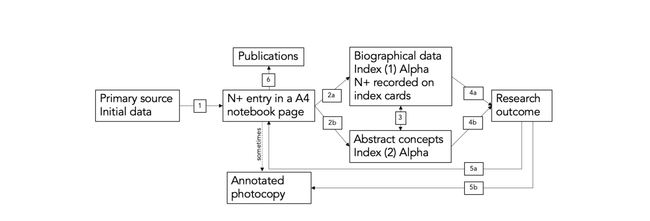
Three points are relevant: (1) done manually the number of possible strings is virtually incalculable and thus impossible to explore into; (2) with each additional level of abstraction from the original source, the total number of potential nodes increases exponentially. In terms of data entities within the analogue-expert system, the example linking the Constitutional Association to the Democratic League via Richard Driver is a string with a potential number of data entities of 37,917. (3) The point of entry is not fixed or predetermined; the data entities can be people (e.g. Richard Driver), locations (such as Elizabeth St, the location of Driver’s public house in 1848), organisations, events, political ideologies, or a number of other tangible and intangible concepts.
5 From Analogue to Linked Data: A Methodology
As illustrated the research processes that constitute the robust methodology in the analogue system mirror those of the Linked Data model. Both approaches rely on unique identifiers assigned to data entities and data resources; the information captured contains both tangible and intangible concepts; and most importantly, knowledge is derived from the relationships that exist between data entities, such as the membership of a particular political organisation, ownership of a beer-selling establishment or member of a sailing club, or all three. The network of associations and connections created by the analogue hypertext system, and the research questions it can help answer, are not unlike the knowledge graphs of Linked Data nor those of SPARQL queries [6].
We encountered a problem space within the context planning the conversion of the system to Linked Data. As outlined in Section 1, the data does not constitute what could be described as Big Data in the Humanities [29] – rather, we are faced with numerous small fragments of data from myriad different sources. This combined with the closed nature of some archives (as discussed in Section 6) mean that large-scale or predominantly automated workflows are not fit for purpose. Instead, we engaged in a lengthy process of producing high-quality RDF using the workflow reported on in [14]. Whilst time-consuming for the user creating the triples, the resulting RDF required no ad hoc tidying.
5.1 Proof-of-Concept
Our choice for a proof-of-concept test case[^5] for this approach was a list published in the Sydney Morning Herald in September 1857 of approx. 1,000 guests in fancy dress costumes who attended a major social event hosted by the Mayor of Sydney. Ostensibly a costume ball might seem to be frivolous with little or no historical significance, but the data provides an important lens onto political influence and liberal sensibilities in Australia’s largest city. The list is available through the National Library of Australia’s digital platform Trove[^6], alongside an OCR transcript of the content. The quality of the OCR made the direct use of the data impossible, and an additional transcription task was completed to produce a tidied .CSV of the personal names, costumes, and titles of guests.
Working with significant granular detail involved a myriad of challenges. For example, the original plan had been to cluster guests based on their sequence of arrival to investigate family connections (people with the same surname), social ties (friends arriving together), and geographical proximity (perhaps neighbours sharing a carriage) – an approach that would benefit from agent-based modelling and action-orientated history simultaneously – but an investigation of the data highlighted an historical decision, that made this approach impossible: the guests’ names had not been listed in order of arrival, but alphabetically. This meant that the data available for computational analysis from a primary source had to be extensively amended and enriched with domain knowledge by a human expert (author Paul Pickering).
The first challenge was that whilst the dataset itself is small (1,000 people, with a total of <10,000 data points once information was categorised and domain expertise was added), as well as computationally simple and structured (.CSV)[^7], the information contained within it does not easily or directly translate to any of the known existing ontologies. What are ostensibly simple words proved to be polyvalent, ambiguous, and rhizomatic, and thus difficult to explicitly define. Our challenge was to present these (deceptively) simple documents diligently and accurately.
5.2 Ontological Modelling
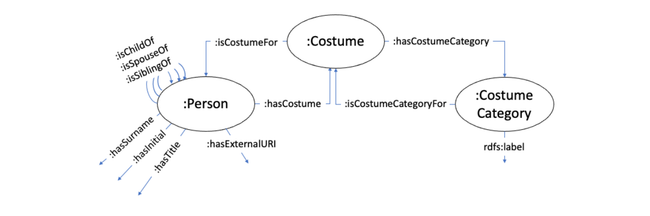
The second challenge was one of specific instances of ambiguities, which could not be solved by repetitive workflow implementations – of dealing with semantic complexity, rather than large scale data: for example, the category of :Costume was divided into 33 distinct categories. Ultimately the simplicity of the underlying ontological model (Fig. 2) reflects that of the costume list data categories, but it nevertheless enables queries of research interest, such as "Which male guests arrived dressed as figures of royalty, and which ones?" (for the corresponding SPARQL query, see below).
select distinct ?name ?costumeName
where
{ ?s :has_costume ?costume ;
:has_title "Mr" ;
:has_surname ?name
.

?costume rdfs:label ?costumeName ;
:has_costume_category ?costumeCategory .

?costumeCategory rdfs:label "royal" .
}
The significant point here is that, to the expert historian, the resulting list of names (32 individuals) is meaningful, and can support hypotheses of royalist (or republican!) ideologies, based on their prior research and tacit knowledge.
The decision was made to define all Classes and properties as project-specific ones, with equivalences drawn to FOAF[^8] and Schema[^9] using skos:closeMatch following [8] [14], in recognition of the overt robustness of owl:sameAs when asserting equivalence. Instance-level RDF was produced by mapping the project-specific ontology (available as .TTL file from the project website) to the .CSV file using Web-Karma[^10]. The project uses Blazegraph[^11] as its triplestore.
The third challenge was the reaching of Five Star Linked Data standard[^12]. In order to reach the top bracket of Linked Data quality, linking to external datasets is necessary. Although many complementary data sources were included in the analogue hypertext system, these are not all available online.
6 Degrees of Archival Access
The different degrees of archival access are illustrated in Table 1 alongside example projects and data sources. The structure of Table 1 represents decrease on three axes: sources are increasingly closed off due to institutional policy, personal preference, and lack of digitisation. Wikidata[^13] and other external sources such as VIAF[^14] do present opportunities for some linking to openly available data and external authority files, but neither contains the full extent of information contained in the analogue hypertext system described in Section 3.
Data source | Level of Access |
|---|---|
Wikidata | Openly accessible, downloadable RDF |
Trove (from the National Library of Australia) | Openly accessible, downloadable PDFs and OCR |
Australian Dictionary of Biography | Online, but cannot download data without permission |
British Newspapers Online (British Library) | Online, but requires permission or subscription |
Men of Mark (selected Australian libraries) | CD-ROM; accessible in hard copy in person |
Butlin Archives (Australian National University) | Partly digitised; entire collection is accessible in person |
National Library of Australia | Hard copy; catalogued, openly accessible in person |
State Library of New South Wales | Hard copy; partly catalogued, openly accessible in person |
Private owner | Hard copy, and not accessible at all |
Similarly, other non-Linked Data projects such as the Australian Dictionary of Biography (ADB)[^15] contain complementary data, and could be linked to as an external source, but does not contain all of the information regarding all of the people in the analogue system. The comprehensive version of the British Newspapers Online project from the British Library is only accessible via a paid for subscription. Men of Mark, a contemporary biographical dictionary, is arguably digitised, but in the obsolete medium of a CD-ROM. The Butlin Archives, at the Australian National University, hold the original source files for the ADB entries but these are not digitised. The National Library of Australia and the State Library of New South Wales both contain relevant archives and manuscript material, but it is only available in hard copy and thus only accessible in person. The travel restrictions and border closures brought on by the COVID-19 crisis have clearly highlighted access to data as a challenge that affects any scholarship based on archives. Furthermore, the most inaccessible of all data archives are those held in private collections. Unaffected by institutional policies, business models, or other social, financial, or political motivations, some complementary data remains inaccessible in all forms. In many ways, this is the embodiment of Rumsfeld’s ‘known unknowns’ [30]. Future work expanding the Lord Mayor’s Costume Balls project will present opportunities to reach further into the Linked Data Cloud[^16], and to as of yet unknown but complementary data. This, and the subsequent expansion of the information available to the project will be the manifestation of the true effect that the shift to a digital platform can offer scholarship in Digital History.
7 Discussion
Navigating the analogue-expert system is an act identical at a conceptual level to clicking on a hyperlink in a Web Document, and being taken to another page. Its systematic and rigorous structure lends itself well to a descriptive representation in the digital space, but is simultaneously both a pragmatic solution and the result of intellectual choice (which manifests in considerations such as granularity of detail and the primary historical sources consulted in the collection of the information). In short, this is not a task of simply indexing newspapers, but one of information curation, and the extraction of relevant content in response to specific research questions, themselves directed by intellectual desire and curiosity. The robustness of the system speaks to an ethical consideration embedded into its design. Because Information is fragmented, choices cannot in good conscience be made to select which parts to include and which to discard. This results in the first instance being as comprehensive of a record as possible, with post facto decisions being made as to whether or not to include a given detail in the final record. Possible researcher errors notwithstanding, the analogue system provides as comprehensive of a record as possible within the parameters of the primary sources. The analogue expert system, in its robust approach to systematic structuring in its interlinking of resources could have been implemented as a hypertext system as is that utilised hyperlinks between webpages to point to .PDFs of historical documents and .JPGs of the index cards. However, in terms of facilitating access to the cornucopia of information held within the system, this approach would have been inadequate, as it would have captured the underlying network of resources but done little to record or represent the semantic associations between the data entities in question. Simply linking records to records was insufficient, and as noted by Bush [5] “the human mind does not work that way. It operates by association. With one item in its grasp, it snaps instantly to the next that is suggested by the association of thoughts, in accordance with some intricate web of trails...”. This sentiment is echoed strongly in [31]: “graph-based hypertext...provided a better way of representing the interconnected way in which I thought and worked”. For the most benefit to the human user, and their thought process, the representation of this information could be done more faithfully, and more accurately in terms of capturing these associations using not only hyperlinks, but by leveraging the computational power of Linked Data.
References
[1] Bridget Almas. 2017. Perseids: Experimenting with Infrastructure for Creating and Sharing Research Data in the Digital Humanities. Data Science Journal 16 (2017).
[2] David Bainbridge, Xiao Hu, and J Stephen Downie. 2014. A musical progression with Greenstone: How music content analysis and linked data is helping redefine the boundaries to a music digital library. In Proceedings of the 1st International Workshop on Digital Libraries for Musicology. 1–8.
[3] Tim Berners-Lee, James Hendler, and Ora Lassila. 2001. The semantic web. Scientific American 284, 5 (2001), 28–37.
[4] Cheryl Mason Bolick. 2006. Digital archives: Democratizing the doing of history. International Journal of Social Education 21, 1 (2006), 122–134.
[5] Vannevar Bush et al. 1945. As We May Think. The Atlantic Monthly 176, 1 (1945), 101–108.
[6] Bob DuCharme. 2013. Learning SPARQL: querying and updating with SPARQL 1.1. "O’Reilly Media, Inc.".
[7] Tom Elliott, Sebastian Heath, and John Daniel Muccigrosso. 2014. Current practice in linked open data for the ancient world. Institute for the Study of the Ancient World.
[8] Harry Halpin, Patrick J Hayes, James P McCusker, Deborah L McGuinness, and Henry S Thompson. 2010. When owl: sameas isn’t the same: An analysis of identity in linked data. In International semantic web conference. Springer, 305–320.
[9] C D’Arcy J Holman, A John Bass, Ian L Rouse, and Michael ST Hobbs. 1999. Population-based linkage of health records in Western Australia: development of a health services research linked database. Australian and New Zealand journal of public health 23, 5 (1999), 453–459.
[10] Jacob Jett, Terhi Nurmikko-Fuller, Timothy W Cole, Kevin R Page, and J Stephen Downie. 2016. Enhancing scholarly use of digital libraries: A comparative survey and review of bibliographic metadata ontologies. In Proceedings of the 16th ACM/IEEE-CS on Joint Conference on Digital Libraries. 35–44.
[11] A Dirk Moses. 2004. Genocide and settler society: Frontier violence and stolen indigenous children in Australian history. Vol. 6. Berghahn Books.
[12] David M Nichols, David Bainbridge, J Stephen Downie, and Michael B Twidale. 2006. Learning by building digital libraries. In Proceedings of the 6th ACM/IEEE-CS joint conference on Digital Libraries. 185–186.
[13] Terhi Nurmikko-Fuller. 2018. 11 Publishing Sumerian Literature on the Semantic Web. In CyberResearch on the Ancient Near East and Neighboring Regions. Brill, 336–363.
[14] Terhi Nurmikko-Fuller, Daniel Bangert, Alan Dix, David Weigl, and Kevin Page. 2018. Building prototypes aggregating musicological datasets on the Semantic Web. Bibliothek Forschung und Praxis 42, 2 (2018), 206–221.
[15] Terhi Nurmikko-Fuller and Kevin R Page. 2016. A linked research network that is Transforming Musicology. In Proceedings of the 1st Workshop on Humanities in the Semantic Web co-located with 13th ESWC Conference 2016 (ESWC 2016). Citeseer, 73–78.
[16] Kevin R. Page, Sean Bechhofer, Gyorgy Fazekas, David M. Weigl, and Thomas Wilmering. 2017. Realising a Layered Digital Library: Exploration and Analysis of the Live Music Archive through Linked Data. In 2017 ACM/IEEE Joint Conference on Digital Libraries (JCDL). 1–10.
[17] Paul Pickering. 1995. Chartism and the Chartists in Manchester and Salford. Macmillan.
[18] Paul Pickering. 1998. The class of 96: a biographical analysis of new government members of the Australian House of Representatives. Australian Journal of Politics & History 44, 1 (1998), 95–112.
[19] Paul Pickering. 2001. “The Finger of God": Gold and political culture in Colonial New South Wales. In Gold: Forgotten Histories and Lost Objects of Australia. Cambridge University Press.
[20] Paul Pickering. 2001. ’The oak of English liberty’: popular constitutionalism in New South Wales, 1848-1856.[A version of this article was presented as a paper at the Humanities Research Centre.]. Journal of Australian Colonial History 3, 1 (2001), 1–27.
[21] Paul Pickering. 2017. L’histoire «honnête» de l’Australie? Revue d’histoire du XIXe siècle. Société d’histoire de la révolution de 1848 et des révolutions du XIXe siècle 54 (2017), 153–156.
[22] Paul Pickering. 2020. Garibaldi in Australia. The Historical Journal (2020), 1–21.
[23] Paul Pickering et al. 2005. Loyalty and Rebellion in Colonial Politics: The Campaign Against Convict Transportation in Australia. In Rediscovering the British World. University of Calgary Press.
[24] Paul Pickering et al. 2005. Mercenary Scribblers and Polluted Quills: The Chartist Press in Australia and New Zealand. In Papers for the People: A Study of the Chartist Press. Merlin Press.
[25] Paul Pickering et al. 2013. From Rifle Club to Reading Room: Sydney’s Democratic Vistas, 1848-1856. Labour History Review (2013).
[26] Paul Pickering et al. 2015. ’Who are the Traitors?’: Rethinking the Eureka Stockade. In Eureka: Australia’s Greatest Story. The Federation Press.
[27] Paul Pickering and Alex Tyrell. 2000. The people’s bread: a history of the Anti-Corn Law League. Leicester University Press.
[28] David Pope and Glenn Withers. 1993. Do migrants rob jobs? Lessons of Australian history, 1861-1991. Journal of Economic History (1993), 719–742.
[29] Giovanni Schiuma and Daniela Carlucci. 2018. Big Data in the Arts and Humanities: Theory and Practice. CRC Press.
[30] Michael Shermer. 2005. Rumsfeld’s wisdom. Scientific American 293, 3 (2005), 38–38.
[31] Rosemary M Simpson. 2020. Augustine as" Naturalist of the Mind". In Proceedings of the 31st ACM Conference on Hypertext and Social Media. 53–57.
[32] Seth Van Hooland and Ruben Verborgh. 2014. Linked Data for Libraries, Archives and Museums: How to clean, link and publish your metadata. Facet publishing.
Notes
[^1]: https://www.w3.org/RDF/. [^2]: https://www.w3.org/standards/semanticweb/data. [^3]: https://www.w3.org/TR/sparql11-query/. [^4]: https://www.w3.org/WhatIs.html#:~:text=Hypertext%20is%20text%20which%20is,around%201965%20(see%20History%20). [^5]: http://lmb.cdhr.anu.edu.au/ [^6]: https://trove.nla.gov.au/ [^7]: A downloadable version of the data is available from the project website. [^8]: http://xmlns.com/foaf/spec/ [^9]: https://schema.org/ [^10]: https://usc-isi-i2.github.io/karma/ [^11]: https://blazegraph.com/ [^12]: https://5stardata.info/en/ [^13]: https://www.wikidata.org/wiki/Wikidata:MainPage [^14]: http://viaf.org/ [^15]: https://adb.anu.edu.au/ [^16]: https://lod-cloud.net/
Visual-Meta Appendix
The data below is what we call Visual-Meta. It is an approach to add information about a document to the document itself, on the same level of the content (in style of BibTeX).
It is very important to make clear that Visual-Meta is an approach more than a specific format and that it is based on wrappers. Anyone can make a custom wrapper for custom metadata and append it by specifying what it contains: for example @dublin-core or @rdfs.
The way we have encoded this data, and which we recommend you do for your own documents, is as follows:
When listing the names of the authors, they should be in the format 'last name', a comma, followed by 'first name' then 'middle name' whilst delimiting discrete authors with ('and') between author names, like this: Shakespeare, William and Engelbart, Douglas C.
Dates should be ISO 8601 compliant.
Every citable document will have an ID which we call 'vm-id'. It starts with the date and time the document's metadata/Visual-Meta was 'created' (in UTC), then max first 10 characters of document title.
To parse the Visual-Meta, reader software looks for Visual-Meta in the PDF by scanning the document from the end, for the tag @{visual-meta-end}. If this is found, the software then looks for @{visual-meta-start} and uses the data found between these tags. This was written September 2021. More information is available from https://visual-meta.info for as long as we can maintain the domain.
@{visual-meta-start}

@{visual-meta-header-start}
@visual-meta{version = {1.1},
generator = {ACM Hypertext 21},
organisation = {Association for Computing Machinery}, }

@{visual-meta-header-end}

@{visual-meta-bibtex-self-citation-start}

@article{local-transitory-id,
author = {Nurmikko-Fuller, Terhi and Pickering, Paul}
title = {Reductio ad absurdum?: From Analogue Hypertext to Digital Humanities},
year = {2021},
isbn = {978-1-4503-8551-0},
publisher = {Association for Computing Machinery},
address = {New York, NY, USA},
url = {https://doi.org/10.1145/3465336.3475107},
doi = {10.1145/3465336.3475107},
abstract = {In this paper we report on a complex and complete archive of historical primary sources that map the political landscape of the anglophone world in the mid-to late 1800s. The ruthless pragmatism applied to the construction of the initial Humanities dataset resulted in an analogue equivalent of a hypertext system, which has already resulted in published academic books and articles. Here, we describe the processes of a current project, which consists of the translation of this analogue information aggregation system into a graph database using Linked Data and semantic Web technologies.},
numpages = {6},
keywords = {Linked Data; information aggregation; political history; hypertext; Australian history},
location = {Virtual Event, USA},
series = {HT '21}
vm-id = {10.1145/3465336.3475107} }

@{visual-meta-bibtex-self-citation-end}

@{visual-meta-end}
Do you like what you are reading? Subscribe to receive updates.
Unsubscribe anytime