
Abstract
Spatial Hypertext (SH) has been a long-standing facet of research within the Hypertext field, yet active research is declining despite ongoing interest in the concept. Is this because the question of SH's nature is resolved, or because is needs re-contextualising? This paper summarises SH's history for today's post-Web researcher as well as current SH research, tools and SH's possible future.
CCS Concepts
Human-centered computing → Hypertext / hypermedia
Information systems → Collaborative and social computing systems and tools
Keywords
spatial hypertext, hypertext, AI, XR, sense making, knowledge management, VIKI, VKB, AQUANET, premature formalisation, information triage, Storyspace, Tinderbox, Notecards
1 Introduction
Spatial Hypertext (SH) has been a long-running theme in the Hypertext Conference. At HT'23, in 'Seven Hypertexts' 2, Sect. 4.3 it is noted as underexploited aspect of Hypertext work 3, Sect. 3.5. But looking at reference to DH within in the wider world, the picture looks a little different—see Figure 1. Why might this be?
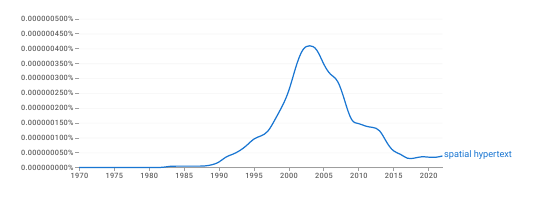
The term 'Spatial Hypertext' was first coined by Marshall & Shipman in 1993 107, though the roots of SH stem from the late 1980s. The last major SH-centric research program was VKB 149 in 1999, with work on and research using VKB running on until c.2014. The core programs in the SH story are AQUANET, VIKI and VKB, all described in more detail below. However, understanding SH is more than just those three experiments.
Before exploring further, it is worth noting that most working-age people today (2025) left junior school after the Web's public debut (c.1993). Thus, for many readers of this paper, the Web's subset of hypertext features is likely their baseline understanding of the meaning of 'hypertext'—perspective is relevant.
Thus, 'Spatial Hypertext' was coined the same year the (World Wide) Web opened to the public, in 1993. VIKI 110 was launched a year later and was being evaluated at a time when research and public interest in hypertext was pivoting to the fast-growing Web. SH's roots actually stretch back further, to the late 1980s—so, pre-Web. Furthermore, from the published record, the inception of projects is often unclear. This is because papers tended to be written at the end of a research grant, or after it finished, making the narrative doubly retrospective and not always easy to follow. Another factor confusing in hindsight is the scale of content used. Systems in the late 1980s might have hundreds of nodes in a hypertext: those were large hypertexts in their time.
Very few of the systems described can be seen working today (or have video of their use), and early print reproduction of screen images was often poor. Indeed, of the three main SH experimental programs discussed here, only the last (VKB) can still be run (see Figure 2). Bernstein's paper at the SH1 Workshop[^1] asked 'Where Are The Hypertext Systems?' 22, p.1 pointing out that at HYPERTEXT'87 'With the exception of NLS/AUGMENT, the old, established systems were all younger than VIKI is today'. The passage of time means that few of today's (2025) hypertext researchers were 'in the room' when the early SH papers came out and given the over 30-year gap it is useful to re-seam together programs and their surrounding literature, before considering where SH stands today and its possible future.
[^1]: The first of four SH workshops held at the HT Conferences '01–'04: see 160.
1.1 So what then is 'Spatial' Hypertext?
At its simplest, SH is the notion that individual hypertext nodes[^2], drawn as a graph or 'map', can have semantic meaning that derives from either/both their position relative to one another or their appearance. It is also not necessary for there to be explicit linkage between lexia for an SH to be meaningful to its user. A crucial distinction of SH is 'the ability to leave structure implicit and informal' 108, p.90.
[^2]: Nodes, notes, elements, lexia—interchangeable terms for the discrete content elements of a hypertext. Here, 'hypertext' stands proxy for both hypertext and hypermedia.
The apparent rejection of links is just that—apparent. SH does not reject hypertext's links, but simply downplays their role in order to explore the implications of specialised display. A link expressed in a hypertext still exists even if not explicitly visualised.
SH also allows people to express what DeRose refers to as 'extensional structure' 49, p.251, idiosyncratic and dependent on the situation at hand, perceived through context, not computed from content. Ambiguity may be left unresolved without compromising the integrity of the structure' 108, p.90 also footnoting that (my italics): 'In explicit hypertextual linking, links are either there, or they are not. When links are given weights or may exist independently from nodes, the existence of the link still must be specified unambiguously'. This hints at what Halasz has described as 'the tyranny of the link'[^3] 67—something SH set out to circumvent.
[^3]: He notes: 'Basically I would like to claim we need to develop a new conception of hypermedia that includes non-network structures as well as virtual structures on an equal footing with network.'
Although some also ascribe a need for SH to involve a (spatial) parser, this is not explicitly noted as a requirement for a hypertext to be spatial hypertext. That expectation seems to arise from the fact it was a necessary part of some early SH experimental applications, to illustrate computer recognition of human intuition. The human arrangement of a 'map' is an implicit form of spatial parsing, but this was Computer Science research and the wonder of new technology could unintentionally shade out the relevance of merely human input. The role of the parser is generally to recognize and capture emergent structure and/or to suggest formalisations to apply. Importantly, the initial structure is created by the human user.
Interestingly, there is no single short, definitive definition of SH, but general SH papers from 1993 107, 1995 108, and 1999 153 respectively, give the best insight as to the wider context of the description of SH given above. Ironically, that potential ambiguity of meaning has been to SH's benefit, as will be seen, not least because partly it speaks to what is not on the 'page' and to humans' associative sense-making skills. Indeed, back in 1945, Bush's 'As We May Think' noted as much: "The human mind does not work that way. It operates by association."[^4] 41, Sect. 6. Kidd 84 also notes an interesting aspect of mapping information as a scaffold for knowledge workers' learning: once internalised, the source material becomes of less immediate interest.
[^4]: Unproven, even if navigation by association feels intuitive for humans.
Tangential to defining SH but important to informing its approach to eliciting implicit structure is Shipman & Marshall's article 'Formality Considered Harmful' 151 that considered issues of premature vs. incremental formalisation[^5]. One unintentional side-effect of early link-typed systems was the need placed upon the user to consider the intent of a link, and its target before that intent was fully formed, and so encouraging premature formalisation.
2 The background to Spatial Hypertext
What may be less clear in hindsight is how transgressive SH's seeming eschewal of links might have appeared back in the early 1990s. Ted Nelson's neologism of 'Hypertext' was of '. . . a body of written or pictorial material interconnected in such a complex way that it could not conveniently be presented or represented on paper.' 122, p.96. Those interconnections were what became termed 'links', and their visibility is something that Nelson himself has always stressed 125 [124, image p1/25].
The 1980s–90s were a time of rapid expansion of hypertext development and research. Pertinent for today's researcher was the fact that most systems then ran on single computers. PCs and workstations were taking over from earlier 'mainframe' computers: merely having a computer was getting easier. Display screens were expensive, physically small, and of low resolution. Colour screens were a rarity. Much of the displayed content was text, partly reflecting the immaturity of displaying image content and partly due to the perceived role of hypertext tools.
For linking, even the very act of traversing (a link) from one node to another was still novel and even confusing, with erstwhile fears of being 'lost in hyperspace' 51, 54 43, p.38. This was also reflected in Landow's consideration of the rhetoric of link-traversal departure and arrival 90. Oddly to today's eye, (hypertext) links were a thing of mystery and not the obvious means of navigation: should I follow this link, what might happen next?
Thus, links and their role (type) were very much to the fore 44, Fig. 8[43, Table 1], not least as there was often little in the way of a graphical overview of the system. The role of link types—an expression of the link's purpose[^6]—increased in 1983 with the arrival of Trigg's TEXNET[^7] 179 and Halascz's Notecards 68. Both these programs were created by staff of Systems Sciences Laboratory (SSL) at Xerox PARC[^8].
[^6]: This is explored by Nelson's link typologies in Literary Machines 124, pp.4/41–4/60 and in Conklin's hypertext survey 43, p.40 44, Sect. 5.2.
[^8]: Xerox's Palo Alto Research Center, in Palo Alto, CA, USA.
Links serve a dual function[107]. Firstly, they give rhetorical structure to a hypertext's overall set of nodes. They offer a literal prompt for, an affordance of, traversal of the hypertext. This might involve following a pre-defined stored path, e.g. Memex's 'trails' 41, scripted documents 190, 191, or 'guided tours' 105, 174. Or, they might involve choice and intuition as in Intermedia 188 or Storyspace 78.
Building on top of Notecards, PARC's Intelligent System Lab built IDE[^9] 76, 129, 138. It added the notion of a graphical Knowledge Structure, allowing visualisation of the domain knowledge to be taught 138, p.209, Fig. 7.9. Within Notecards itself, some structuring of context was possible, primarily via Browser-type cards, and this was leveraged to give 'guided tours' of a hypertext 174. A parallel development was the 'tabletop' card. This allowed a number of cards—and their layout—to be saved, essentially a precursor to today's notion of a saved work space.
[^9]: The Instructional Design Environment.
Other approaches to hypertextual construction and traversal were being tried. Nanard & Nanard expanded the notion of typing further in their MacWeb 120, 121 system—even proposing typed anchors. DeRose, exploring the notion of the link 49, also derived a taxonomy of link types distinguishing intensional links from extensional links. The former follow from the internal structure and content of the nodes compared to the idiosyncratic definition of extensional links.
Taking a differing perspective of the whole, Stotts & Furuta were applying Petri net[^10] principles to the hypertext graph in their Trellis programs 62, 169 using places (notes) and transitions (links) to tease content apart from structure. Van Dyke Parunak's HyperSet 182, 183 explored Set theory as a means of exploring the graph. There was recognition that not all hypertexts were static in representation, so-called 'volatile' hypertexts 29. Fairchild's SemNet 56 looked at using a 3-dimensional view of the hypertext graph as a way of both exposing it to the user and avoiding some of the noise that a densely linked graph has in 2D. Outside the research laboratory, Apple's Hypercard was also following a card-based motif[4].
[^10]: Also known as a place/transition net or 'PT net'
Whilst hypertext traversal via single node-to-node links seemed the most tractable approach, the exact nature of implementing a hypertext was not set as the diverse examples above show. However, the link was a significant component of all these systems.
2.1 Experience of Notecards
Another factor encouraging the primacy of the link at that time was interest in mapping the structure/logic of (AI) argumentation and business process 45, 101, 102. AI and Machine Learning at that time were also making more deliberate use of decision trees 91, 92, 94. Mapping logic seemed a logical route forward. However, as SSL staff and researchers started to use and report on Notecards 66, 68, 75, 105, 115, 116, 174–178, it became apparent that closely-typed linking of type could hamper users employment of linking, and gaining benefit from their hypertexts.
For all that such formalism offered, some users found making a pre-emptive choice of link types before creating links to be an impediment. For instance, it became apparent that less formal Notecards features like Sketch- and Filebox-type notes allowed organisation without the need to commit to a structure whilst it was still not fully formed 101, 102. Though not explicitly on record, this suggests use of sketch or filebox cards hinted at users trying to avoid premature formalisation. Marshall, in a later (2001) retrospective on Notecards, writes 'much of the use I observed . . . did not involve typed links. Link-typing schemes, if adopted, were frequently abandoned. The automatically maintained hierarchical FileBox links were a far more common way of introducing structure to the hypertext.' 103, p.101
Thus, the formalisation of explicit link typing could actually be detrimental as choice of type could force formalisation before the researcher had a clear feel for structure. How might the user explore the shape of the task without having to guess the structure beforehand?
Also informing the design of these early hypertext systems was the current observation of existing forms of (non-digital) information collection and triage, such as desk organisation 97 and the 'pile' as a metaphor 100. The notion of 'information farming' 15 or 'gardening' arose, echoing human nurturing and husbandry of crops (of information). Hypertext development was also conscious of the need to bridge to existing informational practice. Separately, there was interest in semi-structured communication[98] and systems such as Winograd's Coordinator 186 and Gorry's VNS[^11] 63, 64.
[^11]: Virtual Notebook System, built atop Notecards.
3 AQUANET: holding knowledge in place? (1991)
Mindful of the 'tyranny of the link', PARC SSL's next hypertext experiment was 'AQUANET' (c.1990–92). It attempted to look at the 'knowledge structuring task' using spatial layout to explore and impart semantic meaning to emergent knowledge. It drew upon Germ[^12] 38, gIBIS 40, 45, 46, Notecards, and IDE. Conklin's gIBIS was also of note as it sought to visualise, as a graph, argumentation in business processes.
[^12]: (Graphical Entity Relational Modeling: also see 70.
A primary innovation, with regard to hypertext systems, was that the main display space was 'a large unpartitioned display space' 106, p.58, which was a departure from the multiple window (card) displays of the likes of Notecards or Hypercard. The broad aims were laid out at 104, p.264:
Specifying the elements and connection methods of the problem space.
Being able to model the knowledge structure.
For collaboration, regular updating: 'What You See Is What I Did' (WYSIWID).
Allow combinations of methodologies to structure knowledge (citing Streitz 171).
Allow discussion both about and through the structure, as in Conklin's 'going meta' 45, pp.148–9.
[^13]: q.v. NLS/Augments's viewspecs 55.
The structures offered aimed to support both the Dexter Hypertext Reference Model 69 and frame-based representation (per 33) describing nodes as 'basic objects' and links as relationships. Actual links, as were then the norm, were not included; the visualisation of the display space offering implicit (link) relationships instead. Though AQUANET is often seen as a proto-Spatial Hypertext, in terms of what it set out to do, it was far more structure-oriented than what was to follow. Although the map was free-form, the user was expected to insert objects chosen from a set of pre-defined objects. The freedom of user choice was more in the layout than in the type of object (though the user could define custom objects).
Indeed, it was observations of what had not worked as expected, as much as any success that set in train the notion of SH. It was a subsequent reflective paper 'Two Years Before the Mist' 101 that drew upon these user experiences.
3.1 Reflections on AQUANET (1992)
Study of AQUANET users 106 confirmed earlier observations of how the task of choosing link types was an impediment to work, especially when the problem domain is not yet fully understood. In the AQUANET context, the same issue applied to aims 1 and 2 (list above). Thus, the program actually impeded some of the very tasks it was designed to enable. But this was not a straight failure, as the experience showed that the pinch point was not offering a means for early-stage planning, when the necessary structuring of the problem was not yet fully understood. Marshall & Rogers note:
'Our observations of Aquanet use have led us to reconsider the role of relations in the tool. In designing the tool, we combined a richer, more general form of connection than the link with gIBIS's browser-based mode of navigation and access. Later, we found Aquanet's relations to be less commonly used than the tool's design anticipated, and the structures users built to be more volatile than expected (in the sense described in 29). Thus we find it necessary to both support the interpretation and reinterpretation that takes place in a spatial context without user-articulated relational structures and to assist users in identifying structural regularities that they may choose to formalize.' 106, p.58
Users struggled, early in a task, to define a collection of types to describe the problem domain—the challenge of premature formalisation. It was also found that an assumed top-down schematization of the problems space was not occurring and thus expected abstractions were not occurring. In the same way, users wished to start working from concrete examples and only then working back to generic instances: 'users wanted to manipulate instances in situ in order to define or alter the generic structure of their types.' 101, p.57. A parallel was drawn with users' frustrations learning Smalltalk 126. The Semantic Web's 12 failure to grow to envisaged scale might reflect the same problem of the construction of the data requiring too much structure (or prior knowledge) too early in the process.
In effect, though AQUANET could hold knowledge in place, the act of systematising the problem to get to that point proved harder than expected, tempering success. Whilst AQUANET may have had issues with its intended structuring task, it usefully illustrated the effects of premature formalisation that SH later explored. AQUANET's users created spatialised text in preference to using its relational model for semantically and graphically expressing interconnections.
In the final analysis 106, Sect. 5, the authors clearly show that whilst the program's shortcomings were addressable, more meaningful insights had occurred in that the hard-edged structure familiar to (software) engineering work was not as well suited to the structuring of emergent knowledge. As Trigg had found 175, p.106—not all use of the hypertext can be effected within the hypertext alone nor via a single presentational view. More successful were the aims for assisting collaboration which did not present problems.
3.2 Spatial Hypertext takes its name (1993)
At HYPERTEXT '93, Marshall & Shipman's paper 'Searching for The Missing Link' drew on the lessons of AQUANET, but with a looser framing, examining 'the role of structures in hypertext and some ways and reasons that hypertext become implicitly structured.' 107, p.217. It focused on structure not simply as a means of traversal but as a rhetorical or semantic basis for hypertext; it asked of structure:
Where does it lie? Is it inferred from content (as suggested by Superbook's tools 52), or is it defined by context?
How it is constrained? Is it truly ad hoc or is does the cognitive model of the activity 172 impose limits?
How is it conveyed? Is structure laid out by the system 29 or flow straight from the user's head?
An important new consideration drew on the authors' paper on formality 151[^14]. The formal mechanisms of existing hypertext systems could struggle to express the sheer uncertainty of the connections at the early stage of sense-making. One hope was that parse-able factors like distance and collocation might hint at emergent structure. 'In practice, people experience difficulty trying to articulate why they've linked two things (or even deciding if what they're trying to express is a node or a link)' 107, p.219.
[^14]: This drew in turn on Shipman's PhD 141. The article was formally published, with minor edits in 1999 152
In considering links—a construct AQUANET side-steps—the authors mention DeRose's notion of 'implicit vs. extension' 49 as well as other approaches to implicit links in PERSEUS 119, Assistant 187, IDE 76, PHIDAS 112. This is juxtaposed with Nelson's transclusional StretchText 124, Tufte's sidenote presentational style 180, and with 'spatialised text' as described by Bolter 34.
To investigate link-less structure, tests were conducted on eight mature projects created in Notecards, AQUANET, and VNS 145. Although Notecards had a strong node-and-link model, it was evident that some users circumvented this by spatialising text into diagrams in sketch-type cards 107, Fig.1, thus creating structure outside the hypertext. For VNS, there was a stronger set of references (linking) but still with structure deriving from spatial layouts. Interestingly, despite AQUANET having no formal drawing mechanism, the overall map allowed for the emergence of distinct groupings partly aided by the patterns of re-use of formal structural elements used to contain information. In all the specimen programs, there was structure evident in a place where hitherto it had not been expected.
After consideration of visible structures that might be parsed, such as aggregates, lists, bounding lines, and arrows, a specimen parser was built and tested, with a summary concluding that 'that automatic perception of implicit spatial structure is possible, and that it can identify several useful kinds of hypertext constructs.' 107, p.224. This formalised the notion of expressing hypertextual connections without explicit linkage, using a parser ('recognition algorithm') to surface possible structure in analysed documents. Implementing the latter lead to VIKI (see Section 4), the first program able to describe itself as a Spatial Hypertext system.
Thus was Spatial Hypertext introduced, albeit without any close formal definition. SH was noted as extending the more normal node-link structure, rather than acting in opposition to or replacement of it. Reflecting challenges of incremental formalisation, there was also recognition that 'any sort of heuristic recognition should be guided by human interaction.' 107, p.227. The '93 paper's sections on the 'how' and 'why' of implicit structure 107, p.219, expressed in contrast to hypertext linking norms, also speak to the emergent sense of what SH is. In a subsequent 1999 SH paper 153, the authors also emphasised distinctions between 'document-centered' and 'map-based' (SH) hypertext systems and implications of the latter.
4 VIKI—parsing structure (1994)
Introduced at ECHT'94, VIKI made use of the parser tested in the previous year's SH paper (see previous section) as well as other spatial parsing work at PARC 117, 139. Having established the concept of SH, VIKI deliberately set itself apart from the linking of earlier hypertext systems 110, Sect. 2, focusing on representing overall structure rather than navigation. Of note too is that section's discussion of browser-based systems (VIKI, Storyspace, AQUANET, MacWeb, Sepia 170, gIBIS) vs. document-based systems (WWWeb 11, HOS 157, OVAL 99 and PHIDAS). Whilst permissive and prescriptive linking systems can also expand their linking approach (e.g. Storyspace's Link Apprentice tool 14), it was felt that eventually the sheer number range of link types could make system navigation hard to use or visualise. The SH approach let the location and visual style indicate emergent structure. Not stated but implicit was that such an approach suited early-stage hypertexts still under construction, rather than a mature system where structure should have stabilised.
Learning from AQUANET, VIKI used three pivotal requirements: '(1) interaction must be informal; (2) users must have access to a variety of representational modes; (3) additional structure must be available on demand, either through the development of types from examples and prototypes, or through recognition of implicit structure.' 110, pp.15–16.
Rather than use predefined structures to help shape the layout of the hypertext, VIKI took the opposite approach. Now the users would lay everything out, and a parser would assist them by deriving structure. This fostered emergent structure and avoided premature formalisation: use of structure or abstraction in VIKI would always be done at the user's initiative.
To assist the user, three fundamental types of element were offered: objects, composites, and collections. Objects were the basic constructional blocks (lexia) and were semi-structured, allowing the user the choice as to how content was added to them. Composites would consist of two or more objects in a particular visual or spatial configuration. A collection was an arbitrary spatial arrangement of objects, composites, or other collections. A flexible system of object types was available to allow for consistent styling of groupings of similar elements. Visual nesting of elements, on the map but with an implicit hierarchy, was allowed. Following Boxer 50 and Pad 128, VIKI used a spatial navigation metaphor.
The parser, at the users invitation, could suggest new collections based on the detected layout of the selected elements. The assumption was that this would assist the user with generating empty structures for new content, as a productivity accelerator. Note that the parser was not creating the layout of items, but parsing it to suggest recognised and emerging structures. The parser also drew on Shipman's Hyper-Object Substrate (HOS)[^15] 141, 157.
[^15]: HOS included agents to examine text content included in the hypertext and recommend the addition of particular attribute/value tuples and inter-object relations.
Reflecting the newly available world Wide Web, VIKI could also link outwards to the Web to avoid internal replication of content already available (online) elsewhere. As there was an intention for group rather than individual use, 'note' objects were offered to enable meta-communication by group members indicating their intent in incremental formalisations made to the map.
Through this set of features, VIKI was able to test a more permissive SH environment that gave the user more agency in the organisation and styling of information. By not forcing a defined structure, elucidation could be imparted whilst still allowing some information to remain tacit 130. VIKI essentially validated the notion of SH as set out by the 1993 SH paper.
4.1 Building on VIKI's insights
VIKI's use led to a number of papers reporting insights gained from its use, notably Marshall & Shipman's 1995 paper 'Spatial Hypertext: Designing for Change' 108. On linking, it notes:
Instead of providing a mechanism for defining specific links between objects, VIKI focuses on the relationships that can be noted visually and spatially. These relationships may either remain implicit, or be recognized by structure-finding algorithms that automatically analyze spatial layout and visually salient properties of the constituents of a space. (108, p.95)
They also noted that as well as SH surfacing the potential relationship of nodes, it could also 'conceptualise a reader's growing sense of meaning' 108 (citing Kaplan & Moulthorp[83]).
The 1995 paper 'Finding and Using Implicit Structure in Human-Organized Spatial Layouts of Information' summarised four discrete spatial primitives observed being used in VIKI 156, p.348, Fig. 4:
lists: aligned objects of the same type.
stacks: overlapping objects of the same type
composites: repeated arrangements of alignment between objects of different types
heaps: overlapping objects of different types
Of note is that these primitives do not express an explicit reason for their association, such as the use of a categorised link type might enforce. Rather, they allow for capturing implicit and possibly impermanent relationships.
Acknowledging the rapid growth of the Web as a resource, VIKI was updated to improve its ability to draw information via web links for further triage within the program. In 'Spatial Hypertext and the Practice of Information Triage' 109, p.124, Marshall & Shipman reflect on the Web's relevance, noting 'We can see this trend realized in Web workspaces like VIKI, Eastgate's Web Squirrel 16, or the Web Forager 42. The reader is transformed into a gatherer, as Rosenberg suggests 135' (original inline references updated). In this triage role, they mention Joyce's notion of 'successive attendings' and his observation that the 'the value of what we collect is not as much embodied in what it is as in how we found it and why we keep it.' 80. This matches SH's approach of privileging display of context over detailed content. They further state: 'subjects' organizational strategies changed over the task's duration as they became more familiar with the material'. That reflected the cumulative effect of 'successive attendings' and underlined the need for nurturing emergent structure in tasks involving structuring, such as is offered by SH tools like VIKI.
The web access improvements in VIKI led to work on generating web-based presentations 146, itself drawing on Shipman et al.'s prior work with Walden's Paths 154, Zellweger's scripted paths 191, and Trigg's 'Guided Tours and Tabletops' 174.
Shipman & Marshall's 1999 SH paper 'Spatial Hypertext: An Alternative to Navigational and Semantic Links' 153, contextualised their web-based work in VIKI: 'Additionally, systems like Web Squirrel 16, D-LITE 47, Web Forager 42, and Data Mountain 133 provide workspaces for analysis and interpretation similar to that of VIKI.' (original inline references updated).
An impact of increasing the amount of data being added to SH layouts was the problem of being able to display enough of a large SH to work on it without loss of spatial context. One approach to resolving this was an experimental fisheye view added to allow for greater information density 155.
5 Convergent Evolution I: Storyspace (1987)
Developed by Bolter, Joyce & Smith, Storyspace 35, 78 predates SH by almost a decade, having started development in 1984 and was first shown publicly in 1987 at the first Hypertext conference. Whilst SH was not on the minds of Storyspace's creators, there was an intent to give users a place to play and explore with the relation of their notes. The app offered an overall outline structure, whilst its map view allowed a per-outline-container view where the user could arrange their notes ('writing spaces'). Joyce noted:
Differing from the link-less nature of systems like VIKI, Storyspace draws any links on the map (if needed). There is no parser controlling the layout, which is manually arranged by the user, although some placement assistance features are offered. Despite this, the map experience still fosters SH's sense of emergent structure and the serendipity of contingent positioning.
Joyce also described the notion of 'constructive' (creating) vs. 'exploratory' (reading) hypertext 79, pp.40–42[^16] 31. This is not touched on in the early SH papers, but their exploratory [sic] work chimes with the freedom of Joyce's constructive category. Storyspace's presentational duality of discrete tree and graph views echoes Smith's Writing Environment (WE) 162. Bernstein's 'Architecture for Volatile Hypertext' 29 also explores how Storyspace embraces the challenge of the impermanent structure when making constructive hypertexts.
[^16]: A reprint of the unavailable original 77.
VIKI's creators make reference to Storyspace—see 110, Sect. 2—but do not adjudge it to be an SH tool. Note though, with hindsight, that at that time VIKI was trying to prove the point of meaningful SH without any explicit links. By contrast, Storyspace's 'map view' combined a spatial layout of nodes (like an SH) whilst also showing any links between them. Whilst links were the necessary—and intentional—means of navigation the map still offered a perspective only later formalised as SH.
6 Visual Knowledge Builder (VKB) (1999–2014)
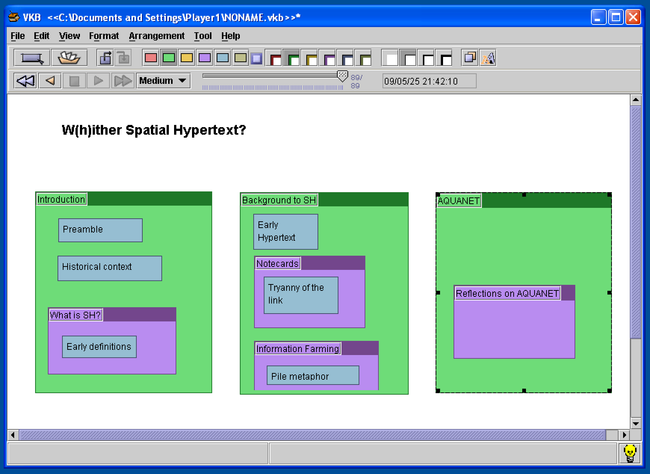
Building on experience from VIKI, at HYPERTEXT '01, Shipman and colleagues presented VKB 149 (also see 144, 147) as a visual workspace for collecting, organising, and sharing information. The design of VKB also incorporated experiences with information authoring and sharing from the Virtual Notebook System 145 and with information representation and formalisation from their previous HOS system 141, 158.
Whereas earlier SH systems had run on PARC's workstations—far more powerful than the PCs of their day, VKB ran under Windows OS on ordinary PCs[^17]. Significantly, SH had broken free of research-grade equipment and was now running on consumer-grade OS and hardware.
[^17]: VKB was written in Java and ran on Windows 98 & NT.
Whilst VIKI had already proved the basic case for SH, VKB identified further emergent SH issues 149, p.113:
the difficulty of interpreting changing visualizations
the visualization interfering with visual source information
the inability to express cross-space interrelations
the lack of means for expressing publishable information spaces
For all tht SH offered, the last item is of particular note and not really resolved by this last of the main SH experiments. Whilst SH is a powerful approach to information triage and initial structure, its 'flattened' state—notwithstanding nested elements—does not necessarily indicate the best approach to the linear narrative needed for most forms of publishing (output). Even digitally native documents still embrace the linearising constraints of paper, even though such documents may never actually be printed. This issue has been addressed, in part, by Tinderbox (see Section 7). The task of writing, as distinct from initial data input, is discussed in Section 4.2 of Shipman et al.'s 'Emergent Structure in Analytic Workspaces' 148.
A further innovation in VKB was its navigable history. Hypertext tools had long had a history list of nodes/objects selected or edited. A novelty in VKB was to allow the user, via a scrubber control, to move back to a particular past snapshot of the system, or watch the emergence of structure replayed snapshot by snapshot. That feature enabled SH users both to find a given state and to (re)view the emergence of structure in the SH. Additionally, links could be added to point to a particular saved snapshot of the SH, though it was noted that the benefits of the latter 71 had yet to be fully explored and established 143. The history scrubber also exposed the time axis of the document for the reader 95 147, pp.163-4. Kim & Shipman revisited this in a VKB v3 10, 86.
In VKB the 'Suggestion Manager' exposed the parser to the user. Invoking the feature results in a number of suggestions relating to the visual layout and styling of the SH, see 159, Fig. 1. The parser is not significantly altering the layout of the SH, but rather surfacing and enhancing apparent emergent structure. Importantly, as with AQUANET and VIKI, the human user controls the overall 'map' of the content of the SH.
To address the issue of SH map size vs. display size, VKB included a 'Miniature Space' navigation overview window that indicated the currently visible area of the whole SH map (used to investigate information triage in SH 9).
With VKB developed, Shipman's research group used it to investigate information triage 9, 85, 113, 127, 150. MASH (Multi-model Adaptive Spatial Hypermedia) 57, 60 saw experimental joining in of SH with Adaptive Hypertext, using VKB as the authoring environment. MASH debuted in conjunction with WARP 58, a web-browser-based dynamic SH presentation, again using VKB as the SH authoring component. Further work was also undertaken on improved spatial parsers for VKB/WARP 59. VITE 72–74 drew on VKB for a visualisation space for structured data (contrasting generally ad hoc input to SH). VKB itself iterated through three major versions over 15 years.
In Shipman's 'Seven Directions for Spatial Hypertext Research' 142, Direction #6 'Writing & Designing Spatial Hypertexts' acknowledges the creator and user are often the same (group of) people. For them, any ambiguity of presentation is offset by the user's ongoing familiarity with the work. Not so for the general reader. This is similar to the problem of creating 'publishable' SH information spaces.
7 Convergent Evolution II: Tinderbox (2001)
Having taken over development of Storyspace in 1990, and with the experience of Hypergate 13, 14, 32 and Web Squirrel 16, 17, in 2001 Eastgate created Tinderbox 23, 24—incidentally contemporaneous to VKB. Reflecting the interim arrival of the Web and an erstwhile interest in blogging, Tinderbox—as compared to Storyspace—moved from being a self-contained hypertext app[^18] to a general 'toolbox for notes', albeit with the same hypertextual core. Storyspace's views, most notably the map view, were retained and since enhanced with further views[^19] 27, 30. The design allows the user multiple concurrent views, of the same underlying data[^20], to visualise their notes' relationships. Tinderbox has also continued to enhance the visual affordances of the map view 25, 30.
[^18]: By comparison, Storyspace is both the authoring app and the reading tool, though a stand-alone reader app was offered.
[^19]: Currently, there are 10 discrete view types.
[^20]: q.v. NLS/Augments's viewspecs 55.
Tinderbox's flexible support for export echoes a need expressed in the conclusions of Trigg's survey of Notecards users 175, p.106—not all hypertext-based work can be effected solely within the hypertext. VKB also noted the challenge of expressing publishable information spaces 149, p.113. The relationship of hypertexts with other media forms is not new. Moulthorp noted: 'This paper begins by asking why hypertext researchers publish their work in print and compose their hypertexts from previously printed sources 118.
Bernstein's two books on Tinderbox 26, 28 explore his design ideas and the origins of the program. An explicit link to earlier SH experiments is that VIKI cited as a key influence 26, p.165. It is also clear that this essentially SH tool—at least within its map view—draws as much on the literary/creative side of hypertext as it does upon pure computer science. Happily, the only SH tool currently available to the general public thus represents both expressions (evolutions) of SH.
8 Spatial Hypertext Since VKB
Similar to later use of VKB, Buchanan et al.'s 'Garnet' 39 used SH as a means to explore digital libraries. (2004). Solis and collaborators merged the concept of SH with that of wikis 93 to make 'ShyWiki' 164–167. Here, discrete wiki articles could be arranged on an SH map. A difficulty experienced was with new users understanding the templating system used to generate structured content 163. This seems to echo earlier SH experiences with AQUANET where it was the design and choice of structures to be used in the SH rather than the overall SH experience that impeded use. (2008–12).
'Emberlight' 111 was an experiment using a Tinderbox file as the back-end to a web display offering both an outline and an (SH) map (2010). Given advances in what more web browsers can now do, this approach remains interesting. In context, Tinderbox's poster concept [28, Ch.11] reverses this by using embedded web browser rendering in map objects obviating the need for building new app-native views (2023). In part, this approach draws on the ideas of van Dam's DASH 181, 189 (2019–to date).
Reprising his earlier influential 'Patterns of Hypertext' 18, Bernstein's 'Can we talk about Spatial Hypertext?' 25 offered an enriched syntax for the representational talkback of SH, moving beyond simple styled boxes of text (2011).
Kolb, writing from a perspective of philosophy, saw value in SH as it related to scholarly writing 88 and in 'Other Spaces for Spatial Hypertext' 89 he drew a connection between useful SH as evolved both via VIKI/VKB and Storyspace/Tinderbox. The case for non-link-based meaning in hypertext having been made by former, SH co-existing with (visible) links seems less odd than when AQUANET was trying to escape the 'tyranny of the link'.
Atzenbeck and colleagues at iisys (Hof, DE) have continued SH work in the context of recommender systems and AI. A three-tier Component-based Open Hypermedia base (CB-OHS) base 8 (2017) underlies their 'Mother' 6 system. Pertinently, the system involves three parsers. A spatial parser observes the arrangement of nodes in the display plane, a visual parser looks at the visual styling similarities of nodes and a temporal parser (Schedel 140) watches the temporal sequence of user interaction with nodes. The latter reflects a more dynamic view of the temporal axis compared to that seen in the likes of VKB. Examples of their 'Mother' system are seen in active decision making 5, story brokering 137, video selection 131, end-user development 136.
9 Spatial Hypertext Today (2025)
Aside from Eastgate's and iisys's work, SH is little in evidence today, the more so outside the research lab. We might ask "Where are all the spatial hypertexts?" (q.v. 20)—why such a dearth of material?
The Twine authoring tool 61, though Web in lineage, does make use of a spatial layout to assist in the narrative construction. Tapestries[^21] 168 (in late beta) is interesting as, whilst not overtly hypertextual in construction, is essentially an SH as the salience of a tapestry comes from the appearance and juxtaposition of its elements.
[^21]: Its team draws on long experience of e-publishing, stretching back to e-book CDs.
9.1 Spacial, or 'Spacialised', Hypertext?
Today, Google Scholar finds c.650 results for papers mentioning 'spatial hypertext'. Brief perusal shows that most reference is tangential to SH, although spatiality of content is still generally the point of interest (and the reason for mention of SH). The wider discussion appears to be of (default: 'false') presentation of text/media. As SH's progenitors never chose to define SH too tightly, these other perspectives are too easily dismissed as 'not Spatial Hypertext'. Now that deliberately hypertextual tools are a rarity, subsumed by a more Web-based perspective, the edge of SH is harder to place.
For instance, 'The Itinerary of King John' 48, a mash-up of digital map, timeline, and textual sources, was not built as an SH but really—potentially—it is. Brath's Visualising with Text 37, based on his thesis 36, when considered alongside VIKI or VKB, shows how much more SH could be doing, even with 'just' text. Yet technology alone is not the crux. Contrast Aigner et al.'s tech-oriented Visualization of Time-Oriented Data 1 against the richness of Rosenberg & Grafton's pre-digital Cartographies of Time 134.
We should also be careful not to mistake an apparent focus on text in older SH's apps as intentionally exclusive of other media, and be mindful of the limitations of the technology of their time. A contemporary issue for both VIKI and VKB was how better to manage non-textual information. This suggests benefit in being more open in our interpretation of the 'what' of spatial hypertext. SH's unspoken part—about the dangers of premature formalisation and over-commitment to structure before warranted—remains just as pertinent even in this wider context as with text alone.
Happily, the Hypertext Conference has long looked across all disciplines. If cross-pollination waned, the reconnection that started at HT'19 7 appears healthy once more. This is good timing, as a recent increase in interest from the Digital Humanities presents an opportunity for SH to help with effective visualisation of their work 82, 184, 185.
Artificial Intelligence. Projects at iisys (see above) are already making use of SH with AI/ML in the context of recommender systems. The recent concept of Model Context Protocol[^22] for Large Language Models (LLMs) offers an interesting new potential for such AI to communicate with SH tools and offer new ways to combine SH views, parsers, and AI.
[^22]: https://modelcontextprotocol.io/introduction (Accessed April 14, 2025).
Extended Reality (XR). At an ECHT'92 keynote, Bolter talked about 'Virtual Reality and the Future of Hypertext' 34 and spatialised text. Since then, capability of XR has improved massively in terms of hardware and software, so XR[^23] is no stranger to Hypertext. The entirely constructed nature of XR loosens some previous limitations for SH, not least in scope and scale. At the more extreme end is the potential to work with spatial arrangements in using non-Euclidean space 114. Non-SH experiments with hypertext are already happening in XR 192.
[^23]: eXtended Reality: a portmanteau term for VR, AR and MR.
XR appears a good medium to expand on SH's capability for problem exploration and information triage. Eidloth, Atzenbeck & Pfeiffer's 'Stepping into the Unknown' 53 has explored this potential, reflecting ideas Simpson imagined in 'Beyond the Plane: Spatial Hypertext in a Virtual Reality World' 161 (1996).
10 Conclusions
Whilst Spatial Hypertext's heyday may appear to be in the past, SH as a means of sense- and knowledge-making remains relevant today, although, as 'Seven Hypertexts' notes, 'Spatial Hypertext has become dormant' 3, Sect. 3.5. I would suggest the issue faced is twofold: a lack of SH tools and a lack of clarity as to how and where to build SH practice into existing work practice.
Scope. It can be seen from its genesis that SH's strength is in exploration of a problem space and elucidation of its potential structure and breadth. But, having made an SH, what can we then do with just the SH result? Is the result meaningful to others, or do we have a beautiful 'mind palace' of use only to its maker(s)? Thus, a challenge for proponents of SH is to make clear what problems it addresses better than other processes, and in what context to use it. SH is a software-mediated experience, and certainly, without SH tools, the analytically assistive power of SH is hidden from a wider audience.
Tools. As noted in Section 9, programs like Tinderbox still offer an SH experience within a wider feature set, but most SH systems described here either are no longer usable or are restricted to a research setting. An early beta of VKB survives, but Tinderbox and Storyspace (now on a common codebase) are the only two publicly available, current, SH tools—albeit for macOS only.
In considering a role for SH, I think Kidd's 1994 observation on knowledge work triage still holds true:
'My explanation is that once informed (ie, given form) by some written material, these workers have no particular need to retain a copy of the informing source. However, if a piece of written material has not yet informed them, then they cannot sensibly tile it anyway because its subsequent use or role in their world is still undetermined, I conclude that the valuable marks are on the knowledge worker rather than on the paper or on the electronic file. . . ' ('Marks in The Water' 84, via 156)
This chimes with this author's experience of using SH tools for over two decades: it is the practice of using an SH environment which is as valuable as using a particular SH tool. But it is having such SH tools that enables and unlocks that experience. Working via SH assists with the contextualisation of new knowledge.
Spatial Hypertext deserves not to whither away. It is to be hoped research on SH will continue.
Acknowledgments
I would like to acknowledge the insights of Cathy Marshall and Frank Shipman in preparation of this paper, not least for their perspective as 'creators' of SH. My thanks to Mark Bernstein for help in re-contextualising some early SH facts, and to Silas Hooper. The paper's peer reviewers also gave helpful input and supplied some missing pieces.
References
A note on referencing and links. Some sources, as originally cited, can be hard to find as early contemporary sources here fall in a period before extensive digital curation of niche print material. This at a time when libraries are sending infrequently used assets (e.g. print journals) to landfill. Unobtainable sources are so noted in the bibliography. Where possible, an actionable URL has been given for resources, including for BibTeX source types not normally linked under default ACM styling via 'acmart'.
Wolfgang Aigner, Silvia Miksch, Heidrun Schumann, and Christian Tominski. 2023. Visualization of Time-Oriented Data. Vol. 4. Springer Nature, New York, NY, USA. 441 pages. https://link.springer.com/book/10.1007/978-1-4471-7527-8
Mark W. R. Anderson and David Millard. 2022. Hypertext's Meta-History: Documenting in-Conference Citations, Authors and Keyword Data, 1987-2021. In Proceedings of the 33rd ACM Conference on Hypertext and Social Media (HT '22) (Barcelona, Spain). Association for Computing Machinery, New York, NY, USA, 96–106. https://doi.org/10.1145/3511095.3531271
Mark W. R. Anderson and David E. Millard. 2023. Seven Hypertexts. In Proceedings of the 34th ACM Conference on Hypertext and Social Media (HT '23) (Rome, Italy). ACM, New York, NY, USA, 42: 1–15. https://doi.org/10.1145/3603163.3609048
Apple Computer, Inc. 1987. Macintosh HyperCard User's Manual. Apple Computer, Inc., Cupertino, CA, USA. 255 pages. https://vintageapple.org/macprogramming/pdf/HyperCardUsersGuide1987.pdf
Claus Atzenbeck, Eelco Herder, and Daniel Roßner. 2023. Breaking The Routine: Spatial Hypertext Concepts for Active Decision Making in Recommender Systems. New Review of Hypermedia and Multimedia 29 (2023), 1–35. https://doi.org/10.1080/13614568.2023.2170474
Claus Atzenbeck, Daniel Roßner, and Manolis Tzagarakis. 2018. Mother: An Integrated Approach to Hypertext Domains. In Proceedings of the 29th Conference on Hypertext and Social Media (HT '18) (Baltimore, MD). ACM, New York, NY, USA, 145–149. https://doi.org/10.1145/3209542.3209570
Claus Atzenbeck and Jessica Rubart (Eds.). 2019. HT '19: Proceedings of the 30th ACM Conference on Hypertext and Social Media (Hof, Germany). ACM SigWeb, ACM SigWeb, New York, NY, USA. https://doi.org/10.1145/3342220
Claus Atzenbeck, Thomas Schedel, Manolis Tzagarakis, Daniel Roßner, and Lucas Mages. 2017. Revisiting Hypertext Infrastructure. In Proceedings of the 28th ACM Conference on Hypertext and Social Media (HT '17) (Prague, CZ). ACM, New York, NY, 35–44. https://doi.org/10.1145/3078714.3078718
Soonil Bae, Rajiv Badi, Konstantinos Meintanis, J. Michael Moore, Anna Zacchi, Haowei Hsieh, Catherine C. Marshall, and Frank M. Shipman, III. 2005. Effects of Display Configurations on Document Triage (INTERACT 2005). In Human-Computer Interaction - INTERACT 2005 (Rome, Italy). Springer, Berlin, 130–143. https://doi.org/10.1007/1155526114
Soonil Bae, DoHyoung Kim, Konstantinos Meintanis, J. Michael Moore, Anna Zacchi, Frank M. Shipman, III, Haowei Hsieh, and Catherine C. Marshall. 2010. Supporting Document Triage via Annotation-based Multi-Application Visualizations. In Proceedings of the 10th Annual Joint Conference on Digital Libraries (JDCL '10) (Gold Coast, QLD, Australia). ACM, New York, NY, USA, 177–186. https://doi.org/10.1145/1816123.1816150
Tim Berners-Lee, Robert Cailliau, Jean-Francois Groff, and Bernd Pollermann. 1992. World-Wide Web: The Information Universe. Internet Research 2, 1 (1992), 52–58. https://doi.org/10.1108/10662241011059471
Tim Berners-Lee, James A. Hendler, and Ora Lassila. 2001. The Semantic Web. Scientific American 284, 5 (2001), 34–43. https://doi.org/10.1108/10662241011059471
Mark Bernstein. 1988. The Bookmark and the Compass: Orientation Tools for Hypertext Users. SIGOIS Bulletin 9, 4 (1988), 34–45. https://doi.org/10.1145/51640.51645
Mark Bernstein. 1990. An Apprentice That Discovers Hypertext Links. In European Conference on Hypertext 1990 (ECHT '90) (Paris, France). Cambridge University Press, Cambridge, UK, 212–223. ECHT '90 Proceedings [132] out of print and unavailable digitally.
Mark Bernstein. 1993. Enactment in Information Farming. In Proceedings of the Fifth ACM Conference on Hypertext (HYPERTEXT '93) (Seattle, WA, USA). ACM, New York, NY, USA, 242–249. https://doi.org/10.1145/168750.168837
Mark Bernstein. 1996. Web Research: The Eastgate Web Squirrel. SIGWEB Newsletter 5, 1 (1996), 6–6. https://doi.org/10.1145/232782.232784
Mark Bernstein. 1997. Design Note: Neighborhoods in Spatial Hypertext. ACM SIGWEB Newsletter 6, 1 (1997), 15–19. https://doi.org/10.1145/278530.278532
Mark Bernstein. 1998. Patterns of Hypertext. In Proceedings of the Ninth ACM Conference on Hypertext and Hypermedia : Links, Objects, Time and Space—Structure in Hypermedia Systems (HYPERTEXT '98) (Pittsburgh, PA, USA). ACM, New York, NY, USA, 21–29. https://doi.org/10.1145/276627.276630
Mark Bernstein. 1999. Link Types: A Commentary on Randy Trigg's 1983 PhD Thesis. Eastgate Systems. Retrieved April 4, 2025 from http://www.eastgate.com/HypertextNow/archives/Trigg.html
Mark Bernstein. 1999. Where Are The Hypertexts? (Keynote). In Proceedings of the Tenth ACM Conference on Hypertext and Hypermedia : Returning to Our Diverse Roots (HYPERTEXT '99) (Darmstadt, DE). ACM, New York, NY, USA, 101–109. https://doi.org/10.1145/294469 Author's slides, see [21].
Mark Bernstein. 1999. Where Are The Hypertexts? (Keynote slides). Eastgate Inc. Retrieved April 14, 2024 from https://www.eastgate.com/ht99/slides/Welcome.htm
Mark Bernstein. 2001. Notes on the Vitality of Hypertext Systems. In First Workshop on Spatial Hypertext (Århus, Denmark). Citeseer, Texas A&M, 4. https://web.archive.org/web/20020204041048fw/http://www.ht01.org/workshops.html#w6 (A workshop at HYPERTEXT '01, unpublished in main Proceedings [65]).
Mark Bernstein. 2002. Tinderbox. Eastgate Systems. Retrieved April 4, 2025 from http://www.eastgate.com/Tinderbox/
Mark Bernstein. 2003. Collage, Composites, Construction. In Proceedings of the Fourteenth ACM Conference on Hypertext and Hypermedia (HYPERTEXT '03) (Nottingham, UK). ACM, New York, NY, USA, 122–123. https://doi.org/10.1145/900051.900077
Mark Bernstein. 2011. Can We Talk About Spatial Hypertext?. In Proceedings of the 22nd ACM Conference on Hypertext and Hypermedia (HT '11) (Eindhoven, NL). ACM, New York, NY, USA, 103–112. https://doi.org/10.1145/1995966.1995983
Mark Bernstein. 2017. The Tinderbox Way (3.ed). Eastgate Systems Inc., Watertown, MA, USA. 492 pages.
Mark Bernstein. 2024. A New View. In Proceedings of the 35th ACM Conference on Hypertext and Social Media (HT '24) (Poznan, Poland). Association for Computing Machinery, New York, NY, USA, 65–69. https://doi.org/10.1145/3648188.3678214
Mark Bernstein. 2025. Thinking with Tinderbox. Eastgate Systems Inc., Watertown, MA, USA. 312 pages.
Mark Bernstein, Jay David Bolter, Michael Joyce, and Elli Mylonas. 1991. Architectures for Volatile Hypertext. In Proceedings of the Third Annual ACM Conference on Hypertext (HYPERTEXT 1991) (San Antonio, TX, USA). ACM, New York, NY, USA, 243–260. https://doi.org/10.1145/122974.122999
Mark Bernstein, Silas Hooper, and Mark W. R. Anderson. 2025. Back To The Information City. In Proceedings of the 36th ACM Conference on Hypertext and Social Media (HT '25) (Chicago, IL, USA). ACM, New York, NY, USA. https://doi.org/10.1145/3720553.3746664
Mark Bernstein, Michael Joyce, and David Levine. 1992. Contours of Constructive Hypertexts. In Proceedings of the European Conference on Hypertext (ECHT '92) (Milan, IT). ACM, New York, NY, USA, 161–170. https://doi.org/10.1145/168466.168517
Mark Bernstein and Erin Sweeney. 1988. The Election of 1912. Eastgate Systems, Inc., Watertown, MA. http://www.eastgate.com/catalog/Election1912.html
Daniel G. Bobrow and Terry Winograd. 1977. An Overview of KRL, a Knowledge Representation Language. Cognitive Science 1, 1 (1977), 3–46. https://doi.org/10.1207/s15516709cog01012
Jay David Bolter. 1992. Virtual Reality and the Future of Hypertext (Keynote Abstract). In Proceedings of the European Conference on Hypertext (ECHT '92) (Milan, IT). Association for Computing Machinery, New York, NY, USA, 2–2. https://doi.org/10.1145/168466.168473
Jay David Bolter and Michael Joyce. 1987. Hypertext and Creative Writing. In Proceedings of the ACM Conference on Hypertext (HYPERTEXT '87) (Chapel Hill, NC, USA). ACM, New York, NY, USA, 41–50. https://doi.org/10.1145/317426.317431
Richard Brath. 2018. Text in Visualization: Extending the Visualization Design Space. Ph. D. Dissertation. London South Bank University, London, UK. https://doi.org/10.18744/PUB.002743
Richard Brath. 2020. Visualizing with Text. CRC Press, Boca Raton, FL, USA. 268 pages. https://www.routledge.com/Visualizing-with-Text/Brath/p/book/9780367259266
G. Bruns. 1988. Germ: A Metasystem for Browsing and Editing, MCC Technical report STP-122-88. Technical Report. Microelectronics and Computer Technology Consortium (MCC). Source not available.
George Buchanan, Ann Blandford, Harold Thimbleby, and Matt Jones. 2004. Integrating Information Seeking and Structuring: Exploring the Role of Spatial Hypertext in a Digital Library. In Proceedings of the Fifteenth ACM Conference on Hypertext and Hypermedia (HYPERTEXT '04) (Santa Cruz, CA, USA). ACM, New York, NY, USA, 225–234. https://doi.org/10.1145/1012807.1012864
K. C. Burgess Yakemovic and E. Jeff Conklin. 1990. Report on a Development Project Use of an Issue-based Information System. In Proceedings of the 1990 ACM Conference on Computer-supported Cooperative Work (CSCW '90) (Los Angeles, CA, USA). ACM, New York, NY, USA, 105–118. https://doi.org/10.1145/99332.99347
Vannevar Bush. 1945. As We May Think. The Atlantic. Retrieved August 7, 2023 from http://www.theatlantic.com/magazine/archive/1945/07/as-we-may-think/303881/
Stuart K. Card, George G. Robertson, and William York. 1996. The WebBook and the Web Forager: An Information Workspace for the World-Wide Web. In Proceedings of the SIGCHI Conference on Human Factors in Computing Systems (CHI '96) (Vancouver, BC, Canada). Association for Computing Machinery, New York, NY, USA, 111–117. https://doi.org/10.1145/238386.238446
Jeff Conklin. 1987. Hypertext: An Introduction and Survey. IEEE Computer 20, 9 (1987), 17–41. https://doi.org/10.1109/MC.1987.1663693
Jeff Conklin. 1987. A Survey of Hypertext. Technical Report. Microelectronics and Computer Technology Corporation. https://citeseerx.ist.psu.edu/document?repid=rep1&type=pdf&doi=d8d352b7418a75d17e004baeb19274408f420396
Jeff Conklin and Michael L. Begeman. 1988. gIBIS: A Hypertext Tool for Exploratory Policy Discussion. ACM Transactions on Information Systems (TOIS) 6, 4 (1988), 303–331. https://doi.org/10.1145/58566.59297
Jeff Conklin and Michael L. Begeman. 1989. gIBIS: A Tool for All Reasons. Journal of the American Society for Information Science 40, 3 (1989), 200–213. http://search.proquest.com/openview/1f059053cb73f662b6a1d44d17e98135
Steve B. Cousins, Andreas Paepcke, Terry Winograd, Eric A. Bier, and Ken Pier. 1997. The Digital Library Integrated Task Environment (DLITE). In Proceedings of the Second ACM International Conference on Digital Libraries (DL '97) (Philadelphia, PA, USA). Association for Computing Machinery, New York, NY, USA, 142–151. https://doi.org/10.1145/263690.263807
J. J. Crump. 2010. The Itinerary of King John. University of Washington. Retrieved April 14, 2025 from http://neolography.com/timelines/JohnItinerary.html
Steven J. DeRose. 1989. Expanding the Notion of Links. In Proceedings of the Second Annual ACM Conference on Hypertext (HYPERTEXT '89) (Pittsburgh, PA, USA). ACM, New York, NY, USA, 249–257. https://doi.org/10.1145/74224.74245
Andrea A diSessa and Harold Abelson. 1986. Boxer: A Reconstructible Computational Medium. Communications of The ACM 29, 9 (1986), 859–868. https://doi.org/10.1145/6592.6595
Deborah M. Edwards. 1989. Lost in Hyperspace: Cognitive Mapping And Navigation in A Hypertext Environment. In Hypertext: Theory Into Practice (HYPERTEXT I) (Aberdeen, UK). Intellect Books, Oxford, 105–125. https://www.intellectbooks.com/hypertext-1
Dennis E. Egan, Michael E. Lesk, R. Daniel Ketchum, Carol C. Lochbaum, Joel R. Remde, Michael Littman, and Thomas K. Landauer. 1991. Hypertext for the electronic library? CORE sample results. In Proceedings of The Third Annual ACM Conference on Hypertext (HYPERTEXT '91) (San Antonio, TX, USA). ACM, New York, NY, USA, 299–312. https://doi.org/10.1145/122974.123002
Lisa Eidloth, Claus Atzenbeck, and Thies Pfeiffer. 2024. Stepping into the Unknown: Immersive Spatial Hypertext. In Proceedings of the 7th Workshop on Human Factors in Hypertext (HT '24) (Poznan, Poland). Association for Computing Machinery, New York, NY, USA. https://doi.org/10.1145/3679058.3688632
William C. Elm and David D. Woods. 1985. Getting Lost: A Case Study in Interface Design. Proceedings of the Human Factors Society Annual Meeting 29, 10 (1985), 927–929. https://doi.org/10.1177/154193128502901006
Douglas Carl Engelbart. 1962. About Viewspecs. Stanford Research Institute. Retrieved March 27, 2023 from https://dougengelbart.org/content/view/218/
Kim Michael Fairchild, Steven E. Poltrock, and George W. Furnas. 1988. SemNet: Three-Dimensional Graphic Representations of Large Knowledge Bases. In Cognitive Science and Its Applications for Human-computer Interaction, Raymonde Guindon (Ed.). Lawrence Erlbaum Associates, Hillsdale, NJ, 201–233. https://doi.org/10.4324/9780203782040
Luis Francisco-Revilla and Frank M. Shipman, III. 2004. Instructional Information in Adaptive Spatial Hypertext. In Proceedings of the 2004 ACM symposium on Document engineering (DocEeg '04) (Milwaukee , WI, USA). ACM, New Yoek, NY, USA, 124–133. https://doi.org/10.1145/1030397.1030423
Luis Francisco-Revilla and Frank M. Shipman, III. 2004. WARP: A Web-based Dynamic Spatial Hypertext. In Proceedings of the Fifteenth ACM Conference on Hypertext and Hypermedia (HYPERTEXT '04) (Santa Cruz, CA, USA). ACM, New York, NY, USA, 235–236. https://doi.org/10.1145/1012807.1012865
Luis Francisco-Revilla and Frank M. Shipman, III. 2005. Parsing and Interpreting Ambiguous Structures in Spatial Hypermedia. In Proceedings of the Sixteenth ACM Conference on Hypertext and Hypermedia (HYPERTEXT '05) (Salzburg, Austria). ACM, New York, NY, USA, 107–116. https://doi.org/10.1145/1083356.1083376
Luis Francisco-Revilla and Frank M. Shipman III. 2003. MASH: A framework for adaptive spatial hypermedia. In Proceedings of the Third Workshop on Spatial Hypertext (SH3), ACM Hypertext Conference (HYPERTEXT '03) (Nottingham, UK). ACM, New York, NY, USA. https://citeseerx.ist.psu.edu/document?repid=rep1&type=pdf&doi=f3d1725ac5d8d081d55be113f6384e83ecbeb995 (SH3 was an upublished workshop at HYPERTEXT '03).
Jane Friedhoff. 2013. Untangling Twine: A Platform Study. In Proceedings of the 2013 DiGRA International Conference: DeFragging Game Studies (DIGRA '13). DiGRA, (online), 10. http://www.digra.org/digital-library/publications/untangling-twine-a-platform-study/
Richard Furuta and David Stotts. 1990. Separating Hypertext Content from Structure in Trellis. In Hypertext: State of The Art, Ray McAleese and Catherine Green (Eds.). Intellect Books, Oxford, UK, 205–213. https://www.intellectbooks.com/hypertext
G. Anthony Gorry, Andrew M. Burger, R. Jesse Chaney, Kevin B. Long, and Christina M. Tausk. 1988. A Virtual Notebook for Biomedical Work Groups. Bull Med Libr Assoc 76, 3 (1988), 256–267. https://pubmed.ncbi.nlm.nih.gov/3046694
G. Anthony Gorry, Kevin B. Long, Andrew M. Burger, Cynthia P. Jung, and Barry D. Meyer. 1991. The Virtual Notebook System™: An Architecture for Collaborative Work. Journal of Organizational Computing 1, 3 (1991), 233–250. https://doi.org/10.1080/10919399109540162
Kaj Grønbæk (Ed.). 2001. HYPERTEXT '01: Proceedings of the 12th ACM conference on Hypertext and Hypermedia (Århus, Denmark). Association for Computing Machinery, Association for Computing Machinery, New York, NY, USA.
Frank G. Halasz. 1987. Reflections on NoteCards: Seven Issues for the next Generation of Hypermedia Systems. In Proceedings of the ACM Conference on Hypertext (HYPERTEXT '87) (Chapel Hill, NC, USA). Association for Computing Machinery, New York, NY, USA, 345–365. https://doi.org/10.1145/317426.317451
Frank G. Halasz. 1991. "Seven Issues": Revisited. In Proceedings of ACM Hypertext '91 Conference (HYPERTEXT '91) (San Antonio, TX, USA). ACM, New York, NY, USA, 1–18. https://www.eastgate.com/hypertext/Halasz/Halasz7Rev.pdf N.B. Keynote omitted from DL.ACM's published record of the conference.
Frank G. Halasz, Thomas P. Moran, and Randall H. Trigg. 1986. NoteCards in a Nutshell. In Proceedings of the SIGCHI/GI Conference on Human Factors in Computing Systems and Graphics Interface (CHI '86) (Toronto, Ontario, Canada). ACM, New York, NY, USA, 45–52. https://doi.org/10.1145/29933.30859
Frank G. Halasz and Mayer Schwartz. 1990. The Dexter Hypertext Reference Model. In Proceedings of the Second Hypertext Standardization Workshop (Gaithersburg, MD, USA). National Institute of Standards and Technology, Gaithersburg, MD, USA, 95–133. https://nvlpubs.nist.gov/nistpubs/Legacy/SP/nistspecialpublication500-178.pdf#page=103
Safaa H Hashim. 1990. AiGERM: A logic programming front end for GERM. In Proceedings: Hypermedia and Information Reconstruction. Aerospace Applications and Research Directions. Addendum (SPEC 1990) (Houston, TX, USA). Software Engineering Professional Education Center, University of Huoston, Houston, TX, USA. https://ntrs.nasa.gov/citations/19910012644
Haowei Hsieh and Frank Shipman. 2005. Activity links: supporting communication and reflection about action. In Proceedings of the Sixteenth ACM Conference on Hypertext and Hypermedia (HYPERTEXT '05) (Salzburg, Austria). Association for Computing Machinery, New York, NY, USA, 161–170. https://doi.org/10.1145/1083356.1083388
Haowei Hsieh and Frank M. Shipman, III. 2000. VITE: A Visual Interface Supporting the Direct Manipulation of Structured Data Using Two-way Mappings. In Proceedings of the 5th International Conference on Intelligent User Interfaces (IUI '00) (New Orleans, LA, USA). ACM, New York, NY, USA, 141–148. https://doi.org/10.1145/325737.325810
Haowei Hsieh and Frank M. Shipman, III. 2002. Manipulating Structured Information in a Visual Workspace. In Proceedings of the 15th Annual ACM Symposium on User Interface Software and Technology (UIST '02) (Paris, France). ACM, New York, NY, USA, 217–226. https://doi.org/10.1145/571985.572018
Haowei Hsieh and Frank M. Shipman, III. 2009. Supporting Visual Problem Solving in Spatial Hypertext. Journal of Digital Information (JoDI) 10, 3 (2009). https://journals.tdl.org/jodi/index.php/jodi/article/view/173
Peggy M. Irish and Randall H. Trigg. 1989. Supporting Collaboration in Hypermedia: Issues and Experiences. Journal of the American Society for Information Science 40, 3 (1989), 192–199. https://doi.org/10.1002/(SICI)1097-4571(198905)40:3<192::AID-ASI10>3.0.CO;2-5
Daniel S. Jordan, Daniel M. Russell, Anne-Marie S. Jensen, and Russell A. Rogers. 1989. Facilitating the Development of Representations in Hypertext with IDE. In Proceedings of the Second Annual ACM Conference on Hypertext (HYPERTEXT '89) (Pittsburgh, PA, USA). ACM, New York, NY, USA, 93–104. https://doi.org/10.1145/74224.74232
Michael Joyce. 1988. Siren Shapes. Academic Computing 3, 4 (1988), 10–14, 37. Not available, but re-published as [79].
Michael Joyce. 1991. Storyspace As a Hypertext System for Writers and Readers of Varying Ability. In Proceedings of the Third Annual ACM Conference on Hypertext (HYPERTEXT '91) (San Antonio, TX, USA). ACM, New York, NY, 381–387. https://doi.org/10.1145/122974.125110
Michael Joyce. 1995. Siren Shapes. In Of Two Minds: Hypertext Pedagogy And Poetics. University of Michigan Press, Ann Arbor, MI, USA, 38–59. https://doi.org/10.3998/mpub.10599
Michael Joyce. 2001. The Lingering Errantness of Place, or Library As Library. In Othermindedness: The Emergence of Network Culture, Michael Joyce (Ed.). University of Michigan Press, Ann Arbor, MI, USA, 67–80. https://press.umich.edu/Books/O/Othermindedness
Michael Joyce and Jay D. Bolter. 1986. Storyspace: A Tool for Interaction, Report to the Markle Foundation regrading grant G85105. Not accessed. Held as part of Michael Joyce Papers at the Harry Ransom Humanities research center and the University of Texas at Austin.
Jyothi Justin and Nirmala Menon. 2023. Spatial Hypertexts or Hypermaps: A Proposal for using Maps as Hypertexts in Geo-Spatial Archives. Journal of Map & Geography Libraries 19, 1-2 (2023), 55–71. https://doi.org/10.1080/15420353.2024.2339866
Nancy Kaplan and Stuart Moulthrop. 1994. Where No Mind Has Gone Before: Ontological Design for Virtual Spaces. In Proceedings of the 1994 ACM European Conference on Hypermedia technology (ECHT '94) (Edinburgh, Scotland, UK). ACM, New York, NY, USA, 206–216. https://doi.org/10.1145/192757.192832
Alison Kidd. 1994. The marks are on the knowledge worker. In Proceedings of the SIGCHI Conference on Human Factors in Computing Systems (CHI '94) (Boston, Massachusetts, USA). Association for Computing Machinery, New York, NY, USA, 186–191. https://doi.org/10.1145/191666.191740
DoHyoung Kim and Frank M. Shipman. 2012. Visualizing History to Improve Users' Location and Comprehension of Collaborative Work. In Proceedings of the 2012 ACM International Conference on Supporting Group Work (GROUP '12) (Sanibel Island, FL, USA). Association for Computing Machinery, New York, NY, USA, 11–20. https://doi.org/10.1145/2389176.2389179
DoHyoung Kim and Frank M. Shipman, III. 2010. Interpretation and Visualization of User History in a Spatial Hypertext System. In Proceedings of the 21st ACM Conference on Hypertext and Hypermedia (HT '10) (Toronto, OT, Canada). ACM, New York, NY, USA, 255–264. https://doi.org/10.1145/1810617.1810663
Matthew G. Kirschenbaum. 2012. Mechanisms: New Media and the Forensic Imagination. MIT Press, Cambridge, MA, USA. 320 pages. https://mitpress.mit.edu/9780262517409/mechanisms/
David A. Kolb. 2005. Association and argument: Hypertext in and around the writing process. New Review of Hypermedia and Multimedia 11, 1 (2005), 7–26. https://doi.org/10.1080/13614560500191287
David A. Kolb. 2009. Other Spaces for Spatial Hypertext. Journal of Digital Information (JoDI) 10, 3 (2009). https://jodi-ojs-tdl.tdl.org/jodi/article/view/171 Journal archived without image, but still available via Internet Archive https://journals.tdl.org/jodi/index.php/jodi/article/view/171/485.
George P. Landow. 1987. Relationally Encoded Links and the Rhetoric of Hypertext. In Proceedings of the ACM Conference on Hypertext (HYPERTEXT '87) (Chapel Hill, NC, USA). ACM, New York, NY, USA, 331–343. https://doi.org/10.1145/317426.317450
Jintae Lee. 1991. SIBYL: A qualitative decision management system. In Artificial Intelligence at MIT: Expanding Frontiers. MIT Press, Cambridge, MA, USA, 104–133. https://doi.org/10.7551/mitpress/1425.003.0008
Douglas B. Lenat, Mayank Prakash, and Mary Shepherd. 1985. CYC: Using Common Sense Knowledge to Overcome Brittleness and Knowledge Acquisition Bottlenecks. AI Magazine 6, 4 (1985), 65. https://doi.org/10.1609/aimag.v6i4.510
Bo Leuf and Ward Cunningham. 2001. The Wiki Way: Quick Collaboration on The Web. Addison-Wesley Boston, MA, New York, NY. 435 pages. https://www.pearson.ch/Informatik/Addison-Wesley/EAN/9780201714999/Wiki-Way-The
Yuxi Liu. 2025. Cyc. Yuxi on the Wired. Retrieved April, 14, 2025 from https://yuxi-liu-wired.github.io/essays/posts/cyc/
Marjorie C. Luesebrink. 1998. The Moment in Hypertext: A Brief Lexicon of Time. In Proceedings of the Ninth ACM Conference on Hypertext and Hypermedia : Links, Objects, Time and Space—Structure in Hypermedia Systems (HYPERTEXT '98) (Pittsburgh, Pennsylvania, USA). Association for Computing Machinery, New York, NY, USA, 106–112. https://doi.org/10.1145/276627.276639
Allan MacLean, Richard M. Young, Victoria M. E. Belloti, and Thomas P. Moran. 1991. Questions, Options, and Criteria: Elements of Design Space Analysis. Human-Computer Interaction 6, 3-4 (1991), 201–250. https://doi.org/10.1080/07370024.1991.9667168 Not accessed.
Thomas W. Malone. 1983. How do people organize their desks? Implications for the design of office information systems. ACM Transactions on Information Systems 1, 1 (1983), 99–112. https://doi.org/10.1145/357423.357430
Thomas W. Malone, Kenneth R. Grant, Kum-Yew Lai, Ramana Rao, and David Rosenblitt. 1986. Semi-Structured Messages are Surprisingly Useful for Computer-Supported Coordination. In Proceedings of the 1986 ACM Conference on Computer-Supported Cooperative Work (CSCW '86) (Austin, Texas). Association for Computing Machinery, New York, NY, USA, 102–114. https://doi.org/10.1145/637069.637081
Thomas W. Malone, Kum-Yew Lai, and Christopher Fry. 1995. Experiments with Oval: A Radically Tailorable Tool for Cooperative Work. ACM Trans. Inf. Syst. 13, 2 (1995), 177–205. https://doi.org/10.1145/201040.201047
Richard Mander, Gitta Salomon, and Yin Yin Wong. 1992. A 'Pile' Metaphor for Supporting Casual Organization of Information. In Proceedings of the SIGCHI Conference on Human Factors in Computing Systems (CHI '92) (Monterey, CA, USA). Association for Computing Machinery, New York, NY, USA, 627–634. https://doi.org/10.1145/142750.143055
Catherine C. Marshall. 1987. Exploring Representation Problems Using Hypertext. In Proceedings of the ACM Conference on Hypertext (HYPERTEXT '87) (Chapel Hill, NC, USA). ACM, New York, NY, USA, 253–268. https://doi.org/10.1145/317426.317445
Catherine C. Marshall. 1989. Representing the Structure of a Legal Argument. In Proceedings of the 2nd International Conference on Artificial Intelligence and Law (ICAIL '89) (Vancouver, BC, Canada). ACM, New York, NY, USA, 121–127. https://doi.org/10.1145/74014.74031
Catherine C. Marshall. 2001. NoteCards in the Age of the Web: Practice Meets Perfect. ACM Journal of Computer Documentation (JCD) 25, 3 (2001), 96–103. https://doi.org/10.1145/507317.507325
Catherine C. Marshall, Frank G. Halasz, Russell A. Rogers, and William C. Janssen, Jr. 1991. Aquanet: A Hypertext Tool to Hold Your Knowledge in Place. In Proceedings of the Third Annual ACM Conference on Hypertext (HYPERTEXT '91) (San Antonio, TX, USA). ACM, New York, NY, USA, 261–275. https://doi.org/10.1145/122974.123000
Catherine C. Marshall and Peggy M. Irish. 1989. Guided Tours and On-line Presentations: How Authors Make Existing Hypertext Intelligible for Readers. In Proceedings of the Second Annual ACM Conference on Hypertext (HYPERTEXT '89) (Pittsburgh, PA, USA). ACM, New York, NY, USA, 15–26. https://doi.org/10.1145/74224.74226
Catherine C. Marshall and Russell A. Rogers. 1992. Two Years before the Mist: Experiences with Aquanet. In Proceedings of the ACM European Conference on Hypertext (ECHT '92) (Milan, Italy). ACM, New York, NY, USA, 53–62. https://doi.org/10.1145/168466.168490
Catherine C. Marshall and Frank M. Shipman, III. 1993. Searching for the Missing Link: Discovering Implicit Structure in Spatial Hypertext. In Proceedings of the Fifth ACM Conference on Hypertext (HYPERTEXT '93) (Seattle, WA, USA). ACM, New York, NY, USA, 217–230. https://doi.org/10.1145/168750.168826
Catherine C. Marshall and Frank M. Shipman, III. 1995. Spatial Hypertext: Designing for Change. Communications of the ACM (CACM) 38, 8 (1995), 88–97. https://doi.org/10.1145/208344.208350
Catherine C. Marshall and Frank M. Shipman, III. 1997. Spatial Hypertext and the Practice of Information Triage. In Proceedings of the Eighth ACM Conference on Hypertext (HYPERTEXT '97) (Southampton, UK). ACM, New York, NY, USA, 124–133. https://doi.org/10.1145/267437.267451
Catherine C. Marshall, Frank M. Shipman, III, and James H. Coombs. 1994. VIKI: Spatial Hypertext Supporting Emergent Structure. In Proceedings of the 1994 ACM European Conference on Hypermedia Technology (ECHT '92) (Edinburgh, UK). ACM, New York, NY, USA, 13–23. https://doi.org/10.1145/192757.192759
J. Nathan Matias and Frederick Cheung. 2010. Emberlight: Share & Publish Spatial Hypertext to the Web. In Proceedings of the 21st ACM Conference on Hypertext and Hypermedia (HYPERTEXT '10) (Toronto, OT, Canada). ACM, New York, NY, USA, 311–312. https://doi.org/10.1145/1810617.1810691
Raymond McCall, Patrick R. Bennett, Peter S. d'Oronzio, Jonathan L. Ostwald, Frank M Shipman III, and Nathan F Wallace. 1990. PHIDIAS: Integrating CAD Graphics into Dynamic Hypertext. In Proceedings of the First European Conference on Hypertext (ECHT '90) (Versailled, France). Cambridge University Press, Cambridge, UK, 152–165. https://people.engr.tamu.edu/shipman/papers/echt90.pdf ECHT '90 Proceedings [132] out of print and unavailable digitally.
Konstantinos Meintanis, , and Frank M. Shipman. 2010. Visual Expression for Organizing and Accessing Music Collections in MusicWiz. In European Conference on Research And Advanced Technology for Digital Libraries (EDCL 2010) (Glasgow, UK). Springer Berlin Heidelberg, Berlin, Heidelberg, 80–91. https://doi.org/10.1007/978-3-642-15464-510
Jacob Miller, Dhruv Bhatia, and Stephen Kobourov. 2024. State of the Art of Graph Visualization in non-Euclidean Spaces. Computer Graphics Forum 43, 3 (2024), e15113. https://doi.org/10.1111/cgf.15113
Melissa L. Monty. 1986. Temporal Context And Memory for Notes Stored in The Computer. SIGCHI Bulletin 18, 2 (1986), 50–51. https://doi.org/10.1145/15683.1044077
Melissa L. Monty and Thomas P. Moran. 1986. A Longitudinal Study of Authoring Using Notecards. SIGCHI Bull. 18, 2 (1986), 59–60. https://doi.org/10.1145/15683.1044092
Thomas P. Moran, Patrick Chiu, William van Melle, and Gordon Kurtenbach. 1995. Implicit structure for pen-based systems within a freeform interaction paradigm. In Proceedings of the SIGCHI Conference on Human Factors in Computing Systems (CHI '95) (Denver, CO, USA). ACM Press/Addison-Wesley Publishing Co., New York, NY, USA, 487–494. https://doi.org/10.1145/223904.223970
Stuart Moulthrop. 1993. Toward a Rhetoric of Informating Texts. In Proceedings of the ACM Conference on Hypertext (HYPERTEXT '93) (Milan, Italy). ACM, New York, NY, USA, 171–180. https://doi.org/10.1145/168466.168520
Elli Mylonas and Sebastian Heath. 1990. Hypertext from the Data Point of View: Paths and Links in the Perseus Project. In Proceedings of the European Conference on Hypertext: Hypertext: Concepts, Systems and Applications (ECHT '90) (INRIA, Paris, France). Association for Computing Machinery, New York, NY, USA, 324–336. ECHT '90 Proceedings [132] out of print and unavailable digitally.
Jocelyne Nanard and Marc Nanard. 1991. Using Structured Types to Incorporate Knowledge in Hypertext. In Proceedings of the Third Annual ACM Conference on Hypertext (HYPERTEXT '91) (San Antonio, TX, USA). ACM, New York, NY, USA, 329–343. https://doi.org/10.1145/122974.123006
Jocelyne Nanard and Marc Nanard. 1993. Should Anchors Be Typed Too? An Experiment with MacWeb. In Proceedings of the Fifth ACM Conference on Hypertext (HYPERTEXT '93) (Seattle, WA, USA). ACM, New York, NY, USA, 51–62. https://doi.org/10.1145/168750.168767
Theodor Holm Nelson. 1965. Complex Information Processing: A File Structure for the Complex, the Changing and the Indeterminate. In Proceedings of the 1965 20th National Conference (ACM '65) (Cleveland, OH, USA). ACM, New York, NY, USA, 84–100. https://doi.org/10.1145/800197.806036 For stretchtext also see [123, HN8, p.27].
Theodor Holm Nelson. 1977. Selected Papers 1965–77. Theodor Holm Nelson. Retrieved April 14, 2025 from https://archive.org/details/SelectedPapers1977 Stretchtext (Note HN9), p.27.
Theodor Holm Nelson. 1987. Literary Machines. Vol. Edition 87.1. Mindful Press, Sausalito, CA, USA. 280 pages. https://archive.org/details/literarymachines00nels
Theodor Holm Nelson. 2018. Xanadu Basics 1a - VISIBLE CONNECTION. TheTedNelson. Retrieved April 14, 2025 from https://youtu.be/hMKy52Intac?t=144
Jakob Nielsen and John T. Richards. 1989. The experience of learning and using Smalltalk. IEEE Software 6, 3 (1989), 73–77. https://doi.org/10.1109/52.28126
Su Inn Park and Frank M. Shipman, III. 2014. PerCon: A Personal Digital Library for Heterogeneous Data. In IEEE/ACM Joint Conference on Digital Libraries (JCDL '14) (London, UK). IEEE, New York, NY, USA, 97–106. https://doi.org/10.1109/JCDL.2014.6970155
Ken Perlin and David Fox. 1993. Pad: an alternative approach to the computer interface. In Proceedings of the 20th Annual Conference on Computer Graphics and Interactive Techniques (SIGGRAPH '93) (Anaheim, CA). Association for Computing Machinery, New York, NY, USA, 57–64. https://doi.org/10.1145/166117.166125
Peter Pirolli and Daniel M. Russell. 1990. The Instructional Design Environment: Technology To Support Design Problem Solving. Instructional Science 19, 2 (1990), 121–144. https://doi.org/10.2307/23369868
Michael Polanyi. 1967. The Tacit Dimension. Routledge & Kegan Paul, London, UK. 108 pages. https://philpapers.org/rec/POLTTD-3
Susanne Purucker, Claus Atzenbeck, and Daniel Roßner. 2019. Intelligent Hypertext for Video Selection: A Design Approach. In Proceedings of the 2nd International Workshop on Human Factors in Hypertext (HUMAN '19) (Hof, Germany). Association for Computing Machinery, New York, NY, USA, 19–26. https://doi.org/10.1145/3345509.3349279
Antoine Rizk, Norbert A. Streitz, and Jacques André (Eds.). 1990. Hypertext: Concepts, Systems and Applications (Versailles, France). Vol. Proceedings of The European Conference on Hypertext, INRIA, France November 1990. Cambridge University Press, Cambridge University Press, Cambridge, UK. https://www.cambridge.org/gb/academic/subjects/computer-science/computing-and-society/hypertext-concepts-systems-and-applications-proceedings-first-european-conference-hypertext-inria-france-november-1990
George Robertson, Mary Czerwinski, Kevin Larson, Daniel C. Robbins, David Thiel, and Maarten van Dantzich. 1998. Data Mountain: Using Spatial Memory for Document Management. In Proceedings of the 11th Annual ACM Symposium on User Interface Software and Technology (UIST '98) (San Francisco, CA, USA). Association for Computing Machinery, New York, NY, USA, 153–162. https://doi.org/10.1145/288392.288596
Daniel Rosenberg and Anthony Grafton. 2010. Cartographies of Time. Princeton Architectural Press, New York, NY, USA. 272 pages. http://www.amazon.co.uk/Cartographies-Time-Daniel-Rosenberg/dp/1568987633
Jim Rosenberg. 1996. The Structure of Hypertext Activity. In Proceedings of the the Seventh ACM Conference on Hypertext HYPERTEXT '96 (Bethesda, MD, USA). ACM, New York, NY, USA, 22–30. https://doi.org/10.1145/234828.234831
Daniel Roßner and Claus Atzenbeck. 2018. Spatial Hypertext for End-User Development Tools. In Proceedings of the 1st Workshop on Human Factors in Hypertext HT '18 (Baltimore, MD, USA). Association for Computing Machinery, New York, NY, USA, 9–15. https://doi.org/10.1145/3215611.3215612
Daniel Roßner, Claus Atzenbeck, and Sam Brooker. 2023. SPORE: A Storybreaking Machine. In Proceedings of the 34th ACM Conference on Hypertext and Social Media (HT '23) (Rome, Italy). Association for Computing Machinery, New York, NY, USA. https://doi.org/10.1145/3603163.3609075
Daniel M. Russell, Thomas P. Moran, and Daniel S. Jordan. 1988. The Instructional Design Environment. In Intelligent Tutoring Systems: Lessons Learned, Joseph Psotka, Leonard Daniel Massey, and Sharon A. Mutter (Eds.). Lawrence Erlbaum Associates, Hillsdale, NJ, 203—228.
Eric Saund and Thomas P. Moran. 1994. A perceptually-supported sketch editor. In Proceedings of the 7th Annual ACM Symposium on User Interface Software and Technology (UIST '94) (Marina del Rey, California, USA). Association for Computing Machinery, New York, NY, USA, 175–184. https://doi.org/10.1145/192426.192494
Thomas Schedel and Claus Atzenbeck. 2016. Spatio-Temporal Parsing in Spatial Hypermedia. In Proceedings of the 27th ACM Conference on Hypertext and Social Media (HT '16) (Halifax, NS, Canada). ACM, New York, NY, USA, 149–157. https://doi.org/10.1145/2914586.2914596
Frank M. Shipman, III. 1993. Supporting Knowledge-Base Evolution with Incremental Formalization. Ph. D. Dissertation. University of Colorado at Boulder, Boulder, CO, USA. https://www.proquest.com/docview/304057782
Frank M. Shipman, III. 2001. Seven Directions for Spatial Hypertext Research. In First International Workshop on Spatial Hypertext (SH1) (Århus, Denmark). ACM, New York, NY, USA. https://people.engr.tamu.edu/shipman/SpatialHypertext/SH1/ A workshop not in main HYPERTEXT '01 published Proceedings.
Frank M. Shipman, III. 2002. Workspace History and the Structure of Hypertext Activity. In Second Workshop on Spatial Hypertext at Hypertext 2002 (College Park, MD, USA). Texas A&M University, College Station, TX, USA, 3. https://people.engr.tamu.edu/shipman/SpatialHypertext/SH2/ A workshop not in main HYPERTEXT '02 published Proceedings.
Frank M. Shipman, III, Robert Airhart, Haowei Hsieh, Preetam Maloor, J. Michael Moore, and Divya Shah. 2001. Visual and Spatial Communication and Task Organization Using the Visual Knowledge Builder. In Proceedings of the 2001 International ACM SIGGROUP Conference on Supporting Group Work (GROUP '01) (Boulder, CO, USA). ACM, New York, NY, USA, 260–269. https://doi.org/10.1145/500286.500325
Frank M. Shipman, III, R. Jesse Chaney, and G. Anthony Gorry. 1989. Distributed Hypertext for Collaborative Research: The Virtual Notebook System. In Proceedings of the Second Annual ACM Conference on Hypertext (HYPERTEXT '89) (Pittsburgh, Pennsylvania, USA). ACM, New York, NY, USA, 129–135. https://doi.org/10.1145/74224.74235
Frank M. Shipman, III, Richard Furuta, and Catherine C. Marshall. 1997. Generating Web-Based Presentations in Spatial Hypertext. In Proceedings of the 2nd International Conference on Intelligent User Interfaces (IUI '97). ACM, New York, New York, USA, 71–78. https://doi.org/10.1145/238218.238293
Frank M. Shipman, III and Haowei Hsieh. 2000. Navigable History: A Reader's View of Writer's Time. New Review of Hypermedia and Multimedia 6, 1 (2000), 147–167. https://doi.org/10.1080/13614560008914721
Frank M. Shipman, III, Haowei Hsieh, Robert Airhart, Preetam Maloor, J Michael Moore, and Divya Shah. 2001. Emergent structure in analytic workspaces: Design and use of the visual knowledge builder Human-computer Interaction (INTERACT 2001). In INTERACT 2001 (Tokyo, Japan). IOS Press, Amsterdam, NL, 132–139.
Frank M. Shipman, III, Haowei Hsieh, Preetam Maloor, and J. Michael Moore. 2001. The Visual Knowledge Builder: A Second Generation Spatial Hypertext. In Proceedings of the 12th ACM Conference on Hypertext and Hypermedia (HYPERTEXT '01) (Århus, Denmark). ACM, New York, NY, USA, 113–122. https://doi.org/10.1145/504216.504245
Frank M. Shipman, III, Haowei Hsieh, J. Michael Moore, and Anna Zacchi. 2004. Supporting Personal Collections across Digital Libraries in Spatial Hypertext. In Proceedings of the 4th ACM/IEEE-CS Joint Conference on Digital libraries (JCDL '04) (Tuscon, AZ, USA). ACM Press, New York, New York, USA, 358–367. https://doi.org/10.1145/996350.996433
Frank M. Shipman, III and Catherine C. Marshall. 1993. Formality Considered Harmful: Experiences, Emerging Themes, and Directions (Technical Report ISTL-CSA-94-08-02). Technical Report. Xerox Palo Alto Research Center. https://people.engr.tamu.edu/shipman/formality-paper/harmful.html Revised/republished in 1999 as [152].
Frank M. Shipman, III and Catherine C. Marshall. 1999. Formality Considered Harmful: Experiences, Emerging Themes, and Directions on the Use of Formal Representations in Interactive Systems. Computer Supported Cooperative Work (CSCW) 8, 4 (1999), 333–352. https://doi.org/10.1023/A:1008716330212
Frank M. Shipman, III and Catherine C Marshall. 1999. Spatial Hypertext: An Alternative to Navigational and Semantic Links. ACM Computing Surveys (CSUR) 31, 4es (1999), 14. https://doi.org/10.1145/345966.346001
Frank M. Shipman, III, Catherine C. Marshall, Richard Furuta, Donald Brenner, Haowei Hsieh, and Vijay Kumar. 1996. Creating Educational Guided Paths over the World-Wide Web. In Proceedings of Ed-Telecom (Boston, MA, USA). Association for the Advancement of Computing in Education (AACE), Waynesville, NC USA, 326–331. https://www.learntechlib.org/p/178690/
Frank M. Shipman, III, Catherine C. Marshall, and Mark LeMere. 1999. Beyond Location: Hypertext Workspaces and Non-Linear Views. In Proceedings of the Tenth ACM Conference on Hypertext and Hypermedia : Returning to Our Diverse Roots: Returning to Our Diverse Roots (HYPERTEXT '99) (Darmstadt, Germany). ACM Press, New York, New York, USA, 121–130. https://doi.org/10.1145/294469.294498
Frank M. Shipman, III, Catherine C. Marshall, and Thomas P. Moran. 1995. Finding and Using Implicit Structure in Human-organized Spatial Layouts of Information. In Proceedings of the SIGCHI Conference on Human Factors in Computing Systems (CHI '95) (Denver, CO, USA). ACM Press/Addison-Wesley Publishing Co., New York, NY, USA, 346–353. https://doi.org/10.1145/223904.223949
Frank M. Shipman, III and Raymond J. McCall. 1994. Supporting Knowledge-Base Evolution with Incremental Formalization. In Proceedings of the SIGCHI Conference on Human Factors in Computing Systems (CHI '94) (Boston, MA, USA). ACM, New York, NY, USA, 285–291. https://doi.org/10.1145/191666.191768
Frank M. Shipman, III and Raymond J. McCall. 1999. Incremental Formalization with the Hyper-object Substrate. ACM Transactions on Information Systems (TOIS) 17, 2 (1999), 199–227. https://doi.org/10.1145/306686.306690
Frank M. Shipman, III, J. Michael Moore, Preetam Maloor, Haowei Hsieh, and Raghu Akkapeddi. 2002. Semantics Happen: Knowledge Building in Spatial Hypertext. In Proceedings of the Thirteenth ACM Conference on Hypertext and Hypermedia (HYPERTEXT '02) (College Park, MD, USA). ACM, New York, NY, USA, 25–34. https://doi.org/10.1145/513338.513350
Frank M Shipman III. 2008. Spatial Hypertext. Texas A&M. Retrieved April 14, 2025 from https://people.engr.tamu.edu/shipman/SpatialHypertext/index.html
Rosemary Michelle Simpson. 1996. Beyond the Plane: Spatial Hypertext in a Virtual Reality World. SIGWEB Newsl. 5, 3 (1996), 13–16. https://doi.org/10.1145/264838.264841
John B. Smith, Stephen F. Weiss, Gordon J. Ferguson, Jay David Bolter, Marcy Lansman, and David V. Beard. 1987. WE: A Writing Environment for Professionals. In National Computer Conference 1987 (AFIPS). American Federation of Information Processing Societies, Chicago, Ill, 725–736.
Carlos Solís. 2012. An Overview of a Spatial Hypertext Wiki and its Applications. SIGWEB Newsletter Winter (2012), 1–7. https://doi.org/10.1145/2073242.2073248
Carlos Solís and Nour Ali. 2008. ShyWiki-A Spatial Hypertext Wiki. In Proceedings of the 4th International Symposium on Wikis (WikiSym '08) (Porto, Portugal). ACM, New York, NY, USA, Article 10. https://doi.org/10.1145/1822258.1822272
Carlos Solís and Nour Ali. 2010. A Spatial Hypertext Wiki for Knowledge Management. In Collaborative Technologies and Systems (CTS), 2010 International Symposium (CTS 2010) (Chicago, IL, USA). IEEE, New York, NY, USA, 225–234. https://doi.org/10.1109/CTS.2010.5478505
Carlos Solís and Nour Ali. 2011. An Experience Using a Spatial Hypertext Wiki. In Proceedings of the 22nd ACM Conference on Hypertext and Hypermedia (HT '11) (Eindhoven, Netherlands). ACM, New York, NY, USA, 133–142. https://doi.org/10.1145/1995966.1995986
Carlos Solís and Nour Ali. 2011. A Semantic Wiki Based on Spatial Hypertext. J. UCS 17, 7 (2011), 1043–1059. http://eprints.brighton.ac.uk/11312/1/Asemantic.pdf
Bob Stein. 2025. Tapestries. The Institute for the Future of the Book. Retrieved April 17, 2025 from https://tapestries.media/dashboard/public An initiative of the Internet Archive.
P. David Stotts and Richard Furuta. 1989. Petri-net-based Hypertext: Document Structure with Browsing Semantics. ACM Transactions on Information Systems (TOIS) 7, 1 (1989), 3–29. https://doi.org/10.1145/64789.64791
Norbert A. Streitz, Jörg Haake, Jörg Hannemann, Andreas Lemke, Wolfgang Schuler, Helge Schütt, and Manfred Thüring. 1992. SEPIA: A Cooperative Hypermedia Authoring Environment. In Proceedings of the ACM European Conference on Hypertext (ECHT '92) (Milan, Italy). ACM, New York, NY, USA, 11–22. https://doi.org/10.1145/168466.168479
Norbert A. Streitz, Jörg Hannemann, and Manfred Thüring. 1989. From Ideas and Arguments to Hyperdocuments: Travelling Through Activity Spaces. In Proceedings of the Second Annual ACM Conference on Hypertext (HYPERTEXT '89) (Pittsburgh, PA, USA). ACM, New York, NY, USA, 343–364. https://doi.org/10.1145/74224.74251
Manfred Thüring, Jörg M. Haake, and Jörg Hannemann. 1991. What's Eliza doing in the Chinese room? Incoherent hyperdocuments—and how to avoid them. In Proceedings of the Third Annual ACM Conference on Hypertext (HYPERTEXT '91) (San Antonio, Texas, USA). Association for Computing Machinery, New York, NY, USA, 161–177. https://doi.org/10.1145/122974.122991
Randall H. Trigg. 1983. A Network-Based Approach to Text Handling for the Online Scientific Community. Ph. D. Dissertation. University of Maryland, College Park, MD, USA. https://www.proquest.com/dissertations-theses/network-based-approach-text-handling-on-line/docview/303173380/se-2
Randall H. Trigg. 1988. Guided Tours and Tabletops: Tools for Communicating in a Hypertext Environment. ACM Transactions on Information Systems (TOIS) 6, 4 (1988), 398–414. https://doi.org/10.1145/58566.59299
Randall H. Trigg and Peggy M. Irish. 1987. Hypertext Habitats: Experiences of Writers in NoteCards. In Proceedings of the ACM Conference on Hypertext (HYPERTEXT '87) (Chapel Hill, NC, USA). ACM, New York, NY, USA, 89–108. https://doi.org/10.1145/317426.317435
Randall H. Trigg, P. Moran, Thomas, and G. Halasz, Frank. 1987. Adaptability and Tailorability in NoteCards. In Human–Computer Interaction—INTERACT '87, H-J. Bullinger and B. Shackel (Eds.). North-Holland, Amsterdam, 723–728. https://doi.org/10.1016/B978-0-444-70304-0.50117-5
Randall H. Trigg and Lucy A. Suchman. 1988. Collaborative Writing in NoteCards. In Hypertext: Theory Into Practice (HYPERTEXT I) (Aberdeen, UK). Intellect Ltd., Oxford, 45–61. https://www.intellectbooks.com/hypertext-1
Randall H. Trigg, Lucy A. Suchman, and Frank G. Halasz. 1986. Supporting Collaboration in NoteCards. In Proceedings of the 1986 ACM Conference on Computer-supported Cooperative Work CSCW '86 (Austin, TX, USA). ACM, New York, NY, USA, 153–162. https://doi.org/10.1145/637069.637089
Randall H. Trigg and Mark Weiser. 1986. TEXTNET: A Network-Based Approach to Text Handling. ACM Transactions on Information Systems (TOIS) 4, 1 (1986), 1–23. https://doi.org/10.1145/5401.5402
Edward R. Tufte. 1982. The Visual Display of Quantitative Information. Graphics Press, Cheshire, CT, USA. 197 pages. https://www.edwardtufte.com/book/the-visual-display-of-quantitative-information/
Andries van Dam. 2019. Reflections on a Half-Century of Hypertext. In Proceedings of the 30th ACM Conference on Hypertext and Social Media (HT '19) (Hof, Germany). Association for Computing Machinery, New York, NY, 3–4. https://doi.org/10.1145/3342220.3344782
H. Van Dyke Parunak. 1991. Don't Link Me in: Set Based Hypermedia for Taxonomic Reasoning. In Proceedings of the Third Annual ACM Conference on Hypertext (HYPERTEXT '91) (San Antonio, TX, USA). ACM, New York, NY, USA, 233–242. https://doi.org/10.1145/122974.122998
H. Van Dyke Parunak. 1993. Hypercubes Grow on Trees (and Other Observations from the Land of Hypersets). In Proceedings of the Fifth ACM Conference on Hypertext (HYPERTEXT '93) (Seattle, WA, USA). ACM, New York, NY, USA, 73–81. https://doi.org/10.1145/168750.168769
Christian Wachter. 2021. Publishing complexity in the digital humanities. magazén 2, 1 (2021), 103–118. https://doi.org/10.30687/mag/2724-3923/2021/03/004
Christian Wachter. 2023. Scholarly Hypertext Revisited: Leveraging Multimodal Publication Formats for Creating Multiperspectivity and Transparent Data Interpretation in the (Digital) Humanities. In Proceedings of the 34th ACM Conference on Hypertext and Social Media HT '23 (Rome, Italy). Association for Computing Machinery, New York, NY, USA. https://doi.org/10.1145/3603163.3609072
Terry Winograd. 1986. A Language/Action Perspective on the Design of Cooperative Work. In Proceedings of the 1986 ACM Conference on Computer-Supported Cooperative Work (CSCW '86) (Austin, Texas). Association for Computing Machinery, New York, NY, USA, 203–220. https://doi.org/10.1145/637069.637096 Also see author's own later version https://hci.stanford.edu/winograd/papers/language-action.html.
Xerox Special Information Systems. 1989. Analyst User Guide Volume II. Xerox Special Information Systems, Pasadena, CA, USA. 164 pages. (Unobtainable). The ANALYST was part of the Xerox Smalltalk-80 tool suite.
Nicole Yankelovich, Bernard J. Haan, Norman K. Meyrowitz, and Steven M. Drucker. 1988. Intermedia: The Concept and the Construction of a Seamless Information Environment. Computer 21, 1 (1988), 81–96. https://doi.org/10.1109/2.222120
Stanley Yip, Bob Zeleznik, Samuel Wilkins, Tyler Schicke, and Andries van Dam. 2020. Dash: A Hyper Framework. In Proceedings of the 31st ACM Conference on Hypertext and Social Media (HT '20) (Orlando, FL, USA (Virtual Event)). Association for Computing Machinery, New York, NY, USA, 237–238. https://doi.org/10.1145/3372923.3404807
Polle T. Zellweger. 1988. Active Paths Through Multimedia Documents. In Proceedings of the International Conference on Electronic Publishing on Document Manipulation and Typography (Nice, France). Cambridge University Press, New York, NY, USA, 19–34. https://doi.org/10.5555/51292.51294
Polle T. Zellweger. 1989. Scripted Documents: A Hypermedia Path Mechanism. In Proceedings of the Second Annual ACM Conference on Hypertext (HYPERTEXT '89) (Pittsburgh, Pennsylvania, USA). ACM, New York, NY, USA, 1–14. https://doi.org/10.1145/74224.74225
Michael Zöllner, Jan Gemeinhardt, Moritz Krause, and Theresa Gebhardt. 2024. Interactive WebXR Hypertext Storytelling for Cultural Heritage. In Proceedings of the 7th Workshop on Human Factors in Hypertext (HUMAN '24) (Poznan, Poland). Association for Computing Machinery, New York, NY, USA, 7:1–4. https://doi.org/10.1145/3679058.3688635
Do you like what you are reading? Subscribe to receive updates.
Unsubscribe anytime