
Literary Hypertext, AI, and Google's New Web: An Aesthetics Discussion
Alessio Antonini (Knowledge Media Institute, Open University, Milton Keynes, United Kingdom), Lucia Lupi (Independent researcher, Ortona, Italy), Mariusz Pisarski (Adam Mickiewicz University, Poznan, Poland), and Sam Brooker (London College of Communication, University of the Arts London, London, United Kingdom)
Published in the 36th ACM Conference on Hypertext and Social Media (HT '25) · DOI: 10.1145/3720553.3746678 · License: CC BY 4.0
Authors: Lucia Lupi, Alessio Antonini, Samuel Brooker, Mariusz Pisarski
Keywords: AI search engine, Classic hypertext, Hypertext aesthetics
Session: All about Hypertexts
Pages: 127–136
Conference: HT'25 Adjunct
Abstract
At the end of 2024, Google released a significant update to the guidelines for their quality ranking. Positioning is now based on "content appropriateness" defined by four main user intents: informational, transactional, navigation, localisation.
The language of these guidelines at times feels like a nostalgic call to a utopian web not realised: in its repudiation of SEO tactics, its emphasis on information and knowledge creation, its focus on expertise and original content. We offer a speculative exploration of what a future web might look like, with an eye to particular forms of hypertext.
This study afforded the opportunity to explore Google's AI Gemini. Used as a proxy for the new AI engines implementing these ranking guidelines, we evaluate its ability to understand hypertext narrative. The paper provides two fully developed case studies, as well as a novel methodology to evaluate the AI's understanding of a more creative future web.
CCS Concepts: • Information systems → Web search engines; • Human-centered computing → Hypertext / hypermedia.
Keywords: Hypertext aesthetics, Classic hypertext, AI search engine
1 Introduction
Concerns about the role of multinational organisations as online intermediaries have a history almost as long as that of the web itself (see [13, 14, 18]). This paper emphasises two main concerns: first, the anxiety over top-down controls that regulate what information is visible or accessible—such as through search engines or social media; and second, the impact of these enforced changes on both forms of expression and creative communities on the web.
These strands are well represented by, e.g., the fall of Flash, a discontinued multimedia platform once responsible for an enormous amount of rich internet content. Following an open letter from then-CEO of Apple Steve Jobs in 2010 announcing that iOS devices would not support Flash, its use declined until Adobe discontinued it in 2017 for all but users in mainland China. This decision rendered a vast majority of Flash content (browser games, video content, complex multimedia experiences) inaccessible to most users. This decision was supported by Google and others, since Flash was always a challenging technology for search engines. Starting around 2008, Google developed technology to crawl and index text and links inside Flash files, but it could only partially understand complex dynamic content or interactive content that required input from users. This challenge does not excuse the damage done in losing a slice of web history, the disappearance of Flash just one example of how significant industry voices can have a dramatic impact on web culture [16].
Pessimists may fear that we find ourselves on a similar course. Since 2017, Google has been rolling out guidance on its new framework for assessing online content – "Creating Helpful Content" and "Search Quality Evaluator Guidelines". In December 2024, they released a significant update to the guidelines [9], now based on content appropriateness to satisfy primary user intents as defined (or understood) by Google: Informational, Transactional, Navigation, Localisation.
This change came in tandem with the introduction of a new class of AI-powered search engines. The first evidence is the AI Overview, rolled out in March 2025, which provides AI-generated summary as the default first answer to information queries by users, making direct access to most websites apparently unnecessary. The impact of this strategy is tangible and disruptive for both professional and casual web authors and publishers, with alarming consequences for digital businesses and creators. These concerns were flagged by search engine optimisation (SEO) and marketing specialists, observing website access to well-established platforms suddenly plummeting in the so-called zero-click scenario[^1]. Many found themselves asking whether a formal website is still needed once content is being consumed and remediated by AI.
The potential impact of this transformation on the web and online experiences is enormous. The web as we know it is a collection of interconnected websites, mostly accessible thanks to their automated indexing by search engines like Google. With AI-powered search engines bypassing websites and providing direct access to content, websites lose their function as curated information hubs for human users. It is reasonable to assume that their relevance will now wither, eroded by AI-mediated interactions that bypass them completely. One countermeasure is for websites to protect their value by providing primarily unique experiences through unconventional combinations of content and forms, e.g. Reddit. Still, we are unsure about how such content will be evaluated and made discoverable under the revised quality ranking guidelines, which seems somewhat at odds with this new regime.
The language of these new Google guidelines, indeed, reads rather like a nostalgic call to a utopian web not realised but fondly imagined: in its repudiation of generalist or shallow content, its emphasis on information and knowledge creation, its focus on expertise and original content. Aimed at encouraging high-quality, human-centric material, this move can be read with an eye to hypertext's history (the hypertext of Engelbart and Nelson, later of Landow, Bolter, Moulthrop).
Beyond the fascination of a nostalgic call, we explored classic hypertext narratives as a historical body of works available to authors and creators of the future web, that could inspire solutions to this challenge of providing unique web experiences. In this exploration, we speculated on which direction the new Google AI search and quality ranking guidelines would lead the Web and how, in practice, this system would evaluate the quality of hypertext-like content. This reflection led us to the following research question:
RQ1 What can today's authors learn from Google AI's understanding of classic hypertext forms to stay relevant and reach an audience?
Addressing this question provides the opportunity to explore also the AI understanding of interactive hypertext works, offering non-linear, hard-to-replicate reading experiences. Indeed, looking back at the Google attempt to index Flash, the technical challenges of navigating hypertextual structures should not be underestimated. Hence, the following question:
RQ2 Can AI understand intentionally non-linear discrete hypertext works and fairly assess their quality against Google criteria?
From this, of course, other more philosophical and methodological questions emerge about the future of the web. How effectively can this new AI-facilitated content evaluation framework tackle hypertext fiction? Can or should these general-purpose guidelines (used in conjunction with AI) be permitted to take an editorial role in preparing content for distribution? How flexibly can AI interpret the broad concepts like Experience, Expertise, Authoritativeness, and Trustworthiness (defined in Google's quality framework) when assessing and evaluating unconventional online creative work?
[^1]: Expression used in SEO field to refer to content that appears directly in search results, requiring no direct visit of the source for the fruition of the content.
2 Background
The emerging field of hypertext aesthetics provide the background for our exploration. Far from being confined to the evaluation of beauty, scholars of aesthetics now comfortably accommodate "divergent goals in the creation of artefacts" [8]. Hypertext is a mode of expression, a way to structure information and ideas, that can accommodate a variety of intended outcomes, goals and strategies [3] – and therefore requires a breadth of strategies to assess its success in conveying meaning.
The field of hypertext studies has typically approached aesthetics through the lens of authorial design and structural logic. In this view, aesthetics becomes closely linked to the compositional strategies employed in the creation of hypertext, where the architecture of nodes and links, management of reader traversal, and the intentional use of fragmentation and intertextuality are all considered integral to the work's aesthetic identity. This framework has given rise to various typologies of hypertextual form, each with its own attitude to interaction and organisation.
2.1 Aesthetics of Literary Hypertext
In their magisterial survey of hypertext, Andersen and Millard (consciously echoing O'Hara and Hall's Four Hypertexts) offer seven intentionally fuzzy categories of hypertext [1]. Of these, the most germane is Hypertext as Literature or medium of expression. The multi-linear and associative structures of hypertext affordances raised numerous questions about narrative and structure:
Perhaps a key difference between hypertext as literature and hypertext as a knowledge base is that literature does not necessarily focus on clarity or understanding: embracing multiplicity of meaning, it may legitimately employ obfuscation or deception.
The aesthetics of classic hypertext fiction are rooted in the early theoretical and experimental frameworks developed during the late twentieth century (see [5, 12]. These early digital texts were characterised by their non-linear structure and active reader participation. Classic hypertext fiction emerged as a mode that challenged traditional literary form; it embraced discontinuity and multiplicity, seeing reader agency as aesthetic virtues rather than narrative liabilities. Works such as afternoon, a story and Victory Garden exemplify this approach, foregrounding links not merely as navigational devices but as poetic and rhetorical units in their own right.
The aesthetics of classic hypertext fiction often resisted visual embellishment in favour of textual depth and structural complexity. Pre-eminent tools for producing such works, such as Storyspace, prioritised functionality over graphical design, placing emphasis on the underlying architecture of nodes and links. This minimalism, while partially driven by technological constraints, also reflected a philosophical alignment with poststructuralist thought; readers were invited to explore webs of meaning in a manner analogous to Barthes's writerly text, where interpretation and construction of narrative were decentralised [7]. Consequently, the aesthetic appeal of literary hypertext was not grounded in visual spectacle, but rather in intellectual engagement and interpretive labour.
The aesthetics of such work can be seen as an extension of modernist and postmodernist traditions, which valued fragmentation, reflexivity, and the subversion of narrative closure. These works often demanded a reconfiguration of the reader's role, shifting from passive consumption to active co-authorship. The formal qualities of hypertext (intertextuality, disorientation, recursion) invited a reconsideration of textuality itself; the aesthetic experience was thus tied not only to the content of the texts but to their mode of delivery and interaction, situating classic hypertext fiction as both a literary and epistemological innovation.
2.2 Aesthetics of The Web (up to 2024)
Despite being the best-known instantiation of hypertext, the aesthetics of the web – emerging in the mid-1990s and rapidly evolving in the decades that followed – represented a significant departure from the textual and structural concerns of the medium to that point. As the web became more commercialised and more widely accessible, aesthetic priorities shifted towards usability and interface coherence. This transition marked the ascendancy of the graphical user interface as a primary site of aesthetic engagement, with cascading style sheets (CSS) and a complex multimedia interaction space becoming central to web presentation. Web aesthetics, in its popular form, was increasingly informed by corporate branding and standardisation, moving away from the experimental textualism of early hypertext.
This evolution brought with it a new paradigm of aesthetics rooted in clarity, consistency, immediacy. The guiding principles of web aesthetics, as embodied in phases such as Web 2.0 emphasised clean design, intuitive navigation, and responsiveness across diverse devices. Visual elements were harmonised through design systems and frameworks such as Bootstrap, which facilitated the reproduction of polished and familiar interfaces. These design choices were not merely decorative but also ideological: the hyperlink, once a symbol of associative freedom and reader agency, was frequently relegated to a functional navigational tool within hierarchical and largely linear structures.
Nevertheless, the web has also enabled new forms of visual and interactive expression, particularly through platforms that support user-generated content and social engagement. Here, aesthetics become entangled with participation and performance, giving rise to forms such as memes and glitch art, community development and the wider social media landscape. Unlike the theoretical underpinnings of classic hypertext fiction, contemporary web aesthetics are often emergent and ephemeral, driven by vernacular cultures. While visually richer and more accessible than their hypertextual predecessors, the aesthetics of the web are also more susceptible to homogenisation and algorithmic regulation, challenging earlier ideals of open-ended exploration and narrative decentralisation.
2.3 AI Remediation of the Web
The recent integration of artificial intelligence into the web marks another significant aesthetic and epistemological shift, a phenomenon that might be described as the AI remediation of the web. This remediation is not merely technical but intrinsically cultural, altering the visual and functional texture of online experience. From recommendation algorithms to generative design, artificial intelligence reshapes our relationship with information, effectively reframing the web as an anticipatory space in which the link becomes an increasingly archaic metaphor. Different from the more static artefacts of classic hypertext, the Web adopts characteristics akin to agents, pursuing their own objectives that are not necessarily aligned with the aims of their authors and readers [2] but with their owners (see the recommender systems and chatbot agents of Amazon or Google).
AI remediation introduces a paradoxical aesthetic: one of both invisibility and hypervisibility, which might be correlated with remediation's double logic of immediacy and hypermediacy [6]. On one hand, the mechanisms of AI are hidden from the user experience, their operations concealed behind seamless interfaces. On the other hand, the outputs of these systems are increasingly dominated by visual and discursive spaces through curated content and generated visual material. The aesthetic appeal of this new web lies in its fluid adaptability: interfaces morph to user behaviour and content reshapes itself in real-time, once more blurring the line between authored and automated artefacts. This is an aesthetic strategy rooted in the now, privileging the immediate and optimised.
The AI remediation of the web raises familiar questions about authorship and agency, while also asking urgent questions about the politics of design. While earlier hypertext aesthetics celebrated decentralisation and user empowerment, the AI web tends toward centralised control and algorithmic governance. As AI systems mediate not only what is seen but also how it is valued and interpreted, the web becomes a curated experience shaped by opaque logics. Thus, the aesthetic experience is no longer a matter of interaction with designed artefacts, but a negotiation with dynamic, data-driven systems that continually reshape the conditions of visibility and knowledge.
3 Methodology
The nature of this study is both explorative and speculative. Indeed, the future web we discuss is neither fully formed nor fully realised. The underlying AI technology driving this change is still evolving. Furthermore, new strategies are being developed to address this unprecedented shift, and it will take several months to a few years to assess who the winners and losers of this new regime are.
The exploratory aspect of the study focuses on Google's AI Gemini as a core component of the future web, engaging in both the evaluation of web content and the assistance of authors and publishers. Moreover, Gemini provides an unprecedented opportunity to discourse with the ranking algorithm (or its closest proxy) implementing and complementing Google latest documentation on the logic of evaluation and its theory of good ("helpful") content.
The speculative element of the study relies on a cavalier attitude toward legacy technologies, exemplifying creative complex contents that could survive AI remediation. The analysis of classic hypertext aesthetics sheds light on the new system of guiding regulations and assessment algorithms. This speculation opens visions potentially projecting our hypertext heritage and foundational principles toward new widespread applications for the future web.
The study is structured into two main phases (see Figure 1). Firstly, a framework of analysis is developed and used to critique two uses cases of classic hypertext narratives, one in stand-alone format, and another remediated for the web. The critique is used as a set of predictions. Then, the evaluation uses, again, Gemini to study the content relevance and target audience emerging from the latest Google quality ranking guidelines.
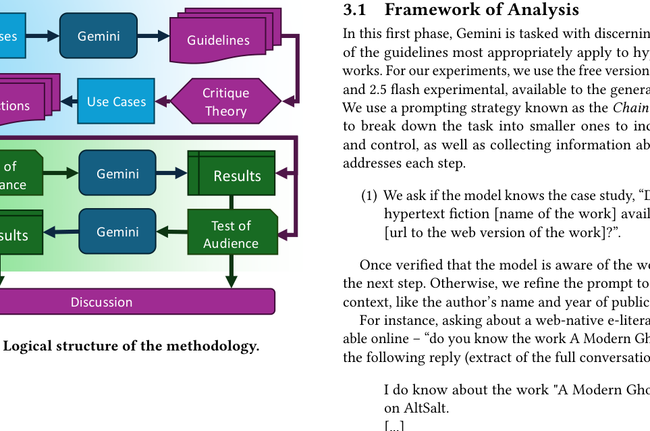
The concept of relevance is tied to the novelty and uniqueness of the content, considered both in relation to other content available on the same topic and to the value it can bring to specific users in terms of satisfied needs. In this view, the audience is the intersection between those who are explicitly identified by the author and those whose needs match the characteristics of the content.
Content within the same thematic niche is no longer differentiated by the level of detail, which can be easily improved by using generative tools and simply adding more related information without much effort (and making apparent the creator's effort is a fundamental aspect of the quality ranking). The differentiation necessary to increase the relevance of content arises from the style and tone of the text, its structure, and the unique personal and professional expertise reflected in it. More importantly, the new guidelines suggest that content is now also analysed as a medium through which the reader accesses the author's unique experience and perspective. In this view, content value for the audience comes from authorial expertise assessed according to "Experience, Expertise, Authoritativeness, and Trustworthiness" (EEAT) dimensions, or rather, in relation to the public narrative available for review across online sources about the EEAT of the author.
Following this underlying theory, we assume the new guidelines aim:
Restoring an authentic, humanist communication between creators and readers mediated by the content (in opposition to communication eschewed by impersonal, generic content with no originality in the thematic niche)
Making the tacit knowledge emerge from deeply personal experiences and perspectives matured in the day-to-day professional practices in a specific sector, and not usually depicted in formal publications.
3.1 Framework of Analysis
In this first phase, Gemini is tasked with discerning which aspects of the guidelines most appropriately apply to hypertext creative works. For our experiments, we use the free version Gemini 2.0 flash and 2.5 flash experimental, available to the general public for free. We use a prompting strategy known as the Chain of Thought [17] to break down the task into smaller ones to increase precision and control, as well as collecting information about how the AI addresses each step.
We ask if the model knows the case study, "Do you know the hypertext fiction [name of the work] available at this link [url to the web version of the work]?".
Once verified that the model is aware of the work, we move to the next step. Otherwise, we refine the prompt to introduce extra context, like the author's name and year of publication.
For instance, asking about a web-native e-literature work available online – "do you know the work A Modern Ghost?" – prompts the following reply (extract of the full conversation):
I do know about the work "A Modern Ghost" listed on AltSalt.
>
[...]
>
Based on this information, I can confirm the following:
- It is a work by Artmayu Studios.
- It has received recognition and has been shortlisted for several awards:
- New Media Writing Prize 2017 (Shortlisted)
- Opening Up Digital Fiction People's Choice Award 2017 (Shortlisted)
- It is featured in the upcoming Electronic Literature Collection Volume 4 of ELO.
- It was presented in the Wordhack anthology by Babycastles Art Gallery.
- The description starts with the sentence: "Above the mirror, small and low, hung a fluorescent bulb..."
We ask Gemini to analyse the relevance of the work in light of the latest Google review and helpful content guidelines.
The prompt generates a structured answer, including a context analysis about the nature of the work, the publisher and other relevant facts. Following, Gemini describes its application of the two guidelines to the work, highlighting "potential areas for consideration" and a summary.
Following the previous example about A Modern Ghost, Gemini remarks that "its recognition suggests a certain level of quality and originality" but also that "the platform hosting it (AltSalt) should also provide a transparent and accurate representation of the work". In its summary, Gemini clarifies that "a well-crafted piece of digital literature like A Modern Ghost would likely align with the spirit of Google's helpful content guidelines by focusing on providing value to its audience through creative and engaging content".
We use the structured feedback of Gemini to compile the set of questions and general principles that will be consolidated into the critique theory we use to analyse the case studies. Gemini extracts from the guidelines questions like:
Is it created for a human audience? Given that it's a work of art, the primary purpose is likely to engage and provide an experience for a human audience. The content should be designed to be interesting, thought-provoking, or entertaining.
The critique of case studies evaluates which elements of the current iteration of web remediation contribute positively or negatively to a potential assessment, making qualitative predictions of their reception by the new version of the Google search engine.
Following the example, predictions address the type of experience and barriers to the audience. For instance, the work provides a unique experience that is a key element of this e-literature work. The accessibility of the work by an AI should be easier than a more complex hypertext work, as the reading experience is linear. A point of concern could be the heavy use of animations that, if not optimised, can slow the loading time. Similarly, the experience may not support different types of devices – it is not responsive – to its detriment. It is uncertain, however, how those positive and negative factors weigh in the final result, and if it is understood that the uniqueness of the work of art provided experience could be in the way of website performance and therefore, to be prioritised in a final evaluation.
3.2 Evaluation
The evaluation phase tests the predictions produced through the critique of the use cases against their actual relevance and perceived target audience (accordingly to the guidelines criteria).
The assessment makes use of a fresh Gemini session[^2] to carry out a relevance test first, followed by an audience test. The relevance text focuses on the novelty and uniqueness of the content, while the audience test focuses on the target audience already identified for the business/author and the discovery of new potential audience niches to target with the tested content or its future variations. The results of the two tests are then compared with the predictions to revise and generalise our findings into a discussion comparing the characteristics of classic hypertext against the novel Google approach to assessing web content.
[^2]: A new session is necessary to avoid the AI parroting back to us our elements from our previous conversation.
3.2.1 Relevance Test
Content needs to be available on the web and accessible to AI crawlers. To reduce the risk of misunderstanding, the prompt includes the title and the work's URL. A preliminary step is needed to check if the work is known to Gemini[^3]. However, in our tests, it was never necessary, as the feedback to the first Prompt 1 includes descriptions and facts that a person familiar with the work can easily spot if the AI refers to the same work. This approach may need reconsideration in the case of an automated analysis pipeline that does not involve a human check between Prompt 1 and Prompt 2.
[^3]: AI cannot be trusted as it does not discriminate between existing and hypothetical content.
The relevance test includes the following two prompts:
Prompt 1: "What's original in this content [title] accessible at this link [URL]". Gemini will provide a detailed list of the [original aspects of the content]. Then, take or produce a description.
Prompt 2: "How to transform this introduction [description] to clarify what makes the full text stand out: [original aspects of the content]". Gemini will provide a list of options for rephrasing the introduction by incorporating a more explicit communication of the text's unique contributions.
Following, we check the recommendations provided by the AI about the [original aspects of the content] against our predictions. The idea is that recommendations are a proxy to understand what is considered weak or misaligned.
3.2.2 Audience Test
Predictions about the audience are structured as a short description of the key features of relevant personas or a list of users' segments, the [audience].
Prompt 3: "Considering the potential target: [audience]. What elements of this text satisfy informational, transactional, navigational, and localisation needs of their web search on the topic of [text topic]?"
Prompt 4: "How to incorporate in the introduction these elements of relevance for the intended target?"
Prompt 5: "What segment of users could find this text useful and relevant, beyond the intended [list of targets]."
Prompt 6: "How to restructure the text to be explicitly relevant for [new niche]"
The prompted recommendations from the AI unveil whether our predictions are sound with the AI understanding of the work or not. Small suggestions are interpreted as positive results, while articulated feedback provides evidence of what part of the work is not perceived as aligned and who should, in the AI understanding, be the target. For our case studies, the target was defined as "hypertext scholars, digital humanists, literary critics and experimental novel readers".
4 Case Studies
The early works of hypertext fiction published by Eastgate Systems in the 1990s and early 2000s are available today in three forms. In most cases, contemporary readers can still purchase the original software sold by the publisher, distributed on CD-ROMs and 3.5" floppy disks. These editions can only be read on original hardware or through emulators.
The second group comprises works that are no longer available in their original formats — unreadable on current Windows and Mac OS — but have been ported to the latest version of Storyspace 3. These editions run on Apple's OS X or later systems and are shipped on USB drives. Currently, only afternoon, a story and Patchwork Girl are available in this format.
The third group includes modern editions of the original hypertexts, now available online for free. This growing collection of media translations of pre-Web, stand-alone hypertext fiction includes Figurski at Findhorn on Acid by Richard Holeton, Victory Garden by Stuart Moulthrop, Uncle Buddy's Phantom Funhouse by John McDaid, and Twilight, A Symphony by Michael Joyce.
In both the first and second scenarios, only meta-commentary and brief excerpts of the works are accessible for human and machine reading. In the third case, however, the full texts are available along with updated introductions, navigation tools, layouts, and visual presentation. Our Gemini relevance and audience tests targeted both scenarios to assess their compliance with Google's new content guidelines.
When approaching Gemini and its discourse with the ranking algorithm, we assumed that the disruptive and experimental use of linking and navigation in literary hypertext would be counterbalanced by strong authorial intent, editorial curatorship, and other traditional markers of hypertexts published by Eastgate Inc. One of the secondary goals of our study was to examine how these traditional relationships between artistic expression and web usability are being re-evaluated and remediated by AI.
4.1 Shelley Jackson's Patchwork Girl
Patchwork Girl by Shelley Jackson, a well-known and much-discussed hypertext fiction from 1995, belongs to the second of the three groups of early digital works. The work reimagines Mary Shelley's Frankenstein and Baum's The Patchwork Girl of Oz, employing a non-linear structure to explore themes of fragmentation and identity formation. It has been ported to Storyspace 3, ships on a pendrive, and can be read on any Apple computer with modern Mac OS. As a stand-alone, and copyright-protected app, the full text of Patchwork Girl, its hypertext structure and visuals are not available online.
When asked about the work, and given the link to the publisher's site, Gemini confirmed its awareness of the nature, the genre, and the context as a "significant work of electronic literature" and a "key example of hypertext fiction". It correctly identified the work as a modern reimagining of Mary Shelley's Frankenstein and Frank Baum's The Patchwork Girl of Oz. It also listed out all its key aspects: non-linear narrative, intertextuality, visual elements, themes of identity and fragmentation and the cyberfeminist perspective.
In the relevance test, Gemini acknowledged the "nuanced" status of the work when it comes to its direct relevance to the latest Google review and helpful content guidelines. Firstly, because the guidelines are designed to evaluate website content, secondly, because the work's primary focus is artistic and exploratory and thirdly, because there aren't Google reviews associated with the work or with the publisher's introduction to it. However, it was able to confirm the established views on hypertext fiction as "people-first", authoritative, with original content and offering the "genuine experience" to the contemporary audience:
The enduring relevance of Patchwork Girl lies in its pioneering exploration of hypertextuality, its innovative reimagining of literary classics, and its insightful engagement with themes that continue to resonate in our increasingly digital and interconnected world. It serves as a benchmark for understanding the creative potential of digital media in storytelling, even if it doesn't directly align with the specific criteria Google uses to rank web content today.
In the second part of the test, when asked to suggest improvements in the way the work is presented to meet informational, transactional, navigational and localisation needs of the targeted audience (of hypertext scholars, digital humanists and literary critics), Gemini listed numerous aspects of the work to be explicitly mentioned. To better meet the informational needs of the audience, illustrating key concepts about the work and its historical significance was suggested. For improving transactional needs Gemini suggested providing a direct link to the work (sic!) for scholars "to engage directly with the subject of their research", to frame the text as a "transactional object" and to promote the experiential aspects of interacting with the hypertext as a form of transaction with the genre itself. Such articulated feedback provides evidence that the content of paratexts does not convincingly align with its target audience.
There were just two suggestions for improving navigational needs: to demonstrate on the work's web page the various links, maps and structural elements of the work, and to highlight "challenges and opportunities for navigating non-linear narratives" via multiple entry points. Finally, when asked to improve the "localisation" needs of users, Gemini admitted that "localisation" in the traditional sense of language or cultural adaptation is not applicable and suggested a "metaphorical" angle to the task. Here it responded in a characteristic verbal fluff: "multifaceted" nature allows Patchwork Girl to be "localised" within the diverse intellectual contexts (of individual scholars and readers).
Lastly, when prompted to suggest additional segments of users beyond the intended target, Gemini produced four possible groups: (a) Creative Writers and Storytellers, (b) Game Designers and Interactive Media Developers, (c) Educators and Students from other disciplines beyond literary studies and – another verbal fluff – (d) "Individuals Interested in the Intersection of Technology and Art". In summary, Patchwork Girl was identified as a work that could benefit those who build lore and design branching structures in video games, help understand intertextuality and visual communication, and understand reader agency and multimodality.
4.2 Richard Holeton's Figurski at Finhorn on Acid
Richard Holeton's Figurski at Findhorn on Acid belongs to the third of the identified groups of early hypertext fictions – fully available online thanks to their online modernised editions. The work is a sprawling, satirical hypertext centred on an absurd quest for a mechanical pig. Its structure accommodates both sequential reading via an index and non-linear exploration, at the reader's discretion. Published by Eastgate Systems in 2001 on a CD-ROM with versions for Mac OS and Windows, Holeton's work was one of the last major hypertext novels created in Storyspace 2. The satirical story about Frank Figurski's quest to acquire a legendary mechanical pig is read through an orderly sequence of lexias delivered via the Navigator, a bespoke content index, or through a hop-scotch poetics of non-linear exploration of the novel's three main characters, three distinct artefacts, and three specific locations.
The web edition comes with expanded meta-commentary that includes essays by Richard Holeton and literary critic Michael Tratner (a critical essay titled "The Distinctive Quality of Holeton's Hypertext"). The link to the Introductions was given to Gemini with the same questions about relevance and audience. Very early in its evaluation of the work, Gemini revealed its inability to read Figurski... directly, even though links to the text proper were available in the Introductions. For example, after identifying that Unconventional Juxtaposition, Exploration of Contrasting Realms, and Potential for Surreal and Absurdist Narrative were unique elements of Figurski..., Gemini concluded:
The combination of these elements strongly suggests a narrative that will embrace surrealism, absurdity, and possibly dark humour. This willingness to venture into unconventional territory is a significant aspect of its originality.
This meta-reading of a contextual, sociological type (and not, for example, a close-reading type) remained consistent even after several attempts to make the model read the hypertext, just as a human would, by following links. Gemini refused to follow links in any order. During the next steps, only three elements to satisfy the informational needs of users were suggested: exploration of non-linearity, hybridity and intertextuality, and experimental narrative.
Gemini listed two transactional needs, Potential for Interactive Interpretation and Source Material for Analysis, with elaboration of the former:
"While the provided text might be linear in its presentation, the concept itself lends itself to hypertextual interpretation. Scholars might use it as a basis for exploring how such a narrative could be transformed into an interactive, multi-path experience. The text could inspire the creation of digital projects that visualise the complex relationships between the story's elements."
Similarly short and vague suggestions were presented in the transactional needs section: potential for interactive interpretation and source material for analysis ("Literary critics and digital humanists could use the text as source material for analyzing how narrative structure, character development, and thematic exploration are affected by the juxtaposition of seemingly incompatible elements"). Gemini suggested that the navigational needs of users could be met by conceptual mapping of the text and an understanding of its "narrative pathways."
Thanks to the explicit connection to a real-life location — the Findhorn community and farm in Scotland — Gemini was able to suggest not only a "metaphorical" perspective on localisation, as in the case of Patchwork Girl, but also a more historically oriented one:
"For those interested in the cultural context of the Findhorn Foundation or the history of psychedelic literature, the text provides a specific localised setting and thematic focus. The text provides a location of setting, which is a key part of localisation. The setting of the Findhorn Foundation is a very important part of the story."
Just as with Patchwork Girl, Gemini was at its most elaborate when asked to identify new segments of the audience. In this case, the range of new target groups doubled: (a) Individuals Interested in Counterculture and Psychedelic Literature, (b) Readers Interested in Spiritual and New Age Themes, (c) Technology and Digital Art Enthusiasts, (d) Philosophy and Consciousness Studies Enthusiasts, (e) Creative Writers and Storytellers, and — finally — (f) Those Interested in the History of Digital Literature.
5 Discussion
5.1 On Case Studies
Shelley Jackson's Patchwork Girl is not available online. However, when evaluated by Gemini AI for relevance to Google's "Experience, Expertise, Authoritativeness, and Trustworthiness" (EEAT) dimensions, Patchwork Girl was recognised as a foundational piece of electronic literature ("people-first", original, authoritative) though not directly aligned with current web content standards due to its artistic orientation and offline distribution.
Gemini's relevance testing produced insights on how the presentation of the work might be enhanced for scholars and readers by framing it as an experiential and transactional object and better visualising its structural and navigational affordances. Despite struggling with localisation in a traditional sense, Gemini suggested metaphorical localisation within scholarly contexts. It also identified broader potential audiences who might draw inspiration from its narrative mechanics and intertextual complexity.
Richard Holeton's Figurski at Findhorn on Acid (2001), by contrast, is available online in a modernised edition, complete with critical commentary. However, Gemini struggled with a lack of insight into link structure and navigation. Its greatest strength was in the identification of new audiences.
The relevance test of the two hypertexts confirmed the high scores when assessing both contents according to the EEAT. The public narrative available online represents their value built over more than two decades as well-known works and authors in the literary niche of experimental fiction. From this point of view, hypertext fiction remains a source of authentic, humanist communication, even if its original text—as is the case with Patchwork Girl—is accessible neither to AI nor to the average reader. In both cases, Gemini's recommendations for improvement focused on aligning the content structure more closely with SEO principles, algorithmic regulation and homogenised web aesthetics—an approach in direct contrast to the "thought-provoking" and "entertaining" qualities of the works themselves, which Gemini acknowledged on several occasions.
The audience test revealed the benefits of AI's remediated curatorship—particularly its ability to deliver homogenized target evaluations, whether the object is the entire work, its introduction, or even surrounding paratexts. The result is targeted suggestions that may exceed traditional scholarly or curatorial expectations. This remediated expression of the web—as an agent executing its own objectives, which may not align with those of readers or writers—is both self-serving for platforms like Gemini (driving more audience and traffic) and beneficial for the work itself, which AI situates within a "cultural niche".
In its current iteration, Gemini was not able to properly traverse a work of hypertext fiction in the sense and methodology presented by Grigar and Moulthrop [10]. When prompted to follow links—either in order of appearance or at random—to create a reading report, the model refused to cooperate. This anti-hermeneutic and anti-aesthetic mode of reading, which accumulates and summarises knowledge about a work, its historical context, and its reception, is—paradoxically—beneficial for hypertext fiction as a genre. It does not matter whether a given work has been released as a web edition with its original text fully available online and free of charge. What matters is the quality of the paratexts and the symbolic capital that a work — and its author — accumulates over time. This is good news for curators, publishers, archivists, and scholars of early digital narrative. Even without access to a work in its original form, and even without the text itself available to readers, AI can offer contemporary audiences a valuable cultural reading — provided that high-quality introductions, repository entries, and other contextual materials are available.
Extended introductions—such as those accompanying the web edition of Figurski at Findhorn on Acid (Tratner's essay, titled The Distinctive Quality of Holeton's Hypertext, being informative in its own right)—serve as essential scaffolding for AI-assisted assessments. One might assume that such a paratextual apparatus would give Gemini an advantage in evaluating Figurski. However, this assumption did not hold. Gemini's responses to prompts about Figurski were strikingly similar in scope and insight to its responses regarding Patchwork Girl – the work with full text not available online, and its sample introduction being a short entry in the ELO Repository.
While Figurski benefited from a more substantial introduction, this did not necessarily yield a broader or more refined list of key narrative elements, nor did it expand the variety of interpretive angles Gemini provided. What mattered more was the inclusion of additional contexts, such as references to psychedelic culture and countercultural movements. These elements appeared to stimulate the model's generative capacity in more creative directions, potentially attracting new, culturally curious audiences. In both cases, however, Gemini exhibited a tendency to rely on semantic fillers and list-making patterns. The model's proclivity for enumerative responses often led to a noticeable decline in quality and relevance toward the lower items on these lists.
5.2 On the Research Questions
What can today's authors learn from classic hypertext fiction to stay relevant and reach an audience?
Before 2025, website visibility was nominally related to the depth and popularity of content (albeit with some tweaking). The new Google web prioritises serving four main user intents, as defined by Google (Information, Transaction, Navigation, Localisation). Notably, aesthetic experiences and creative expression are excluded. However, the final result may still favour an early hypertext approach that weaves together structure and content into carefully crafted literature-grade works, a stark contrast to standardised websites, because those experiences cannot be remediated into conversations with AI but require direct engagement of users.
Structured and highly standardised informational websites are the favourite of the new quality guidelines. However, those very websites are the most at risk of being remediated by AI and no longer being visited by users. Hence, it seems the best chance to keep websites relevant (and recommended for direct visit by AI) is to provide unique experiences to users, hard or impossible to remediate via AI, while being automatically recognised as valuable to an audience. Nevertheless, Google is yet capable of identifying such unique experiences, as evidenced also in the second case study, hindering the findability and accessibility of those experience-focused websites.
The Web excluded Flash for technical reasons, while unique websites may be penalised – despite the accessibility-oriented web standards[^4] – as not falling into any of the four main intents and not trully compatible with the parameters of the quality ranking guidelines.
[^4]: A stack that specifically overcomes the technical challenges of Flash to search engine crawlers
Worth discussing explicitly are parameters such as speed, direct funnelling, deception and fluid navigation that in classic hypertext do not have such a negative semantics but, instead, belong in the artist's toolbox.
Speed. Loadings, puzzle solving or amazement that slow the reading to allow reflection, from Google's perspective, are signs of poor user experience.
Funnelling. Playing with users' expectations and driving them away from their initial goals, from Google's perspective, is the failure of serving users' intent.
Deception. Implicit meaning conveyed through contrast and explicit media dissonance between text, images or sound, from Google's perspective, signifies deceptive content.
Navigation fluidity. Classic hypertext narrative seeks exploration of multiple choices and alternative paths, from Google's perspective, generating disoriented users jumping back and forth.
A positive result is that Gemini is capable of going beyond the boundaries of Google's strict quality evaluation framework. For instance, during the audience tests, Gemini provided elaborate answers identifying new audiences based on intent other than Google's four, such as belongingness and spiritual consciousness of people "Interested in Counterculture and Psychedelic Literature". However, Gemini seems not to transfer the identification of those needs into a correct assessment of websites satisfying those needs through unique experiences.
Finally, can AI understand non-linear hypertext works?
Gemini's analysis of the online edition revealed significant limitations in processing the actual hypertextual structure, instead offering a sociological meta-reading. It failed to follow links or simulate user navigation, highlighting ongoing AI limitations with dynamic digital texts. Suggestions for improving informational value focused on explicating its non-linearity, hybridity, and narrative experimentation. The work's connection to the real-world Findhorn community enabled a more concrete localisation assessment, grounded in cultural and historical specificity. Gemini again made recommendations for expanding the potential audience for this work.
Google's approach to web content is quite compatible with literary hypertext (at least as far as its own AI is concerned). While sharing the challenges of indexing that plagued Flash, what material could be accessed was readily understood in its correct literary context. Indeed, the analysis went further, suggesting interested audiences and potential adaptations that would bring greater engagement without unnecessary imposition on the fundamental creative and aesthetic approach.
Worth remarking on is the 'parroting' behaviour of AI: assessing the relevance or quality of a work based on the review and description of that work that are found online, not the result of a first-hand analysis of its intrinsic characteristics. This behaviour is, in essence, akin to the old web skewed toward popularity (also known as the rich gets richer effect). AS such, AI is mostly unequipped to assess the new works and authors that lack external social recognition.
6 Conclusions
In this contribution, we provided a first account of the future web based on the hypothesis that websites will drastically change to survive the AI remediation by incorporating features and the aesthetics of early hypertext fiction. To this end, we developed a research methodology to investigate the AI's understanding of content against the guidelines that it is supposedly implementing. This methodology can be used as a reference for the Hypertext community of authors, curators and scholars about how to engage with AI search engines, as the new web distribution paradigm, to either optimise content curation or evaluate hypotheses about audience and reach.
Our exploratory study is of crucial relevance and timely, providing a look into the future that is likely to emerge from Google's new system, deciding what is relevant and for whom. The case studies highlighted the technological gap that still exists between the opportunity of providing unique web experiences and the ability to assess and make discoverable those experiences based on non-standard structures and complex engagement tactics (misunderstood as poor user experience at best or fraudulent at worst).
Beyond the technical challenge, the fundamental issue is that Google does not recognise authoriality and the author's intent in its quality assessment (hence the misunderstandings). Instead, Google reduces quality to serving users' basic purposes in a retail logic, neglecting higher needs like belonging, flourishing, validation, relationships, or self-cultivation. Coherently, in Google's view, users seem to engage in consuming content or buying only, never to enter into a selfless communion with others, like an author, that does not fulfil an immediate need (a transactional "conversion"). In this view, those needs could be satisfied within social media or private platforms such as Substack or Discord. However, if websites must foster in-depth relationships between authors and readers to overcome the AI remediation, Google must expand its perspective on users' intent to account for the relational needs and authors' diversified creative intents.
Why does it matter? Authors write to be read, and distribution is central to the maintenance of a literary economy, fueled by high-quality content. "The authoring problem is a publishing problem", as Mark Bernstein [4] puts it, while the sustainability of creating literary hypertext is a common theme in commentaries on Twine [11, 15]. As AI search engines replace the web of links, a new paradigm based on the AI's ability to read and interpret connections within and across unconventional contents becomes the new distribution infrastructure and the inevitable dominant mode of discovery and engagement. As such, to empower and support authors, our attention must be, as Bernstein would probably say, on the mechanisms and consequences of this new distribution infrastructure.
Google's framework is probably a necessary corrective action against the flooding of AI-generated generalist content. However, its inability to read and interpret the intent of human creative authors and correctly assess their work will leave high-quality creative content as disconnected islands. The end result will actually be against the aim of Google's effort for a utopian web of human-centric, high-quality content, discouraging authors from publishing works that would never reach their audience.
Who wins and who loses? The picture is complex. AI agents like Gemini are well-equipped to recognise the literary qualities of hypertext only when emerging secondary sources in the form of social reading. However, social reading cannot be possible (or very reliable) for novel works that lack the needed historical context. On the one hand, it is too early to see if overcoming the technical challenges (enabling a direct reading and assessment of complex non-linear content) will actually result in boosting the discoverability and access to hypertext-like websites. On the other hand, an acceptance right now of EEAT dimensions is a tacit acknowledgement that Google is in a position to impose its own aesthetic judgment when determining what is and is not worthy of attention. We will willingly seek out the advice of a librarian when we need help, but not at the expense of freely wandering the stacks.
References
Mark W. R. Anderson and David E. Millard. 2023. Seven Hypertexts. In Proceedings of the 34th ACM Conference on Hypertext and Social Media: The Humanity Within (Rome, Italy) (HT '23). Association for Computing Machinery, New York, NY, USA, Article 42, 15 pages. https://doi.org/10.1145/3603163.3609048
Alessio Antonini. 2023. Positive by Design: The Next Big Challenge in Rethinking Media as Agents?. In Proceedings of the 34th ACM Conference on Hypertext and Social Media: The Humanity Within (Rome, Italy) (HT '23). Association for Computing Machinery, New York, NY, USA, Article 40, 4 pages. https://doi.org/10.1145/3603163.3609068
Alessio Antonini and Samuel Brooker. 2020. Mediation as Calibration: A Framework for Evaluating the Author/Reader Relation. In Proceedings of the 31st ACM Conference on Hypertext and Social Media: HYPERTEXT for Social Good (Orlando, FL, USA (virtual)) (HT'20). Association for Computing Machinery, New York, NY, USA, 17–25. https://doi.org/10.1145/3372923.3404789
Mark Bernstein. 2022. The Authoring Problem is a Publishing Problem. In The Authoring Problem, Charlie Hargood, David E. Millard, Alice Mitchell, and Ulrike Spierling (Eds.). Springer, Cham. https://doi.org/10.1007/978-3-031-05214-96
Jay David Bolter. 2001. Writing Space: Computers, Hypertext, and the Remediation of Print (2 ed.). Lawrence Erlbaum Associates, Mahwah, NJ.
Jay David Bolter and Richard Grusin. 1999. Remediation: Understanding New Media. MIT Press, Cambridge, MA.
Sam Brooker. 2022. Is there an Author in this Labyrinth?: Hypertext Fiction and Farrell's Textual Fallacy. In Proceedings of the 33rd ACM Conference on Hypertext and Social Media (HT '22), June 28-July 01, 2022, Barcelona, Spain. ACM, New York, NY, USA, 8 Pages.
Samuel Brooker and Alessio Antonini and. 2025. On the aesthetics of hypertext: a case study on names and a general framework. New Review of Hypermedia and Multimedia 31, 1-2 (2025), 7–29. https://doi.org/10.1080/13614568.2025.2463889
Google Search Central. 2025. Creating Helpful, Reliable, People-First Content. https://developers.google.com/search/docs/fundamentals/creating-helpful-content. Accessed: 2025-04-29.
Dene Grigar and Stuart Moulthrop. 2015. Pathfinders: Documenting the Experience of Early Digital Literature.
Alison Harvey. 2014. Twine's Revolution. GAME: The Italian Journal of Game Studies 3 (2014). https://www.gamejournal.it/3harvey/
George P. Landow. 1992. Hypertext: The Convergence of Contemporary Critical Theory and Technology. Johns Hopkins University Press, Baltimore.
Lawrence Lessig. 1999. Code and Other Laws of Cyberspace. Basic Books, New York.
Rebecca MacKinnon. 2012. Consent of the Networked: The Worldwide Struggle for Internet Freedom. Basic Books, New York.
merritt kopas. 2015. Videogames for Humans. Instar Books, New York, NY.
Anna Mladentseva. 2022. Responding to obsolescence in Flash-based net art: a case study on migrating Sinae Kim's Genesis. Journal of the Institute of Conservation 45, 1 (2022), 52–68. https://doi.org/10.1080/19455224.2021.2007412
Jason Wei, Xuezhi Wang, Dale Schuurmans, Maarten Bosma, Fei Xia, Ed Chi, Quoc V Le, Denny Zhou, et al. 2022. Chain-of-thought prompting elicits reasoning in large language models. Advances in neural information processing systems 35 (2022), 24824–24837.
Tim Wu. 2010. The Master Switch: The Rise and Fall of Information Empires. Alfred A. Knopf, New York.
Do you like what you are reading? Subscribe to receive updates.
Unsubscribe anytime