
Co-constructed readings of the Internet: voyaging on a digital storytelling platform
Nayana Prakash (Oxford Internet Institute, University of Oxford, Oxford, UK — nayana.prakash@oii.ox.ac.uk)
Published in HT '23: 34th ACM Conference on Hypertext and Social Media · DOI: 10.1145/3603163.3609070 · License: © Copyright held by the owner/author(s). Publication rights licensed to ACM.
Keywords: Digital storytelling, navigation, reading, travel, writing
Session: Authoring, Reading, Publishing: Web reading
Conference: HT '23
Abstract
Using the oft-cited metaphor of hypertext and electronic fiction as a voyage for the reader, this paper considers the theme and practice of voyaging and map-reading on the digital storytelling platform Voices of Rural India, an Indian rural platform that uses stories to invite tourists to visit. This website embodies the theme of travel and tourism while also allowing readers the opportunity to navigate through the digital platform. Using sitemaps and close readings of the stories in the platform, this paper considers the notion of “community storytelling” and whether digital storytelling can be used to empower the reader, as well as the other parties involved in the creation of a text. This research builds on hypertext theory and scholarship in the area of collaborative writing and co-authorship, while arguing for new concepts of collective writing and media creation.
1 Introduction
“Fare forward, you who think that you are voyaging…” T.S. Eliot, The Dry Salvages, 1941
So unusual is the experience of reading hypertext fiction that it is oten described by comparison to the experience of doing otherthings, some of them very different to the practice of reading. In Michael Joyce’s 1992 essay, for example, the hypertext pioneerrefers to reading electronic fiction as everything from playingwith “children’s rolypoly pushover toys” to an image emergingfrom a chemical bath in the darkroom “in present tense, fullfocused…ablink” [9]. In this paper, I draw particularly on a simileused by Howard Becker (and countless others) in a conferencelecture given in Lisbon. Becker notes that “The experience of[hypertext fiction] is more like consulting a map than it is [likereading]” [2]. The themes of navigation and the reader’s choicesare thus emphasized not only by Becker, but by other scholarssuch as George Landow [10] However, I argue that it is not purelyvoyage that Becker refers to here, but also the co-construction ofthis journey. It is only in the user’s reading of the map that themap takes on significance; Farrell refers to this as the “textualfallacy”, that “the text is meaningful purely on its own” [5]. Thereader and the map thus depend on each other to co-constructmeaning. The mapmaker – whether analogue or digital –populates the map with symbols that they know the reader willunderstand and see as shorthand for a variety of meanings.In this short paper, I consider first the concept of co-constructedmeaning between reader and writer, and the ways in which theexperience of reading online – whether via hypertext or otherforms of digital storytelling – can demonstrate this co-construction and co-creativity. In doing so, I use Barthes’argument for “readerly” and “writerly” texts [1], an oft-cited yetnecessary reference in hypertext studies, to better understandhow digital storytelling may converge reader and writer. In doingso, I argue for a closer consideration of this relationship and itsimplications in text-building, website-building, and the impact thereader can have on storytelling online.I focus my argument on my doctoral field site of digitalstorytelling platforms in India. Digital storytelling platforms inthis context are websites or apps which house and facilitate stories
written by amateur storytellers. They are not hypertext storytelling platforms, but hypertext theory and the features of hypertext – specifically, links – greatly inform my arguments on digital storytelling. I specifically focus on Voices of Rural India (voicesofruralindia.org) [12], a rural storytelling platform in India aimed at using local folklore, histories, and stories to attract tourists, for several reasons. Firstly, in reading Voices of Rural India (henceforth, VRI), I was struck by the common theme of voyaging in both practice and theme. The experience of navigating through the website and reading the texts echoed Becker’s discussion of hypertext as a map. The theme of tourism, too, features heavily in the stories on VRI, suggesting the way voyage and travel are created and woven through the digital texts. Secondly, the concept of community storytelling is central to VRI. The website emphasizes that the storytellers are telling stories about their rural community, from their rural community. They are supported, too, by the community of editors and volunteers who support the initiative, as encapsulated by the graphic below in Figure 1, from VRI’s website:
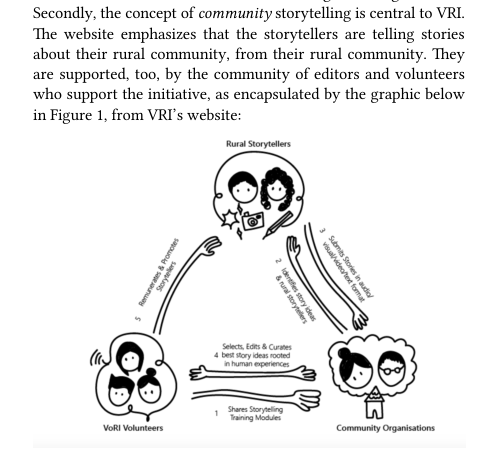
Figure 1 A graphic on VRI showing the relationship between community organizations, storytellers, and volunteers. Note the use of hands instead of arrows linking these segments.
I argue that one strand missing from Figure 1 is the reader/user, who is also seen as a potential tourist to the communities in Voices of Rural India. The reader is thus even more powerful than usual on VRI, not only as the co-constructor of meaning, but also as the more consumer-focused “target market” for the tourism embedded throughout the texts. VRI thus brings to life many of the elements of hypertext culture discussed earlier, from the voyage of reading to the dynamics between reader and writer, who are both central to the production and maintenance of the VRI website and initiative, along with editors, translators, and other volunteers. Finally, I focus on the metaphor of hypertext as map-reading because it both fruitful and laden with necessary historical context. Hypertext scholars rarely make mention of information geographies and inequalities between the Global South and Global
North in Internet access and production [8]; thus, I focus on a digital storytelling platform based in India, a former colony and more recently its own center of technological production. The act of mapmaking is historically not a neutral one; despite its presentation of knowledge and distance as reality, the map as a colonial artefact can shape this reality based on the limitations and biases of knowledge [8]. Mark Graham describes a 13th century navigational chart, the Carta Pisana, observing that the map depicts accurate information about the area it is local to (Italy), with scarcely any information at all about the world outside Europe [7]. Such lack of representation represents the limits of the mapmakers’ knowledge. If we are to compare hypertext to a map, then what are the limits of the hypertext voyage? Can the reader travel beyond the limits of the mapmakers’ knowledge? This short paper will begin to explore these relationships with reference to Voices of Rural India’s storytelling practice, while also arguing for the importance of future research into this realm of hypertext culture and Indian storytelling platforms.
2 Literature Review
As already discussed, the notion of empowered readers and the convergence of the reader/writer dynamic is not new to hypertext scholarship. Landow even notes that the reader-as-writer is “hardly strange” in the wider context of classical literature, since readers were encouraged to practice by mimicking experienced writers [13]. He is clear, however, that the empowerment of the reader does not automatically turn the reader into co-author. I agree with the framing of the term automatically, but will later question this notion; is solo authorship possible at all? Other writers note that the reader acting as navigator through hypertext destabilizes the authority of the text. Michael Heim argues that “as the authoritativeness of text diminishes, so too does the recognition of the private self of the creative author” [10]. The author’s sense of ‘self’ becomes less important as the reader takes on a more central role; the so-called ‘Death of the Author’ [2] is the extreme end of this argument. Yet it is not the death ofthe author, but the life of the reader, that invigorates my research.To that end, I focus instead on the notion of community orcollective storytelling, as described by Michael Joyce in his 1992essay:
Multiple fictions quite literally require collaboration by the reader of the hypertext to give meaning to the texts through her constant textual intervention and shaping, her construction of successive interpretive frameworks and her responses as a reader. [9]
This travelling reader, presented with “multiple forking paths” [2], is seen to be something of an architect in Joyce’s words, via the construction of interpretive frameworks. This is one depiction of the reader, but I turn instead to Barthes’ famous arguments for “readerly” and “writerly” texts; the adverbial forms of these words suggest a spectrum of reader and writer dynamics. Readerly content is fixed, linear, its meaning pre-determined. Writerly content enables the reader to take a role in constructing and
determining meaning. Barthes argues that the “ideal” text blurs distinctions between the reader and writer:
. . . the networks are many and interact, without any one of them being able to surpass the rest; this text is a galaxy of signifiers, not a structure of signifieds; it has no beginning; it is reversible; we gain access to it by several entrances, none of which can be authoritatively declared to be the main one; the codes it mobilizes extend as far as the eye can reach, they are indeterminable . . . ; the systems of meaning can take over this absolutely plural text, but their number is never closed, based as it is on the infinity of language [1]
If hypertext is a map, the text that Barthes describes is a map with no one path; it has “several entrances” is “absolutely plural” and never-ending. This sense of plurality and multiplicity can only be achieved if the text invites and enables the reader to be a writer. Not all digital storytelling can unlock this potential, but that which can suggests a voyage that is never-ending and unmappable in its infiniteness.
3 Method
This work uses close reading of digital storytelling websites (including paratextual elements of these websites, such as sitemaps), website walkthroughs and ethnographic “thick description” [6] to make rich notes on the experience of reading online [4]. I consider the flows and navigation on websites to consider how the reader’s movement between options and text form a narrative and journey. The stories on VRI take the form of short (1500 – 2000 word1) anecdotes typically reflecting on a specific aspect of life in the community the storyteller is from. These elements of community history are told through the lens of personal history; storytellers oten introduce themselves and their relationship with thecommunity before discussing the specific ritual, tradition,historical event, or site that is the focus of the writing. The storiesare not fictional, but they oten focus on superstitions or folklorein the community. All the stories on the website are interspersedwith scenic photos of landscapes – usually mountains or rivers –and heritage sites where relevant. Some of the stories also includeaudio clips (via Sound Cloud), video clips (via You Tube), ortranslations of the story. Such a mix of forms is impossible in printstorytelling, hence the use of digital storytelling to examine thelinks between the story and to make features such as translationand oral storytelling more viable.There are fity-one stories on Voices in Rural India. All of theseare available in English, with thirty-four stories available in Hindior Tamil text (or with Hindi audio). As these are the Indianlanguages I speak, I read through or listened to these texts in the
1 This word count does not include the word count of the work in translation, or indeed the words in the video or audio clips.
original language as well. I thus read all fity-one stories for the first time in English and the available Hindi or Tamil a second time in these languages. My work between languages was less of a straightforward translation – this is undertaken by Voices of India’s volunteers and translators – but rather an examination of moments of tension and ineffability across the texts and their translated counterparts.
4 Discussion
4.1 Mapping Voices of Rural India
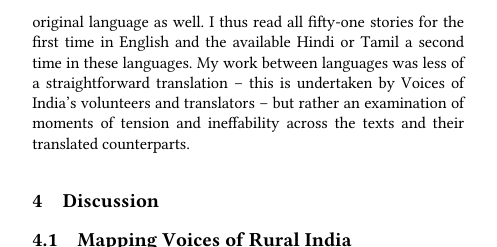
Figure 2 represents a sitemap I created to show the design of the VRI website. I built a sitemap of Voices of Rural India for several reasons. Firstly, as VRI is a relatively new and unfamiliar website to most readers of this paper, it was important to show my readers how the website functions and presents. As well as introducing the reader to the web design of VRI, I created a sitemap to show the navigation and flows of the website. This visual medium adds further detail to my ‘textured reading’ of the website. As mentioned, the sitemap indicates that different tabs on VRI are discrete and separate, rather than connected to each other. For example, one cannot travel from the ‘About’ section straight to ‘Stories’, and the Language options can only be used one at a time. Rather than a structure of flows, moving from one to another, the read experience of the VRI website is relatively linear; content is read mostly from top to bottom, and the reader/user is likely to move from let to right in using the website. It is thus different to most hypertext fiction in this way. In building the sitemap, I argue that the choices the website user makes are akin to the choices made in reading hypertext fiction. The website is dynamic; it exists to be read, travelled, navigated through. In the sitemap, the reader makes decisions about where to go first and where to go next. The path is not scripted; the reader decides where to travel – albeit with some nudges from the platform, the ‘map’ that allows the reader to stay on course. Not only can hypertext (or maps) not be read linearly, there oten is no linear reading at all. The reader/user can leave the website and return another time, choosing a different path and thus “reading” a different text, in making different choices. On Voices of Rural India, this journeying is practical – in terms of the navigational experience of being on a website – and thematic. The stories are explicitly written to ‘transport’ the reader to a different place; each story contains pictures of scenic landscapes and rural locales to further create this sense of distance. The forking paths of website navigation take the reader to different destinations across the website, and across India. The reader is a traveller, using a map and carving a unique path across the website, across stories, and across space.
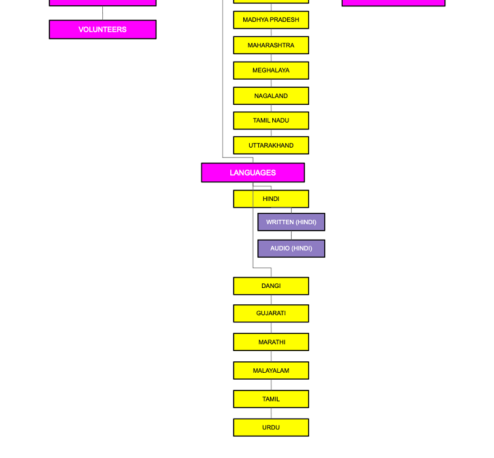
Figure 2: A sitemap I created of the web design on Voices of Rural India.
4.2 Community storytelling
If readers define and choose the paths of the website, and thus the aspects of the website they read, then the readers become part of the constant creation and re-creation of the website. This is itself a form of community storytelling. Voices of Rural India is an initiative that focuses on the construction of stories by multiple people, and the graphic in Figure 1 indicates the way the organisation sees its own work as being constructed by multiple ‘hands’. I argue that communal storytelling is embedded in VRI’s design, and that in the co-construction of building meaning and reading meaning into stories, the reader, and the storyteller both challenge ideas of ownership, and also disrupt notions of what the book “should” be. We, the users of the website, are part of the community both telling stories and reading them. In a more literal sense, this is gestured to on VRI’s website via the numerous tabs whereby users can participate in the initiative, via donation, volunteering, or other contributions. There are numerous ways to become involved in the labour of maintaining the initiative, and
KEY
Home page is in black Primary tabs are in blue Secondary tabs are pink Tertiary tabs are yellow Quaternary tabs are purple
ye
numerous ways to become a “part” of the community of storytellers referenced on the website. In the stories themselves, community is a central theme, existing as something to protect and preserve against external forces of change. The story “No Place Like Home”, for example, focuses on a storyteller who is deeply tied to his village and has chosen not to leave; he says:
I had no desire to study in an English medium school or to go abroad for higher studies. I completed my studies right in my native place in a government school and college. I never let go off [sic] an opportunity to connect with people here. [13]
The storyteller here is clearly satisfied with his choice but is also seemingly judgmental of those who “study in an English medium school or go abroad”. In “never letting go of an opportunity to connect”, the storyteller emphasises the importance of community and connection. Paradoxically, the community here exists as both a uniting force and one that isolates the storyteller from his peers, who have evidently let the village. Although the
text does not explicitly criticise the decision to pursue change and leave the community, the storyteller concludes by saying, “I’d rather be content living in my village and striving to make it better than chasing success and happiness elsewhere.” Like all stories on VRI, the storyteller’s words are punctuated by images of the community at hand:
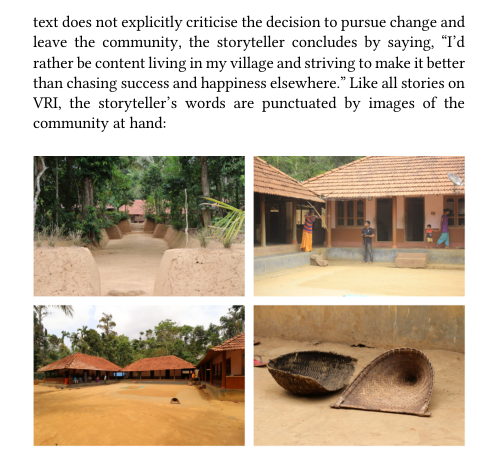
Figure 3: The community in Wayanad, as described in the story "No Place Like Home".
Some of the individual stories on Voices of Rural India have differing views on the concept of what community is and how it can be strengthened. Yet the stories are not meant to be read individually; we must consider the archive as a body of work of its own, where each story contributes a chapter in the larger book of Voices of Rural India. The ability to scroll from one community to another, or to quickly click from one story to another – as depicted in the ‘Site Map’ section – indicates the co-constructed nature of the archive. In this sense, VRI acts as a substitute for travel; the reader can click on a story and be ‘transported’ to a different place in India, a different village. The text does not merely encourage travel, it is a form of travel.
4.3 Co-constructed meaning
To a great extent, meaning is co-constructed across all forms of storytelling, not merely the digital. As Ursula Le Guin puts it: “Story is a collaborative art. The writer’s imagination works in league with the reader’s imagination…to fill in, to flesh out, to bring their own experience to the work” [11]. However, co-constructions of meaning take on a literal sense on VRI, where editors and translators work with the storytellers to draw out and form the stories. Though Brooker argues that editors do not have significant influence on art [3], this is not true on Voices of Rural India. Many of the stories on VRI are initially spoken or written in an Indian regional language, before being translated into English text; this necessarily alters both the form and the content of what is being conveyed. For example, in the story “How Love Has Changed Ater 4 Generations”, the storyteller tells the tale of her own marriage and the phenomena of ‘love marriages’ in her community. She notes, “The wrath of casteism is brutal in our
society and persists even today” [14]. This line is slightly different in the Hindi version of this story, which is the original. A better translation would be that “even today, there is a lot of pressure in/on the caste system”. The English translation exists as a more eloquent conclusion to this issue, while also providing emotive commentary on the issue of caste, by labelling it “brutal”. This seemingly minor edit reflects both the difficult task of translation as well as the ways in which the text is literally shaped by two people. In some stories, the storyteller “speaks” the story via a Sound Cloud excerpt, and the translator and editor formalise this into English text. This relationship between editor, translator and storyteller reflects the way meaning is made and shared between people. The storyteller has the original memory, the “plot” of the story; the editor may have the formal skills and technical knowledge to commit this to the website. The reader thus interacts with both parties when on VRI and is reading the stories of both.
5 Conclusion
“Not fare well, But fare forward, voyagers.” T.S. Eliot, The Dry Salvages, 1941
In this short paper, I have examined the theme and practice of voyaging and map-reading on the digital storytelling platform Voices of Rural India as a form of reading. I have also examined the notion of community and communal storytelling as both theme and praxis. In interacting with this platform, the reader of VRI is challenged by the notion of ‘solo authorship’, one which is typical in the world of print text. Landow argues that “long observed multiplicities of the self” [13] make it clear that hypertext and other forms of digital storytelling are not unique in their decentring of the author. I question whether solo authorship can exist at all. On VRI, the intentionality of the editors and volunteers who make up the organisation is crucial to the production of the texts. The reader is important as both the navigator of the website and in their more consumerist role as potential tourist to these locales. Thus, in a very literal sense, storytelling is necessarily a joint endeavour on Voices of Rural India. Even beyond this platform, however, the ideas in this paper should give us pause for thought on what it means to be a co-author, and what it can look like for a community to be a writer. Is a writer only the person who (figuratively, in the case of digital stories) puts pen to page? Other forms of power and agency can be held by readers and editors, the “community” that inspires the writer. In this sense, the collaborative nature of hypertext disrupts notions of “solo work”, or the individual author as the ultimate possessor and authority on their work. Future research in this field should delve more into the notion of collaboration as a beneficial, fruitful, and necessary act to be sought, as well as thinking about these in the postcolonial context which is oten missing from hypertext work. The reader is not blindly following a map, but rather writing their own route as they make a voyage together and forward with the storytellers of the text.
References
[1]Roland Barthes. 1974. S/Z: An Essay. Farrar, Straus and Giroux.
[2]Howard Saul Becker. A New Art Form: Hypertext Fiction. Retrieved May 3, 2023from https://www.uv.es/~fores/programa/beckerhypertextfiction.html
[3]Sam Brooker. 2022. Is there an Author in this Labyrinth?: Hypertext Fiction and Farrell’s Textual Fallacy. In Proceedings of the 33rd ACM Conference on Hypertextand Social Media, ACM, Barcelona Spain, 91–95.
DOI:https://doi.org/10.1145/3511095.3531285
[4]Barry Brummett. 2019. Techniques of Close Reading. SAGE Publications, Inc, 2455 Teller Road, Thousand Oaks California 91320.
DOI:https://doi.org/10.4135/9781071802595
[5]John Farrell. 2017. The Varieties of Authorial Intention: Literary Theory Beyond the Intentional Fallacy. Springer.
[6]Clifford Geertz. 1998. Deep Hanging Out. The New York Review. Retrieved January 19, 2021 from https://www.nybooks.com/articles/1998/10/22/deep-hanging-out/
[7]Mark Graham. 2014. Inequitable Distributions in Internet Geographies: The Global South Is Gaining Access, but Lags in Local Content. Innov. Technol. Gov. Glob. 9, 3–4 (July 2014), 3–19. DOI:https://doi.org/10.1162/inova00212
[8]Mark Graham. 2015. Information Geographies and Geographies of Information.Retrieved July 27, 2023 from https://papers.ssrn.com/abstract=2666227
[9]Michael Joyce. 1992. A Feel for Prose: Interstitial Links and the Contours of Hypertext. Writ. Edge 4, 1 (1992), 83–101.
[10] G.P. Landow. 2006. Hypertext 3.0: Critical Theory and New Media in an Era of Globalization. Johns Hopkins University Press. Retrieved from
https://books.google.co.uk/books?id=exz QDHI8rp QC
[11] Le Le Guin. 2004. The Wave in the Mind: Talks and Essays on the Writer, the
Reader, and the Imagination. Shambhala Publications, Boston.
[12] Voices of Rural India - A curated platform for rural storytellers. Retrieved July
28, 2023 from https://www.voicesofruralindia.org/
[13] No Place Like Home - Voices of Rural India. Retrieved July 28, 2023 from
https://www.voicesofruralindia.org/no-place-like-home/
[14] How Love Has Changed Over Four Generations - Voices of Rural India.
Retrieved July 28, 2023 from https://www.voicesofruralindia.org/how-love-has-changed-over-four-generations/
Do you like what you are reading? Subscribe to receive updates.
Unsubscribe anytime