
Name Links: an Aesthetic Discussion
Alessio Antonini, The Open University, Milton Keynes, UK (alessio.antonini@open.ac.uk) · Sam Brooker, University of the Arts London, London, UK (s.brooker@lcc.arts.ac.uk)
Published in HT '23: 34th ACM Conference on Hypertext and Social Media · DOI: 10.1145/3603163.3609039 · License: CC BY 4.0
Authors: Samuel Brooker, Alessio Antonini
Keywords: aesthetics, links, names, semiotics
Session: Authoring, Reading, Publishing: Hypertext Authoring
Pages: spit
Conference: HT '23
Abstract
A correspondence between the link in hypertext and the sign (both semiotic and linguistic) is well established. Consisting of source and destination, links parallel the signifier and signified of the semiotic and linguistic sign, as they do wider models and approaches to intertextuality. Deeper investigation of the connection between the sign and the link is, however, a currently rather neglected area for hypertext. Better understanding the complexities of the semiotic sign, however, can be beneficial for the epistemology of hypertext and more generally for understanding the complex meaning the link engenders.
To link or not to link - and to what - is an equivalently nuanced question for hypertext. In closed hypertext, such decisions are, while important, more limited in scope; in open hypertext, however, links represent a form of delegation (or sharing) of authority and responsibility. This contribution explores this aesthetic dimension of hypertext design, through reference to the semiotics of names developed through a case study on name links.
CCS CONCEPTS
• Human-centered computing → Hypertext / hypermedia.
KEYWORDS
names, links, aesthetics, semiotics
ACM Reference Format
Alessio Antonini and Sam Brooker. 2023. Name Links: an Aesthetic Discussion. In 34th ACM Conference on Hypertext and Social Media (HT '23), September 4–8, 2023, Rome, Italy. ACM, New York, NY, USA, 6 pages. https://doi.org/10.1145/3603163.3609039
1 INTRODUCTION
The best newcomer paper at the 30th ACM Hypertext and Social Media conference presented a pipeline for the automatic text augmentation of manuals in PDF format using DBpedia [2]. The audience commended project, especially given the challenge of working with PDF, but there was extensive discussion about the use of Wikipedia as argumentum ab auctoritate. The blanket, automatic integration of Wikipedia content raised numerous questions, not least given the then-contemporary concerns about funded far-right groups targeting profiles and pages about politics for large-scale revisionist activity.
This problem is rooted in the question of ownership and authority - who bears responsibility for associations created via links, both in the initial act and in the longer term? Arguably this is an impossible challenge - the nature of hypertext means that different applications will accord different levels of ownership and authority. Some platforms demand users put their name to a timestamped, versioned edit; others take an ahistorical, anonymous approach. Association, ownership, and the drift of meaning can all be better understood by reference to semiotics, and - as this paper argues - the specific semiotics of names.
A correspondence between the link in hypertext and the sign (both semiotic and linguistic) is well established [11, 17, 20]. Consisting of source and destination, links parallel the signifier and signified of the semiotic and linguistic sign, as they do wider models and approaches to intertextuality. Whether automated or (increasingly rarely) bespoke, the link expresses connection between a source and destination, much as the semiotic sign does.
Deeper investigation of the connection between the sign and the link is currently a rather neglected area for hypertext, semiotics appearing more often in reference to analysis of spatial hypertext systems than theoretical discussion. Better understanding the complexities of the semiotic sign, however, can be beneficial for the epistemology of hypertext and more generally for understanding the complex meaning the link engenders.
This paper explores one particular type of sign - the name - and how learning from this domain can be applied to our current and future understanding of links and link functions. This discussion is, however, grounded in a more general problem concerning the evaluation of the use of links. Decisions at this level affect hypertext authors, scholars and lecturers. More precisely, hypertext lacks an aesthetic theory usable as an objective framework to design or analyse hypertext works and systems.
In this view, works on style - the cinematic [19]; the sculptural [5]) - can be seen as attempts to provide a form of order or practical guidance for consistent use of hypertext in a particular context. Flexibility is both a significant strength and challenge for hypertext, considered by literary critics with mixed feelings in relation to, e.g., its (lack of) materiality [15] and design flaws based on poor understanding of how people enjoy reading [16]; equally, more avant-garde hypertext works make these qualities a virtue [3]. The complexity of the medium can be matched by the magnitude of our effort to understand its core aesthetic principles.
Such a general aesthetic theory for hypertext is beyond the scope of this paper, of course. As such, this contribution is just a step in this direction. This paper aims at establishing some key concepts through an initial discussion on the concept of link applied to an equivalently straightforward case of names. This apparently simple discussion, on simple names on link names, will be used to tap into a range of topics from the connections between hypertext and semiotics to references for an aesthetic theory of hypertext media.
2 BACKGROUND: HYPERTEXT AND SEMIOTICS
Hypertext and the semiotic sign share significant overlap, both in terms of function and approach to structure. In each case, meaning is conveyed through association and a relationship between elements. In hypertext, a network of associations is created through links between elements, while the semiotic sign work by association between the signifier and the signified.
Both hypertext and the semiotic sign are open to interpretation, possessing multiple potential meanings depending on both context and the reader perspective. In hypertext, the reader's journey through the text is shaped by their choices and interests, and meaning derived from the text varies depending on path taken. Similarly, semiotic signs are open to interpretation and can have different meanings depending on the cultural context and the individual's personal experience.
Finally and most importantly for this paper, both hypertext and semiotic signs are in a state of constant change. In hypertext, new links can be added or existing links can be modified, creating new paths and connections between ideas. Similarly, semiotic signs can change in meaning over time as language and culture evolves and new associations emerge. This dynamic nature of hypertext and the semiotic sign allows for the creation of new meanings and ideas, rendering them powerful tools for communication and creativity.
This final comparison is significant, as it represents a possible point of departure for the link and semiotic sign - one best understood by looking in more detail at the semiotics of names.
Since Ferdinand de Saussure's pioneering work on the linguistic sign, we have recognised that the relationship between signifier and signified is not fixed [23]. It is quite possible for meaning to drift over time - an awful lecturer might fill students with dread, wonder, or dismay, depending upon which century the statement was made. Similarly the hyperlink can drift over time, source and destination (our analog for signifier and signified) becoming disconnected from one another. A link created between a university page and an article on Wikipedia, for example, may see the latter become a victim of vandalism, with the article ultimately representing a view at odds with the original intention of the link creator.
The pragmatic approach argues that link creators have no control over the content of the destination page, recognising that this is not under the link creator's jurisdiction. This is the approach adopted by most organisations and individuals, since the dynamic nature of the web requires that we acknowledge an inability to monitor this connection over time. The source referred to the destination only because that entity which created the link intended an association at a particular point in time. The drift in meaning over time is simply not something under our jurisdiction.
This approach assumes - as semiotician Charles Peirce does [22] - that the semiotic sign is in fact tripartite. There is the form which the sign takes, which we have so far referred to as the signifier; the thing to which the sign refers (the signified); and finally, the sense made of the sign. This third component, mediating source and destination, is where jurisdiction over meaning shifts. If the signified shifts over time, it is down to the interpretant (or user) to either unearth the original, intended meaning or derive their own.
In the dynamic linking space of the web, the destination is never fixed. To a semiotician, this might suggest that the link is akin to the open signifier, which possesses a signifier but no referrant and therefore resists meaning. While valid, this interpretation is incomplete - the link always possesses both a signifier and a referrant, a source and a destination, even where that destination is a 404 error. It therefore lacks the qualities of an open signifier, though it shares similar ambiguous qualities.
If link destination is not fixed, however, such networks become complex spaces for knowledge management. Twitter's long-term refusal to introduce an editing function – ostensibly a holdover from its origins in SMS messaging – means users cannot falsify content after the fact. Rival Mastodon's approach is more nuanced - the original and previous versions of a post are saved and accessible through a history view, while those who have previously shared a post are about any edits - in the words of Mastodon's team "so they can un-share if there's foul play" [?]. each is a reflection of the same fundamental challenge - how to deal with associations that are natively atemporal? Less controllable is the boiling frog problem. Users may link to seemingly benign content that over time becomes part of a larger network of more extreme content. This may in turn draw the user deeper into extremist content [27].
To explore how a link might carry a greater sense of its own history, the following section explores the more specific semiotics of names.
2.1 Semiotics of names
Names are an "obvious type of [semiotic] sign" [26]. As with signs more generally, they consist of a signifier and a signified – the thing and thing to which it refers. Offering a stability not found in other words, names can identify a class of entity ("I saw an elephant") or a specific one ("I saw Michael"). As understood by philosophers of language, however, names are more complex relationship with meaning than may at first appear – one that has implications for our approach to knowledge in web spaces.
The descriptivist approach to names – an approach taken by Frege and Searle, among others – is succinct, if tautological [10, 18, 24]: names refer to objects only because the speaker uses that name to refer to that object. The statement "Michael is tall", for example, tells you only that the speaker associates the name Michael with the condition of being tall. It is entirely possible for different speakers to hold different descriptive associations with a name – Michael may be your best friend and my mortal enemy, for example. Perhaps the original speaker is particularly short, therefore seeing Michael in terms not shared by others. It should be noted that first names in many cultures have no relationship with any descriptive characteristic, being essentially arbitrary, though in some cases names may have some more concrete association with descriptive qualities.
The primary challenge to this view derives from the work of Saul Kripke, though we find support elsewhere [8?]. Let us suppose that, in another world, Michael did not grow up to be tall. Is he no longer Michael, despite having been named so by his parents? This causal view argues that designations flow from the initial "grounding" of Michael being assigned his name. From that point onwards that entity is named Michael, with all future discussion related causally to that naming. Even if a speaker mistook Michael for some other person entirely, it is still Michael that is being referred to in the original statement.
This line of enquiry shifts toward what is called the causality theory of reference [14], which explains the function of names in terms of a causal chain. In the case of our first names, for example, we borrow our names from some agent (usually our parents) who created that first connection between us and this arbitrary term. Similarly, our schoolmates, colleagues, and friends borrow our names from us. It is for this reason that Kripke refers to names as rigid designators:
"When I use the notion of a rigid designator, I do not imply that the object referred to necessarily exists. All I mean is that in any possible world where the object in question does exist, in any situation where the object would exist, we use the designator in question to designate that object."
However arbitrarily that first name is assigned, once established it grounds the entity – no matter how these descriptions may change around it. There is a weight to the establishment of a name, since it will thereafter 'borrow' meaning in a causal chain linking back to that naming event.
This section established a particular view of names. The designation of a certain signifier as referring to a particular entity establishes a relationship that then becomes part of a causal chain. Subsequent meaning - even if it is contradictory - still flows in a causal chain from that initial naming. The following section will explore the consequences of seeing links as names.
3 CASE STUDY: NAMES AND NAME LINKS
The act of naming involves the assigning of a chosen signifier to a specific signified. Thereafter this signified is linked in a causal chain to that signifier, regardless of the drift in meaning. Could we see the link as a rigid designator? The source always refers to that particular destination, regardless of contextual changes, placing all subsequent changes within a causal chain that connects now to then.
When and why do we feel the need to link a name? What are the benefits of making an implicit reference explicit to a named entity? How do we assess the choice of the link target?
There are a variety of ways we might assess the viability of a connection, whether we are assessing source suitability for automated links or manually creating links. This section adopts semiotician C.S. Peirce's definition of normative science [21] [^1], which he splits into three positions: logic, the study of reason; ethics, the study of conduct; aesthetics, the study of what ends are worthy of pursuit [^2]. To assess what is admirable (or good), we need to study objects as phenomena. While this approach does not in itself tell you what is good or not, we can build (according to Peirce) ethics on this understanding of the object link and object hypertext (of which the link is a part). We apply this approach to a specific decision case: whether to transform proper names (implicit links) into explicit links, an aesthetic choice about using (or not) the link technology to achieve a "good' result (i.e., connecting the logic of the tool link with the author's ethics).
[^1]: Harvard lecture in 1903, but published as part of a collection in 1997.
[^2]: The latter is a special and wider definition of aesthetics, which differs from common definitions pertaining to beauty.
As medium, a hypertext can take a multitude of shapes and forms between plain text and an all-linked/actionable document. As such, every single name and instance of a name (in case of multiple occurrences) is a choice to take. The question at hand is how to define an evaluation approach for when a name should be used as an isomorphic link, and when instead should be seen as an associative link.
As a matter of medium aesthetics, we refer to Brandi's "Teoria Generale della Critica" [6] (general theory of critique), an attempt at generalising aesthetics to all forms of artefacts. According to Brandy, the aesthetic properties of an artefact pertain to two distinct aspects:
a) "Flagranza", how artefacts exist and appear in the material world in front of the audience as the background for cognition and access to their underlying message
b) "Astanza", how artefacts exist (or placed) in the mind and social consciousness as background for interpretation and other mental factors involved in experiences such as expectations
These two concepts highlight two complementary perspectives on artefacts connecting the material with the immaterial and suggesting to reflect on how appearance makes accessible the invisible properties of cultural artefacts. In this view. Brandi argues that the aesthetics of artefacts cannot be analysed out of context. In this view, the aesthetics of an artefact concerns its "datità", the entanglement between the artefact and its conditions that makes the experience possible.
Following this approach, the evaluation should address the effects or contribution of this decision to the aesthetic experience of hypertext. i.e. the change caused by the interaction of significant (self-contained) units under the light of what has been envisioned by the author. The evaluation approach we propose follows the above-mentioned aesthetic properties of artefacts – how it appears and what it represents - and their embodiment, i.e. where the artefact is experienced. In terms of hypertext, the evaluation should focus on:
a) Paratext and cues signposting the link as part of the document
b) Target and semantic role of links, how the link changes the meaning of the document
c) Conditions through which the document and links are used and the hypertext experience is realised
These three topics will be analysed in inverse order, starting from the condition of experience, then deeper into the semiotic of names, and finally the paratext of links. Through this discussion, we highlight what we think are the key decision points and considerations.
3.1 Interpretation - Conditions for Experience
The act of creating name links mediates the interpretation and experience of a hypertext. Name links provide a specific modality to identify name entities from regular names: links alter the conditions of interacting with named entities with cascade effects on hypertext works.
The concept of "flagranza" suggests looking at how names and links work/contribute to the cognition of the artefact or their function in making the content available. The concept of "astanza" suggests placing the focus on how names and links help in positioning the artefact in cultural discourse, or how they contribute to building a representation of the work. To sum up, we look at the two following roles:
(1) Functional role of the named entity in the interpretation of the work. Function of names, what their resolution into the named entity accomplishes in fulfilling the communication value of content. Names and name links are grounding tools used to support communication, building and support the content thanks to the functions they hold
(2) Representational role of names, what names can represent in the general discourse and how their representation help in placing content in a broader perspective. Names and name links are landscaping tools used to draw connections, supporting the comparative component of interpretation that requires an explicit and implicit system of references.
We explore the interactions between these two roles using Greimas's semiotic square [12]. A semiotic square structures the articulation of two concepts in terms of opposites, complementary and contradictions. In our case, Figure 1) represents the articulation of functional and representational roles.
For the first use, there is a need to know the specific angle or take of the author on the named entity, bounded to the name function for the sake of content. The use of names for grounding is the activity of aligning readers to what is necessary for them to know and can be provided by an external source. This alignment may require the provision of necessary reference to the entity that provides the required viewpoints (filling or complementing, the knowledge of the reader, etc.) For the second use, their reader does not need to know, or the alignment between the reader and author is not strictly necessary in terms goal of the communication. Indeed, the system of relations is part of the common ground shared by the audience and the reader. The interpretation of names can be seen as readers' filling a gap with their own knowledge and sensibility, part of the negotiation of meaning between that is so important in, e.g, fictional narrative. In contrast, the use of names for landscaping is the activity of providing and establishing an outline of the named entity necessary to place the name as a part of the overall work.
In a nutshell, linking is either a way to (a) control the conditions of experience through the interpretation of name entities and/or (b) a stimulus for readers about how to frame a work (or a section of the work) in a broader context. In this view, link targets and the choice of making or not a name into a link can take a different meaning. This meaning should be communicated to readers and in the explicit control of authors. As such, we follow consider the specific semiotic of names and the relation between paratext and cues with this articulation of the use of links.
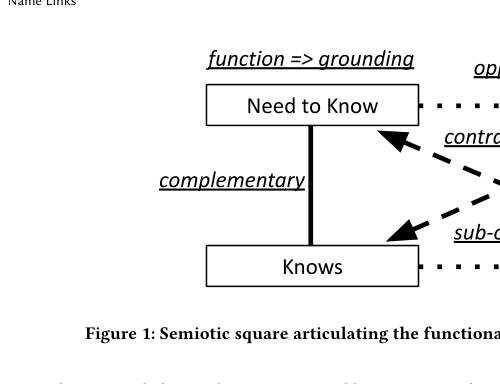
Figure 1: Semiotic square articulating the functional and representational roles of names and name links.
3.2 Semantics - Borrowing Names
Following Kirpke's earlier argument, names are always borrowed from someone else and they come with a string attached, the causal chain connecting the specific instance of a name with the named entity. If borrowing is the mechanism behind names, the question is how to control and read what has been actually borrowed.
We can look at the two types of roles of names and name links from this perspective. The functional role can be achieved by attaching content to borrowed chain from the link target. The representational role would make use of these borrowed chains differently, as a reference rather than an integration.
For instance, in historical romances, names may refer either to a history manual or from the narrative world of the creative work. Often, articulated texts borrow names case by case from different sources, e.g., historical facts about the context of the character or about facts pertaining to the romance.
Hypertext technology is about making invisible connections tangible. As such, the question is how authors can make tangible this use of names (if they wish so) to readers. Using Pierce's language, how a hypertext system would make the correct interpretant (the borrowed chain) explicit to the reader.
Following Kirpke's argument, names refer to a named entity. This specific semantic of names is different from common words, which meaning is well represented by a network of correlations (at least in computational linguistics). In this view, an interpretant of a named entity is a modality of interaction: how readers can come across the named entity.
The modality of interaction can be understood as a way the reader can directly or indirectly experience the named entity. For instance, Mt. Everest is that thing you can find if you go to a specific location or the tallest peak when you look at a skyline. The modality of the approach hides the complexity of named entities. For instance, a person is differently understood looking at different years, phases of her/his life, roles in society or actions taken.
To sum up, the relevance of the borrowed chain is connected to the use of the hypertext has for it. Names and name links hide the complexity of named entities. This complexity can be navigated as part of the hypertext or left outside, as a regular text, through the choice of how to handle names. In this view, the last part of this discussion focuses on how paratext and other cues should make these decisions on names tangible.
3.3 Signifiers - Paratext and Cues
The last questions concern how names are presented to the reader, and what this presentation communicates.
The beauty and critical flaw of hypertext is its flexibility. Virtually, any hypertext can establish its own use of links. However, the reality of hypertext systems is based on conventions. For instance, web links are commonly underlined words, in the colour blue, that offer a "mouse on" interaction changing the cursor shape to a finger for clicking. Advanced implementations of links help readers in discriminating between internal and external sources or an in-context preview of the target content. Every hypertext system offers a specific take on links in terms of rules or recommendations. Indeed, as for any issue concerning the pragmatics of communication, there is a need for consistency at least within a specific domain/system.
As above argued, the trend in computational linguistics encodes regular words in relation to their use, as part of a network. As such, it is not a surprise how the simplest take on links fits with the viewpoint. However, this elegant yet simplistic approach is not expressive enough to encode the complexity of the intention behind a name link (as discussed in this contribution).
An interesting take on name links uses question marks to discriminate links that refer to dictionaries (names of definitions). These systems often assume a non-functional use of names and a specific modality of interaction on the name entities through the dictionary definition. Definitions are not essential but the connection with a dictionary is used to position contents in the sphere of professional/highly reliable sources. This solution expresses the special type of chains that are being borrowed but still assumes the role of name links.
If we commit to a specific theory of names, it should be possible to define a consistent language beyond the specific application. This language would be the result of a design choice that provides the expressivity to convey the specific case-by-case use of names.
Following the previous example, a solution could make use of two symbols, ? and !, to express the two roles of link names landscaping and grounding. The definition of these symbols could be as follows:
? At this link you can find extra information for your own knowledge, I do not vouch for it but this is what you can find if you search for it
! This is what I mean and wish to point you to with this link, regardless of what you know or not, or what others may think.
Thus, the conversion of names into name links would provide the means for authors to express their specific use of names. With this capability, names would be better understood as strong commitments, or statements of intent. As such, their evaluation should become possible in light of the specific intent encoded in the name link.
Changing how links however do not fully address the issue. Indeed, there is a need to establish practices behind the specific type of use and maybe the plurality of modalities of interacting with named entities. For instance, ! links should not refer to dynamic sources like Wikipedia in favour of web archives that provide a static view of the web you can rely on in the long term.
4 CONCLUSION
Names are references in their own rights. Following De Rosa's taxonomy [7], as (intensive, vocative) isomorphic links names are both identifiable, understandable, and actionable by readers; readers can independently resolve names connecting the associated entity and the document. As such, regardless of the technological capability hypertext systems offer, name links should be treated as an authorial choice and, from the authorial perspective, used to convey meaning.
Names are easy to identify in the text and readers know intuitively how they work. As such, name links are a kind of violation of Grice's "conversational maxim" of synthesis [13], providing information that is not strictly necessary. However, these violations are also legitimate communication tools [4], a means to grab attention or to achieve a "perlocutionary effect" [25] such as mirth, surprise, or rage. For instance, the act of linking a politician's name to a company website, Wikipedia page, social network profile, or dictionary entry for a "corruption" can be an effective statement.
In more general terms, the decisions concerning name links are events and potential hooks for the subsequent experience. The role of the medium is to provide the right experiential blueprint, i.e. the form of event that supports the type of aesthetic experience that we aim to achieve. For instance, keeping a name as it leaves the burden and responsibility to the reader in choosing what signifier (chain) to borrow, opening them to experiences like serendipity, testing, and discovering. In contrast, a name treated as an arbitrary link is a statement from the author that supports a challenge of common sense or reinforces readers' opinions, or a push to further expand their understanding in a specific direction.
Hypertext presents its own challenges regarding the disentanglement between medium and content. Hypertext systems are both the crafting tool and material of hypertext works. much like the visual arts, the relation between craft, materials, and expression is of great relevance - and the object of artistic reflection. In this view, the connection between media and content in the achievement of aesthetic experience deserves a role in hypertext reflection, and in theoretical work oriented to reconcile and integrate the results of hypertext by-products, e.g., reading social media and web-native novels, and misinformation. As outlined here, name handling is an aesthetic activity, regardless of being a decision of the author or a pipeline for text augmentation.
Like any other technology, Hypertext is not neutral: the medium mediates access to meaning through specific lenses. As such, the design and engineering choices of hypertext systems are not neutral, but bearers of assumptions about the optimal experience. An analysis of this dynamic is offered by the field of ethics of information systems. Floridi (2013) defines the concept of "infraethics" [9] as the ethics integrated into information infrastructures. Floridi argues that information technologies enforce their underlying ethics on their users as the result of the combined characteristic rigidity of technology and the adaptability of humans. Similarly, aesthetic choices are encoded into media. As such, infraaesthetics represents a systemic push toward a specific type of experience. This approach can then be applied to justify both the good and detrimental effects of hypertext systems, such as "doom scrolling" on social media, or "transportation" within novels and games.
This interdisciplinary exploration of names feeds into a wider investigation on the aesthetics of interactive and intelligent media. 20th-century literary studies uncovered the importance of ambiguity and gaps, re-qualifying the relation between author and reader as a negotiation of meaning rather than one of monodirectional communication. Hypertext technology taps into this conversation by expanding the potential capabilities of both agents in the creative process. On the one hand, interactive media enable personalisation and control over the experience of content. On the other, coding, embedding, multimedia and linking give authors extra control over aspects of interpretation. As argued in a recent paper, digital technologies reconfigure the landscape where the author-reader negotiation takes place [3].
From both perspectives, it is increasingly hard to evaluate digital authoring and even more so hypertext produced by generative AI systems. Decades of discussion saw general positions on both the good and bad sides of hypertext. At the core of the dispute is the lack of an aesthetic theory of hypertext as a medium. Hypertext works can be evaluated from a literary perspective while hypertext systems are assessed for human-computer interaction metrics like usability or adoption. However, hypertext systems and contents are one and the same: the logic of the digital tool implements an ethic about the work and the general approach to authoring and reading experience.
References
[1] [n. d.]. Mastodon 3.5. https://blog.joinmastodon.org/2022/03/mastodon-3.5/
[2] Isaac Alpizar-Chacon and Sergey Sosnovsky. 2019. Expanding the Web of Knowledge: One Textbook at a Time. In Proceedings of the 30th ACM Conference on Hypertext and Social Media (Hof, Germany) (HT '19). Association for Computing Machinery, New York, NY, USA, 9–18. https://doi.org/10.1145/3342220.3343671
[3] Alessio Antonini and Samuel Brooker. 2020. Mediation as calibration: a framework for evaluating the author/reader relation. In Proceedings of the 31st ACM Conference on Hypertext and Social Media. 17–25.
[4] B. G. Bara. 2000. Il metodo della Scienza Cognitiva: Un appoccio evolutivo allo studio della mente. (2000).
[5] Mark Bernstein, David E Millard, and Mark J Weal. 2002. On writing sculptural hypertext. In Proceedings of the thirteenth ACM conference on Hypertext and hypermedia. 65–66.
[6] C. Brandi. 1974. Teoria Generale della Critica. Einaudi.
[7] Steven J DeRose. 1989. Expanding the notion of links. In Proceedings of the second annual ACM conference on Hypertext. 249–257.
[8] Michael Devitt and Nicolas Porot. 2018. The reference of proper names: Testing usage and intuitions. Cognitive Science 42, 5 (2018), 1552–1585. https://doi.org/10.1111/cogs.12609
[9] Luciano Floridi. 2013. Infraethics. The Philosophers' Magazine 60 (2013), 26–27.
[10] Gottlob Frege. 1948. Sense and Reference. The Philosophical Review 57, 3 (1948), 209–230. http://www.jstor.org/stable/2181485
[11] Álvaro Gomes and Duarte Costa Pereira. 1992. Towards a hypertext semiotics. Hypermedia Courseware: Structures of Communication and Intelligent Help (1992), 91–96. https://doi.org/10.1007/978-3-642-77702-811
[12] A. J. Greimas. 1966. Sémantique structurale: recherche de méthode. Presses universitaires de France.
[13] Herbert P Grice. 1975. Logic and conversation. In Speech acts. Brill, 41–58.
[14] S. A. Kripke. 1980. Naming and necessity. Harvard University Press.
[15] Anne Mangen. 2008. Hypertext fiction reading: haptics and immersion. Journal of research in reading 31, 4 (2008), 404–419.
[16] Anne Mangen and Adriaan Van der Weel. 2017. Why don't we read hypertext novels? Convergence 23, 2 (2017), 166–181.
[17] Sabrina Mazzali-Lurati. 2007. Here is the author! hyperlinks as constitutive rules of hypertextual communication. Semiotica 2007, 167 (2007). https://doi.org/10.1515/sem.2007.074
[18] E. Michaelson and M. Reimer. 2019. Reference. In Stanford Encyclopaedia of Philosophy. The Metaphysics Research Lab Centre of the Study of Language and Information.
[19] Adrian Miles. 1999. Cinematic paradigms for hypertext. Continuum: Journal of Media & Cultural Studies 13, 2 (1999), 217–225.
[20] Stuart Moulthrop. 1994. Rhizome and Resistance: Hypertext and the Dreams of a New Culture. Johns Hopkins University Press, 299–322.
[21] Charles Sanders Peirce. 1997. Pragmatism as a principle and method of right thinking: The 1903 Harvard lectures on pragmatism. Suny Press.
[22] Charles S. Peirce and Max H. Fisch. 1982. Writings of Charles S. Peirce: A chronological edition. Indiana University Press.
[23] Ferdinand de Saussure, Charles Bally, Albert Sechehaye, and Wade Baskin. 1960. Course in general linguistics. Peter Owen.
[24] John Rogers Searle. 1982. Proper Names and Intentionality. Pacific Philosophical Quarterly 63, 3 (1982), 205–225.
[25] John R Searle and J. R. Searle. 1969. Speech acts: An essay in the philosophy of language. Vol. 626. Cambridge university press.
[26] Grant Smith. 2017. The semiotic meanings of names. Onomastica 61, 1 (2017), 111–118.
[27] Katharina Von Knop. 2007. Countering web-based Islamist narratives: conceptualizing an information war and a counter-propaganda campaign. In Hypermedia seduction for terrorist recruiting. IOS Press, 245–266.
Do you like what you are reading? Subscribe to receive updates.
Unsubscribe anytime