
Historiographies of Hypertext
Simon Rowberry (s.rowberry@ucl.ac.uk), Department of Information Studies, University College London, London, United Kingdom
Published in HT '23: 34th ACM Conference on Hypertext and Social Media · DOI: 10.1145/3603163.3609038 · License: CC BY 4.0
Authors: Simon Rowberry
Keywords: Digital Publishing, History of Computing, History of Hypertext
Session: Reflections & Approaches: Reflections
Pages: spit
Conference: HT '23
Abstract
Hypertext professionals have been writing the history of hypertext since Ted Nelson coined the term in the 1960s and claimed Vannevar Bush's Memex as a precursor to his Xanadu system. Despite the abundance of papers celebrating important figures and anniversaries in hypertext history, there has been less critical reflection on the methods for conducting this analysis. In this paper, I outline the dominant methods of writing histories of hypertext within the community. Through tracing the overlaps and gaps within this literature, I argue for a greater focus on regular users of these technologies and comparative analyses of hypertext in relation to broader trends. The paper concludes with a brief demonstration of how to apply this historical work through a case study of reading on-screen and hypertext.
CCS CONCEPTS
Human-centered computing → Hypertext / hypermedia;
Applied computing → Publishing; Arts and humanities.
KEYWORDS
History of Hypertext, Digital Publishing, History of Computing
ACM Reference Format:
Simon Rowberry. 2023. Historiographies of Hypertext. In 34th ACM Conference on Hypertext and Social Media (HT '23), September 4–8, 2023, Rome, Italy. ACM, New York, NY, USA, 10 pages. https://doi.org/10.1145/3603163.3609038
1 INTRODUCTION
Hypertext, most commonly understood to mean the non-linear presentation of text and other media exemplified by the link-node model of the Web, has a long and complex history. As a result, what counts as hypertext has changed alongside the popular imagination of the computer, from terminals to cloud-based social media services. Johnson-Eilola and Kimme Hea argue that "hypertext has always been a multiple and conflicted term, shifting and reconfiguring at the nexus of local tendential forces. Hypertext coalesces, it seems, around a wish of what we want text to be." [51]
Such shifting definitions and debates allow us to consider the connection between the present and our understanding of history. As Bernard Geoghegan argues, "choices about periodization entail decisions about which social, political, and ethical configurations weigh on us today." [41]¹ If our recollection of the past is interconnected with our understanding of the present, it is important to critically evaluate how both contemporary and historical accounts of hypertext have been constructed and reflect the conditions of that moment.
The hypertext community is keen to emphasize its history, often through periodization (as discussed further in Section 3.1).² For example, this year's ACM Hypertext conference includes a dedicated 'Reflections and Approaches' track that encourages historical reflection and analysis. Equally, previous conferences featured panels on the field's history and important anniversaries.³ As I argue below, these historical reflections often focus on a relatively narrow part of hypertext's rich past, which could be improved by engaging critically with historical methods.
Discussing and interpreting the pre-Web history of hypertext is difficult given the paucity of extant evidence. This challenge persists across the history of computing. As Driscoll and Latzko-Toth argue, "finding what has not been found, patching holes in narratives and acquiring new documentation are classic problems in modern historiography." [29] In this paper I take cues from recent shifts in histories of computing, and methods from the discipline of history to explore how scholars write histories of hypertext and how these might be productively extended. I conclude by sketching out the links between reading on-screen and hypertext that demonstrates the potential of a media archaeological approach to the field.
2 'DOING' HISTORY
In Thinking About History, Sarah Maza argues that "history as a field of study is unusual in its lack of overarching structure or definition–a trait that paradoxically accounts for its wide and enduring appeal beyond academia." [58] The ease with which readers can engage with published histories masks the complex task of documenting and analyzing history, commonly known as "historiography." Various credible yet contradictory ways exist for identifying, interpreting and contextualizing sources that will influence the overall argument. This process requires a degree of introspection and deliberate action.
I detail various historical approaches to hypertext in Section 3, but it is worth briefly pausing to consider my own position here. I am a historian of digital publishing in Anglophone countries who primarily draws methods from Science and Technology Studies (STS), and book/media history. My work aims to contest conventional narratives about the evolution of digital publishing, emphasizing the role of previously marginalized actors. The case study in Section 4 reflects this expertise and offers a blueprint for how other disciplinary perspectives on hypertext could combine subject expertise with more intentional historical research methods.
A comprehensive overview of contemporary historiography is beyond the scope of this paper but range from foundational textbooks in the field of history (e.g. [11, 58]) and journals including History and Theory and Journal of the History of Ideas. Instead in this paper, I summarize several approaches to historical research around hypertext that extend beyond chronological descriptions including, but not limited to, revisionism [11], intellectual history [89], organizational and systems-based approaches [30], and media archaeology [31].
We need to think about the benefits and drawbacks of traditional beliefs in historical research around hypertext, particularly when it comes to methods or the researcher's standpoint. For example, "first drafts of history" are often incomplete and imperfect, but they can serve as starting points for later historians to refine and expand upon. As James Banner notes, "all history is revisionist history," despite the increasingly polemical use of the term "revisionist history" to categorize both harmful conspiratorial positions and to denigrate progressive work such as the 1619 Project. [11]. Instead, Banner defines revisionism in its broadest form as a way of reassessing claims made by historians through using new critical lenses, evidence, methodologies, or other means. Some revisionist work will have a broader impact, but nonetheless, the basic tenet is that history is not fixed and is always subject to being challenged or rewritten.
In Memory Machines, Belinda Barnet generously reflects on how others might revise her arguments based upon her oral histories of central actors in the development of early hypertext systems. As Barnet acknowledges, interviews with elite participants cannot constitute a full record of the development of hypertext. [12] Complementary work can address the areas of weakness and challenge some of the normative assumptions of foundational figures through bringing new evidence to light. For example, we can now re-appraise Ted Nelson's claims to Barnet with the new archival evidence from Stanford University and the Internet Archive. Barnet expressed a desire to view these records, which remained inaccessible to her at the time. From the materials available through the Internet Archive, this would have allowed Barnet to produce a richer history of Nelson's thinking around computational systems and publishing in the early 1960s before he publicly presented the work in 1965.⁴
The audience of the work is another important consideration. Histories of hypertext can be seen as a niche topic and therefore strong work aimed at the smaller community might not be integrated into a broader understanding of the field's history. We might take Thomas Haigh and Paul Ceruzzi's A New History of Modern Computing as a template for how historians of computing discuss hypertext. Hypertext appears in their chapter on publishing rather than the following chapter on networks, moving the field closer to desktop publishing rather than connecting it to the Internet and Web. The authors relay the standard names (Bush, Engelbart, Nelson and Berners-Lee) with little reference to work published after 1988, leading to the impression that hypertext is no longer an active research topic and there was a clear single pathway towards an end goal. [45]
2.1 Chronological and Recursive Histories
Chronological history presents events in a linear order even though a clear chain of influence might not be possible to discern. While print and oral storytelling require a strict linear organisational mechanism, this can fail to embrace the rich messiness of historical events such as the French Revolution, which might benefit from non-linear presentation or thinking. This is not a new observation within hypertext scholarship: In 2005, Mark Bernstein suggested that hypertext systems could provide a framework for modelling the nuance of causality in historical narratives [15] and George Landow documents several experimental hypertext essays in Hypertext 3.0 [54]. Nonetheless, hypertext historians [39], or digital historians more broadly [9], have generally avoided using non-linear presentation methods. Hypertext systems could offer a robust visual language to present the complexity of the history of hypertext where influence is often unclear and newer ideas influence the on-going development of earlier systems (for example, Nelson's appropriation of aspects of the Web in his later Xanadu systems).
Print media does not restrict researchers from challenging linear histories and exploring lesser-known historical connections. For example, media archaeology approaches the history of technology as cyclical or non-linear rather than maintaining a strictly chronological view of historical progress. Erkki Huhtamo introduced media archaeology as a challenge to "a predominantly chronological and positivistic ordering of things centered on the artifact" within media history. He instead proposed "treating history as a multi-layered construct, a dynamic system of relationships." Media archaeology focuses instead on "recurring cyclical phenomena that (re)appear and disappear and reappear over and over again in media history, somehow seeming to transcend specific historic contexts." [50] A school of media scholars has responded to Huhtamo's suggestion by producing work on 'zombie media' (or hardware that is repurposed after its commercial demise on the Gartner hype cycle) [49], film history [50], and the repeated moral panic around the 'death of the book' in light of emerging technologies [10]. Media archaeology presents one avenue for reconsidering the history of hypertext outside of our typical chronological expectations. There are clear overlaps between the two research communities. For example, Huhtamo mentions "unrealized 'dream machines,' or discursive inventions" that independently echoes Nelson's coining. [50, 64, 68] It is therefore surprising that the two have not been combined more frequently beyond scholarship such as Terry Harpold's Ex-Foliations. [48]
Instead, the history of hypertext has been portrayed as a form of positivist chronological history with a direct line of progress from HG Wells' World Brain [88] to Vannevar Bush's Memex [20] through to Engelbart and Nelson's concretization of the concept in the 1960s [32, 65].⁵ This form of narrative building can tend towards hagiography, typically framed around 'great men.'⁶ Streeter extends this discussion of myth-making in relation to the Internet's development by describing this assumed lineage as 'folklore,' which re-frames "mythology" as an important fiction that can provide valuable information about a community. [83] Myth-making can be an important first stage in demonstrating the importance of an area but it is vital to push beyond this mode through revisionist histories.
Hypertext as a field matured in the late 1980s when there was a critical mass of researchers and institutions working on hypertext systems, coalescing in the launch of the ACM Hypertext Conference series. This history concludes with Tim Berners-Lee's development of the World Wide Web and its subsequent victory over competing standards such as File Transfer Protocol (FTP), Gopher, and Wide Area Information Service (WAIS), in part due to its adoption of hypertext where other protocols elected to implement other navigational structures. [38]
This narrative is alluring as it suggests that hypertext research trended in one direction with the inevitable 'invisible' adoption of hypertext on the Web marking the victory of the form. While this might be a convincing narrative in hindsight, the historiography is more complicated. To demonstrate this, I will briefly outline two examples of challenges that emerge from viewing hypertext through the lens of positivist chronology: (1) the chain of influence in the early years of hypertext; and (2) how the Web fits into these longer histories.
2.2 The Early Years of Hypertext
Since Nelson defined the term 'hypertext' in 1965, it is possible to categorise both historical and pre-historical generations of hypertext, although this categorization can be unhelpful (as I discuss further in section 3.4). It is challenging to rationalize Vannevar Bush and H.G. Wells' interventions as part of the development of the concept a posteriori but they nonetheless had an important intellectual influence on the first generation of hypertext theorists. They were not the only influences though, as Nelson cites the multi-linear Japanese film Rashoman (1950) [78] and Holling C. Holling's Paddle-to-the-Sea (1941) [69] as alternative early influences, while Engelbart was influenced by Benjamin Whorf's concept of linguistic relativism [12]. Influence is multi-linear rather than strictly chronological.
Historians of innovation argue that sole inventors are the exception rather than the rule, as there are many instances of simultaneous independent discoveries, such as Leibniz and Newton developing their models of calculus without knowledge of the other. In his analysis of "Singletons and Multiples in Scientific Discovery," Robert Merton concludes that "far from being odd or curious or remarkable, the pattern of independent multiple discoveries in science is in principle the dominant pattern, rather than a subsidiary one." [59] Likewise, Ralph Epstein pushes back against what he terms the "'heroic theory' of invention" to instead argue for the "theories of small increments." [36] Simonton extends this line of argument to propose the 'zeitgeist' model of innovation, whereby an idea may occur simultaneously in different locations due to environmental conditions. [80]
In this context, Ted Nelson and Doug Engelbart's simultaneous work on hypertext is not necessarily the result of individual genius. Instead, it represents the consequence of a wave of information professionals considering the impact of computational culture on our relationship with text. The computer offered alternative forms of presentation that were likely to diverge from the expectations of print even if Nelson had never coined the word "hypertext." Large-scale digitization projects within database and information retrieval contexts emphasize how these environmental conditions were emerging in 1960s computational culture more broadly. [18]
Through Simonton's lens, we can shift from overemphasizing inventors to also acknowledging the early, non-elite computer users of the pre-1990s, offering a more balanced and inclusive narrative of hypertext's development. Questioning established narratives, as demonstrated in this paper, is gaining momentum in the field of computing history in recent works from scholars like Morgan G. Ames, Kevin Driscoll, and Joy Lisi Rankin. [1, 28, 56].
2.3 The Web and 'The End of Hypertext'
The rise of the Web represents a significant moment in hypertext history that deserves a critical reevaluation. While HTML was not the most advanced implementation of hypertext, it captured the public's imagination when other more sophisticated systems did not, effectively concluding an experimental phase of hypertext development. With the benefit of hindsight, however, it is unclear whether hypertext was the driving force behind the Web's transformation from a tool to solve information overload at CERN to an integral part of our media ecosystem. In retrospect, the 'killer app' status of hypertext in the context of the Web seems less certain.
The Web's early adopters were not necessarily most interested in hypertext. The most well-recited example is Marc Andreessen's introduction of the <img> tag for images in early implementations of Mosaic [4], thus transforming a largely text-based protocol into a space for multimedia. Images appealed to a broader range of users than the technical sophistication of the Web's linking infrastructure. While full multimedia implementation would only come with HTML 5, the introduction of <img> tags nonetheless demonstrated the direction of travel.
Furthermore, the development of the Web since the early 1990s, especially with the rise of social media platforms, has moved away from link-based navigation. Instead, users largely receive content served in a linear fashion determined by recommendation algorithms or chronological order. This began with the shift from web rings and directories such as the early years of Yahoo to the dominance of Google and other search engines. While Frank Halasz stated that "search is an incomplete link" in his keynote for the first ACM Hypertext conference [46], the utility of search engines in finding relevant information quickly negated the need to find relevant links.
Even though the Web's arrival was simultaneously a watershed moment for hypertext systems and the apex of the field's popularity, it clearly did not mark the closure of the 'grand narrative' of hypertext, as evidenced by the continuation of the ACM Hypertext conference series and its exploration of more complex hypertext systems both within and outwith the Web. Likewise, Jill Walker Rettberg coined the term "feral hypertext" to encompass the development of collaborative hypertexts such as Wikipedia, blogging, or tagging on Flickr, often clustered under the "Web 2.0" umbrella, enabled the development of new forms of hypertext, that were in sharp opposition to 'domesticated' pre-Web hypertext systems. [86]
Beyond these social aspects of how users and platforms built creative infrastructure on top of the Web stack, the post-web hypertext research community continued to work on alternative systems and infrastructure. For example, while many hypertext systems prior to the Web were smaller in scale and relied on metaphors of consumable media (e.g. Storyspace works, Hypercard stacks), the Web offered a blueprint for conceptualizing larger systems that led to growing interest in areas such as Open Hypertext Systems [2].⁷ Rather than enclosing the boundaries of hypertext, the Web instead pushed researchers to consider alternatives that addressed what they perceived to be its limitations. It is therefore worth questioning orthodox narratives to develop alternative futures for hypertext.
3 GENRES OF HYPERTEXT HISTORY
Published works on the history of hypertext take a number of approaches to integrating historical methods into their narrative or analysis. This often appears to be conducted in an ad hoc manner rather than intentionally building upon previous research or established research traditions in history, which is most apparent in cases such as bibliometric analyses of the ACM Hypertext conference series, where authors do not reference previous studies with similar research designs. Nonetheless, as I document below, there are clear patterns in hypertext researchers' approaches that help us to identify both strengths and under-explored pathways.
3.1 Periodization
Periodization offers a straightforward approach to understanding the history of technology by clearly defining different developmental phases, influenced by contemporary trends [41]. It can nonetheless be reductive, especially when inter-twinned with the history of ideas, since the boundaries of periods can be quite porous. Talking about first, second and third generations of hypertext systems, for example, eludes some of the overlap that exists during this period. The three most frequently cited inventors of analog and digital hypertext systems (Vannevar Bush, Ted Nelson, Doug Engelbart) all worked on their designs over multiple decades. Bush published "Memex Revisited" in 1967 [21], after Nelson and Engelbart's early publications. Likewise, Nelson and Engelbart worked on Xanadu and AUGMENT respectively until beyond the introduction of the Web in 1989. The boundaries separating different periods are too porous to be meaningful.
3.1.1 Pre-history?
Hunting for the 'first' instance of a new phenomenon is closely associated with periodization. As Michael Williams argues, "there is no such thing as 'first' in any activity associated with human invention. If you add enough adjectives to a description you can always claim your own favorite." [91] One such example can be seen in Nelson and others' rhetorical strategy of arguing that hypertext is inherently digital (see, for example, [25, 65]), which limits the role of earlier examples in print. Hypertext sits in an awkward position in terms of periodization as Nelson and other early advocates made arguments about its precursors in print (a mythical pre-history) to demonstrate the potential for the form while simultaneously arguing it was entirely new. In his most prominent paper from 1965, "Complex Information Processing," Nelson defines hypertext as "a body of written or pictorial material interconnected in such a complex way that it could not conveniently be presented or represented on paper." [65] This negative definition (hypertext is not print-based) does not hold up to further scrutiny and ignores a longer tradition of physical literature that complements digital media's affordances. [42, 75]
Describing print hypertexts as merely a preliminary phase of the field's development overlooks a more persuasive argument related to the 'zeitgeist' theory of innovation. While there are many earlier precursors to hypertext (such as the I Ching and medieval manuscripts [37]), the early 1960s saw the publication of Vladimir Nabokov's Pale Fire (1962), Julio Cortázar's Hopscotch (1963), and Marc Saporta's Composition No. 1 (1963). Experiments with the materiality of non-linear storytelling were clearly emerging in several international and disciplinary contexts during the 1960s. Ignoring this larger context to make a case for computational exceptionalism limits our understanding of broader literary and societal shifts. Nelson acknowledged the influence of Nabokov's Pale Fire on his thinking through including it as an example in an aborted script for a demonstration of the Hypertext Editing System (HES) in 1968. [66]
Likewise, we can view early hypertext in relation to the then-emerging field of information retrieval and its intersection with both digitization and computational microfilm efforts⁸ that characterized work on computational textual transmission in the 1950s and 1960s. [18] For example, Lockheed's DIALOG system was running as a prototype full text retrieval system that would allow users to search the text as early as 1966. The overlap between information retrieval and hypertext has been complicated but both disciplines approach text in similar manners, especially if we consider Frank Halasz's aforementioned comments around search. This is another case of a gap between the largely theoretical work of hypertext scholars and practical action occurring elsewhere.
3.2 Intellectual Histories
Hypertext is often remembered within the literary studies community for its convergence with continental twentieth-century critical theory, exemplified by George Landow's series of Hypertext X.0 books. [54] It is now a cliche to note the parallels between hypertext systems and theoretical concepts such as Roland Barthes' "death of the author" [13], Julia Kristeva's "intertextuality" [53], or Gilles Deleuze and Félix Guattari's "rhizomes" [27], although scholars including Samuel Brooker have restarted productive investigations in this topic recently. [19] Early hypertext scholars in the humanities used the connection between then-popular critical theory with the emerging field of hypertext to ensure that it could be discussed within the broader constituent disciplines of the humanities, drawing the conversation into the history of ideas.
Nelson and other early hypertext inventors attempted to distance themselves from critical theory. Consider, for example, the oft-recited anecdote of Nelson retorting "You! Up there... Wrong!" to an unidentified speaker at the 1989 ACM Hypertext conference [12]. Nonetheless, many hypertext scholars working before the widespread uptake of the Web were constrained by computational limits at the time. As a consequence, systems such as Xanadu remained theoretical until the technology improved. Many of these theorists' ideas continued to develop and circulate regardless of these constraints. This can be seen most prominently in Nelson and Engelbart's trajectories. According to Barnet, both Engelbart and Nelson supported linguistic determinism, also referred to as the 'Sapir-Whorf' hypothesis, which suggests that language structures our understanding of the world. [12] Viewed through this framework, language becomes a structural technology that can in turn help to shape the world. Even though earlier hypertext scholars did not engage directly with critical theory, other theoretical frameworks were instrumental in their notions of what hypertext should be.
3.3 Organizational histories
After tracking the history of hypertext as an idea, organizational histories are one of the most popular genres of hypertext historiography. For example, Inna Kouper's ACM History Fellowship-funded work explored SIGWEB's development as a vital organizational mechanism as the community's interests shifted. [52] This organizational approach also encapsulates research that demonstrates or explores the importance of specific publishers such as Eastgate [35], the formation and role of the Electronic Literature Organization (ELO) in promoting hypertext and other born-digital fiction [74]; or the cluster of organizations driving the development of the New Oxford English Dictionary [73].
The funding of early hypertext systems presents another avenue for exploring the organizational history of its community. In terms of the early years of hypertext history, there is a clear deference to this model of the heroic inventor, when instead it can be more fruitful to consider the broader context that enabled the material conditions for hypertext to develop in the mid-twentieth century such as Mark Bernstein's work on war and hypertext. [17] Likewise, alternative histories of hypertext's development between 1965 and 1990 could examine its use within military and other heavy industrial applications, and the funding derived from this connection, rather than focusing on narratives of mass adoption. [33] Hypertext's connection to the intelligence community is another area of interest from this research perspective and could begin by interrogating Nelson's claim that the CIA approached him after one of his early presentations on hypertext in the 1960s, leading to the creation of The Nelson Organization. [67]
Early iterations of the ACM Hypertext conference attracted interest from a variety of commercial partners including Boeing, DEC, Lotus, and Texas Instruments. The main conference track was accompanied by a series of courses on topics such as "Becoming a CD-ROM Publisher" and "Corporate Conversion Strategies and Methodologies," aimed at cultivating further industry connections [72]. Evidence of this activity is ephemeral, existing primarily in personal archives of historical calls for papers or in the parts of proceedings documentation that were not included in the transition to the ACM Digital Library.
3.4 Surveys and Bibliometrics
Macro-level analyses of published scholarship on hypertext have been a popular form of hypertext in the field. Surveys were a popular genre of writing in hypertext's formative years, which saw summaries from Jeff Conklin [24], Frank Halasz [46], and John Smith and Stephen Weiss in their introduction to the 'hypertext' special issue of Communications of the ACM [81]. Beyond helping to develop the field, surveys have been a useful tool for mapping the emergence of various hypertext systems paradigms over the last sixty years, a line of thought beyond the scope of this paper but summarized by recent work by Claus Atzenbeck and his collaborators. [7, 8]
It is especially noteworthy that bibliometric analyses of the ACM Hypertext conference series have been a popular recurring form of analysis of the field's emergence since the 1980s. There are three snapshots of citation patterns in conference papers from the 1991 iteration [26], the first nine conferences [23], and most recently, all iterations up to 2021 [3]. Macek et al complemented the bibliometric approach through attempting to document in-person interactions at the 2011 ACM Hypertext conference through RFID tags. [57]. This series of papers offers an illuminating impression of both formal and informal networks within the ACM community but would benefit from further contextualization of this discussion in relation to other disciplines.⁹
3.5 Preservation and Archives
Separating preservation and archives may appear reductive but within the context of hypertext, I use the terms to refer to two different phenomena. Preservation refers to the act of maintaining, updating, and recirculating older works and systems even within the formal structure of an institutional archive but also through publication and making materials publicly available on the Web or through other repositories. Archives refer to the more specific practice of maintaining records and papers related to individuals and organizations working on hypertext, which again may be digitized or born-digital and accessible via the Web such as a selection of Ted Nelson's papers on the Internet Archive.¹⁰ Archives may also contain born-digital artifacts that cannot be run within the archive, making a disconnect between the archives and digital preservation.
3.5.1 Preservation
The literary hypertext and electronic literature communities have been more successful in acts of preservation than computer scientists.¹¹ For example, in early 2023, the Historic Hypertext Project, that aims to document and preserve access to pre-Web hypertext systems through emulation, lists two projects and five early web browsers as accessible, while the 'Wanted' page lists nineteen projects. [6] Conversely, Eastgate Systems continues to update Storyspace [16] and re-publish updated versions of titles such as Michael Joyce's afternoon, a story and Shelley Jackson's Patchwork Girl. To complement this commercial preservation work, several universities including Washington State University's ELO NEXT Lab, maintain access to the older machines required to run early hypertext fictions ensuring access for both teaching and reading purposes.
Dene Grigar and Stuart Moulthrop developed the documentary method of 'pathfinders' [44], where 'traversals' of literary hypertext act as a form of documentation to account for the challenges of maintaining the software and hardware required to run them. Grigar and Moulthrop recorded a range of users (from the authors of the works and scholars with in-depth knowledge through to first time readers) exploring works of hypertext fiction. This documentation ensures that the uses of these tools can still be tracked in the future, providing valuable evidence to help re-situate these developments in context.
3.5.2 Archives
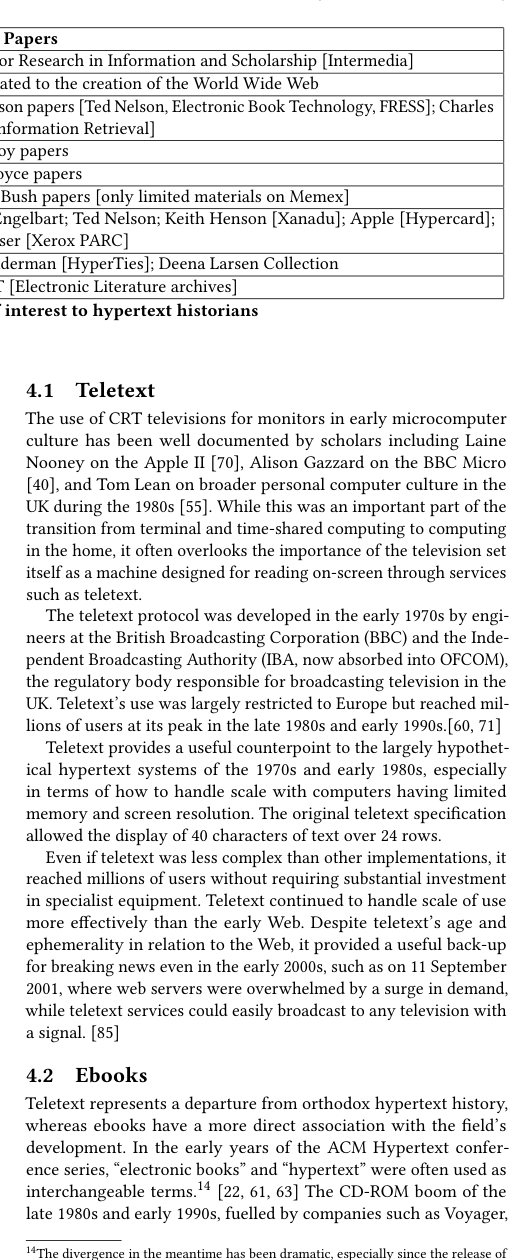
There is great potential in re-evaluating normative assumptions about the history of a technology such as hypertext, especially as its history begins to become institutionalized and classified documents enter public circulation. This shift is beginning to occur within hypertext scholarship. While Vannevar Bush's papers at the Library of Congress are remarkably light on materials relating to the Memex,¹² Douglas Engelbart's papers at Stanford offer a great insight into his formative work on hypertext. In 2022, Stanford also acquired Ted Nelson's papers, which is more extensive than the material he previously digitized and uploaded to the Internet Archive. The CERN Archives host materials on the invention of the Web and the foundation of the World Wide Web Consortium (W3C) which are opening up after a 30-year embargo period. This wealth of archival evidence, summarized in Table 1, can begin to supplement and challenge many of the claims established through oral histories and secondary sources, including documenting the secondary uses of these platforms.
Simultaneously, it is worth considering the archival gaps and silences from these records, as well as those events and born-digital artifacts that have not been adequately preserved. For example, important figures in hypertext history such as Tim Berners-Lee and Wendy Hall's personal papers, as well as their early contributions to the field, Enquire (the precursor to the Web) and Microcosm, have yet to find an institutional archival home. This is especially true of these early systems' users who may not be included in the archives of the inventors. To account for these gaps, we may need to deploy counterfactuals or use media archaeology as a research method to ensure that these voices do not disappear from the historical record.
3.6 Revisionist Histories
While, as James Banner acknowledges, all history is revisionist to some degree, revisionism requires a level of intentionality for challenging established narratives that is often lacking from hypertext histories. This might take the form of exploring a substantial body of new evidence, such as an archive detailed in the previous section, decolonizing hypertext history through looking for early work from outside of the Anglo-American world, or exploring the social history of hypertext through focusing on regular users rather than canonizing a small number of creators.
Feminist histories of literary hypertext demonstrate a blueprint for revisionist histories, which form part of what Banner terms "conceptual revisionism [or] a rethinking of the grounds of any large area or subject of historical interpretation." [11] The clearest articulations of this feminist revisionist work comes in the form of Kathi Inman Beren's argument that Judy Malloy's Uncle Roger should be considered the first work of hypertext fiction [14], Jill Walker Rettberg's 'distant reading' of the formation of electronic literature as an artistic field [87], and a group effort to improve the representation of female electronic literature authors on Wikipedia, led by Deena Larsen [90]. Feminist historiography in hypertext is not the only form of revisionist history, but nonetheless, it offers a useful working model for how to approach underdeveloped themes within the scholarship.
3.7 What's missing?
From this survey of previous historical excursions on the topic of hypertext, we can see a wealth of valuable research. Nonetheless, there are clear under-explored areas in these approaches. Most readily, the focus on elite participants and the history of ideas can overlook the regular users of these systems.¹³ Outside of web histories, that has a rich history of documenting regular users, Twine offers the best evidence for works created by under-represented groups, who used this tool with a low start-up cost for creative expressions that would not necessarily be possible otherwise. These creators are often emphasized over the role of Chris Kilmas in developing and maintaining the platform. [5, 79]
Historians of computing have benefited from shifting focus from elite participants to users. As Lisi Rankin argues: "The relentless emphasis on the legend of Engelbart, PARC, and Apple masks the existence of the thousands of people who crafted computing on personal terminals in Illinois during the 1960s and 1970s. The legend obscures the fact that there were once computing citizens who were not consumers." [56] The history of hypertext depends as much on understanding these computing citizens, working on and pushing the boundaries of the systems available to them, as the computer scientists and theorists who were designing more sophisticated systems. Lisi Rankin's term "computing citizen" is especially important as it establishes how early computer users engaged actively with these systems, providing feedback and tweaks for the developers rather than a model of passive consumption.
There is also strong potential for the development of further comparative histories. Rather than viewing hypertext in isolation, it could be contextualized in relation to other developments. For example, early ACM Hypertext conferences were co-sponsored by SIGIR (ACM's Information Retrieval Special Interest Group): When and why did these two communities diverge and what might be gained from considering these two fields together? Equally, biographical work on the central actors in hypertext could benefit from further contextualization of their contributions to hypertext alongside their other work: How did Andries van Dam's work on computer graphics influence the development of HES/FRESS? What role did Ted Nelson's advocacy work for the personal computer in Computer Lib and other outlets have in his development of Xanadu? Why do the Vannevar Bush papers and consequently his biographers lack substantial material on the Memex compared to his other achievements? There are a wealth of under-explored questions that would help re-contextualize assumptions within the literature, while also possibly encouraging other fields to engage with hypertext again.
| Archive | Relevant Papers |
| --- | --- |
| Brown University, Rhode Island | Institute for Research in Information and Scholarship [Intermedia] |
| CERN, Geneva | Papers related to the creation of the World Wide Web |
| Computer History Museum, California | Esther Dyson papers [Ted Nelson, Electronic Book Technology, FRESS]; Charles Bourne [Information Retrieval] |
| Duke University, North Carolina | Judy Malloy papers |
| Harry Ransom Center, Texas | Michael Joyce papers |
| Library of Congress, Washington DC | Vannevar Bush papers [only limited materials on Memex] |
| Stanford University, California | Douglas Engelbart; Ted Nelson; Keith Henson [Xanadu]; Apple [Hypercard]; Mark Weiser [Xerox PARC] |
| University of Maryland | Ben Shneiderman [HyperTies]; Deena Larsen Collection |
| Washington State University | The NEXT [Electronic Literature archives] |
Table 1: Selection of archives of interest to hypertext historians
4 TOWARDS A MEDIA ARCHAEOLOGY OF HYPERTEXT AND READING ON-SCREEN
In the final section of this paper, I offer a media archaeological excavation of the interchange between hypertext and reading on-screen over the latter half of the twentieth century. These tensions are most revealing when considering the role of television-based reading during the early years of the personal computer and the parallels between hypertext and electronic books in the formational years of the ACM Hypertext conference series.
Cathode Ray Tube (CRT) television and electronic paper displays both draw attention to the materiality of the screen and its role in digital text presentation, which are often ignored in historical analyses of hypertext. Regardless, there is a clear connection between how text was outputted from a computer and how users were able to interact with it, from punch cards and printouts to multi-touch haptic devices and large ultra high definition screens. Nick Montfort warns us against the risks of 'screen essentialism' (the assumption that computers have always been screen-based) [62] and the material form and limitations of output deeply matters. In this regard, the CRT television and electronic paper display act in opposition to one another: CRT is designed for low resolutions and constantly refreshes in order to display a moving image, while electronic paper displays are designed to be static until an additional user input and require a higher degree of legibility. Through exploring teletext, an example of reading on CRT screens, and the early development of ebooks (and its relationship to hypertext), we can start to see how a history of screens and hypertext would challenge and enhance our current understanding of hypertext history.
4.1 Teletext
The use of CRT televisions for monitors in early microcomputer culture has been well documented by scholars including Laine Nooney on the Apple II [70], Alison Gazzard on the BBC Micro [40], and Tom Lean on broader personal computer culture in the UK during the 1980s [55]. While this was an important part of the transition from terminal and time-shared computing to computing in the home, it often overlooks the importance of the television set itself as a machine designed for reading on-screen through services such as teletext.
The teletext protocol was developed in the early 1970s by engineers at the British Broadcasting Corporation (BBC) and the Independent Broadcasting Authority (IBA, now absorbed into OFCOM), the regulatory body responsible for broadcasting television in the UK. Teletext's use was largely restricted to Europe but reached millions of users at its peak in the late 1980s and early 1990s. [60, 71]
Teletext provides a useful counterpoint to the largely hypothetical hypertext systems of the 1970s and early 1980s, especially in terms of how to handle scale with computers having limited memory and screen resolution. The original teletext specification allowed the display of 40 characters of text over 24 rows.
Even if teletext was less complex than other implementations, it reached millions of users without requiring substantial investment in specialist equipment. Teletext continued to handle scale of use more effectively than the early Web. Despite teletext's age and ephemerality in relation to the Web, it provided a useful back-up for breaking news even in the early 2000s, such as on 11 September 2001, where web servers were overwhelmed by a surge in demand, while teletext services could easily broadcast to any television with a signal. [85]
4.2 Ebooks
Teletext represents a departure from orthodox hypertext history, whereas ebooks have a more direct association with the field's development. In the early years of the ACM Hypertext conference series, "electronic books" and "hypertext" were often used as interchangeable terms.¹⁴ [22, 61, 63] The CD-ROM boom of the late 1980s and early 1990s, fuelled by companies such as Voyager, strengthened these comparisons at the time but it is more fruitful to explore an earlier period in what is now considered the e-reader's developmental history (drawing upon my previous work on the 'ebook imagination' of early ebook patents [76]) to assess how inventors were engaging with hypertext systems outside of canonical examples.
There are two fruitful examples: Angela Ruiz Robles' mechanical books (c.1930; patented in 1949) [77] and the Personal Electronic Aid for Maintenance (PEAM), a collaboration during the 1980s between the US Army Research Institute for the Behavioral and Social Sciences, Texas Instruments and a range of other industrial partners over the decade. [47, 92]
Both of these projects offer useful counterpoints to established assumptions around hypertext's development. Ruiz Robles' work sits alongside Bush's on mechanical, analog systems for traversing text and another example of what Richard Hughes Gibson calls 'paper electronic literature.' [42] Ruiz Robles designed the 'Mechanical Encyclopedia' as an educational aid for children. She envisioned the device, which never went beyond the prototype stage, to comprise of a base system with removable media scrolls that provided interactive lessons with a locking key mechanism. Students would therefore traverse the materials in a non-linear method, in a similar, less mechanically complex equivalent to the Memex, theorized at a similar time.
The Personal Electronic Aid for Maintenance (PEAM)'s absence within hypertext histories is more intriguing given its proximity to both central actors in the community,¹⁵ and its closeness to the first ACM Hypertext conference.¹⁶ Nonetheless, this early attempt at digitizing and indexing large military technical manuals largely appears to have been overlooked within histories of hypertext. PEAM was a rugged computer embedded in an attaché case that allowed engineers to follow cross-references in repair manuals to ensure they located all relevant context in a short time. The device provided some positive early results from use in the field, where engineers were able to more quickly identify relevant information through cross-references than from a print version. [92]
Neither of these projects used electronic paper, which was invented simultaneously in the 1970s by researchers at Xerox PARC and Matsushita for the PARC desktop computer and digital advertising respectively. [76] Instead, they demonstrated the importance of portability for reading on-screen. Reading does not necessarily always take place at a desk, and readers are more likely to engage if they can read within the spaces they otherwise read in. The material and market conditions of portable computing including high quality portable screens were an important limiting factor for the uptake of reading on-screen in both linear and multi-linear ways until the 2000s.
If we consider this longer history of experimentation with non-linearity in e-reader prototypes, we can start to see a deeper connection between electronic books, screen reading, and hypertext. The material constraints of early screens dedicated to reading reveals in part why hypertext failed to have a mainstream breakthrough until the end of the 1980s: the types of screens people used were generally insufficiently high resolution for ease of reading on screen and more advanced displays were not commercially viable. These limitations extended beyond the screen to other hardware elements (storage, RAM, processing power) that ensured that the more ambitious projects such as Project Xanadu would remain out of reach.
5 CONCLUSION: RECONSTRUCTING FORGOTTEN AND LOST HISTORIES
In this paper, I have outlined both how histories of hypertext cluster around a limited range of methods and offered a case study of how alternative comparative histories could complement these approaches. As more resources and evidence become available, it is vital to question established understandings of the field's origins and developments. This work is advanced within the context of the Web but there are merits for expanding these approaches towards earlier technical hypertext systems and the intellectual ideas behind them.
Broadening the historiography of hypertext not only enriches our understanding of the field's development, it also presents opportunities to build upon in future work. This might take the form of revisiting previously closed debates, such as Samuel Brooker's work on authorship, [19] or it might look to understand the social or material conditions that led to the adoption of the Web and the Kindle as opposed to a more complex hypertext platform. Rather than simply celebrating hypertext's long history, it is worth a more reflexive critical appraisal. The opportunities grow for conducting this research through the opening and acquisition of pertinent archives, while simultaneously, the risks of time-based loss to both systems and core actors becomes a greater threat.
ACKNOWLEDGMENTS
This paper heavily relies on digital and physical archival evidence and I am grateful for the time and support of the archival workers at CERN, Stanford University's Green Library, the University of Illinois, the BBC Written Archives, Bournemouth University's Independent Broadcast Authority records, and Channel 4. Funding for this archival research was provided in part by the Bibliographic Society of America and the Carnegie Trust. I am grateful for the three anonymous reviewers' thoughtful and generous engagement with my initial submission, which helped significantly improve the overall structure and argument of this paper.
Notes
For example, Mark Bernstein acknowledges that his work on hypertext, the Web and war was the result of Russia's illegal full-scale invasion of Ukraine in 2022 [17]
In this paper, I use the term community to describe the human actors involved in the production, dissemination and reception of hypertext and 'field' to describe its various outputs, technologies, and discursive strategies. What constitutes 'hypertext' remains a contested term within the community. [7, 43]
It is interesting to note, however, that the Web did not receive a retrospective on its decennial anniversaries.
As of early 2023, the papers at Stanford have not been processed
See, for example, the subtitle to Barnet's Memory Machines: The evolution of hypertext, and summaries of the field in publications including [45, 84]
Equally, focusing on Bush, Engelbart and Nelson's contributions to hypertext alone reduces their significant contribution to other fields.
Atzenbeck et al provide a useful historical summary of hypertext infrastructure. [8]
Often building upon Vannevar Bush's earlier work in this field.
Unfortunately, as the authors of these studies acknowledge, the published proceedings and RFID badges can only provide a partial impression of the field.
https://archive.org/details/tednelsonarchive
Arguably the result of historical scholarship's central place in literary studies, while still remaining marginal to most computer science curricula.
Barnet cites just one source, "Mechanization and the Record," from Bush's Library of Congress papers in Memory Machines. [12]
Early users of Storyspace have been well documented in histories of the software and early hypertext fiction but the community was largely connected through the academy and ACM Hypertext conference so would not necessarily include 'regular users.'
The divergence in the meantime has been dramatic, especially since the release of the Kindle.
The Douglas Engelbart papers at Stanford University Libraries indicate that Engelbart attended a workshop on the equipment in 1989 [34]
Some of the earliest work on the project, dating back to 1982, even called it "A Hypertext Electronic Job Aid for Maintenance" [82]. Equally, the connection between PEAM and early ebook culture has largely been overlooked other than [76].
References
[1] Morgan G. Ames. 2019. The Charisma Machine: The life, death, and legacy of One Laptop One Child. MIT Press, Cambridge.
[2] Kenneth M. Anderson. 1997. Integrating open hypermedia systems with the World Wide Web. In Proceedings of the eighth ACM conference on Hypertext (HYPERTEXT '97). Association for Computing Machinery, New York, 157–166. https://dl.acm.org/doi/10.1145/267437.267454
[3] Mark W. R. Anderson and David Millard. 2022. Hypertext's Meta-History: Documenting in-Conference Citations, Authors and Keyword Data, 1987-2021. In Proceedings of the 33rd ACM Conference on Hypertext and Social Media (Barcelona, Spain) (HT '22). Association for Computing Machinery, New York, 96–106. https://doi.org/10.1145/3511095.3531271
[4] Marc Andreessen. 1993. proposed new tag: IMG. http://1997.webhistory.org/www.lists/www-talk.1993q1/0182.html
[5] Anna Anthropy. 2012. Rise of the Videogame Zinesters: How Freaks, Normals, Amateurs, Artists, Dreamers, Dropouts, Queers, Housewives, and People Like You Are Taking Back An Art Form. Seven Stories Press, New York.
[6] Claus Atzenbeck. 2023. The Historic Hypertext Project. https://human.iisys.de/histHT/
[7] Claus Atzenbeck and Peter J. Nürnberg. 2019. Hypertext as Method. In Proceedings of the 30th ACM Conference on Hypertext and Social Media (HT '19). Association for Computing Machinery, New York, 29–38. https://dl.acm.org/doi/10.1145/3342220.3343669
[8] Claus Atzenbeck, Thomas Schedel, Manolis Tzagarakis, Daniel Roßner, and Lucas Mages. 2017. Revisiting Hypertext Infrastructure. In Proceedings of the 28th ACM Conference on Hypertext and Social Media (HT '17). Association for Computing Machinery, New York, 35–44. https://dl.acm.org/doi/10.1145/3078714.3078718
[9] Edward L. Ayers. 1999. History in Hypertext. http://www.vcdh.virginia.edu/Ayers.OAH.html
[10] Andrea Ballatore and Simone Natale. 2016. E-readers and the death of the book: Or, new media and the myth of the disappearing medium. New Media & Society 18, 10 (2016), 2379–2394. https://doi.org/10.1177/1461444815586984
[11] James Banner. 2021. The Ever-Changing Past: Why all history is revisionist history. Yale University Press, New Haven.
[12] Belinda Barnet. 2013. Memory Machines: The Evolution of Hypertext. Anthem Press, London.
[13] Roland Barthes. 1977. The Death of the Author. In Image, Music, Text. Fontana/Collins, Glasgow, 142–148.
[14] Kathi Inman Berens. 2014. Judy Malloy's seat at the (database) table: A feminist reception history of early hypertext literature. Literary and Linguistic Computing 29, 3 (2014), 340–348.
[15] Mark Bernstein. 2005. Hypertext and the linearity of history. http://www.eastgate.com/HypertextNow/archives/History.html
[16] Mark Bernstein. 2016. Storyspace 3. In Proceedings of the 27th ACM Conference on Hypertext and Social Media (Halifax, Nova Scotia, Canada) (HT '16). Association for Computing Machinery, New York, 201–206. https://doi.org/10.1145/2914586.2914624
[17] Mark Bernstein. 2022. On The Origins Of Hypertext In The Disasters Of The Short 20th Century. In Proceedings of the ACM Web Conference 2022 (WWW '22). Association for Computing Machinery, New York, 3450–3457. https://doi.org/10.1145/3485447.3512280
[18] Charles P. Bourne and Trudi Bellardo Hahn. 2003. A History of Online Information Services, 1963-1976. MIT Press, Cambridge.
[19] Samuel Brooker. 2019. Man proposes, God disposes: Re-assessing Correspondences in Hypertext and Anti-Authorist Literary Theory. In Proceedings of the 30th ACM Conference on Hypertext and Social Media (HT '19). Association for Computing Machinery, New York, 39–48. https://doi.org/10.1145/3342220.3343649
[20] Vannevar Bush. 1945. As We May Think. The Atlantic 176 (1945), 101–108.
[21] Vannevar Bush. 1967. Memex Revisited. In Science in Not Enough. William Morrow & Company, New York, 75–101.
[22] Nipon Charoenkitkarn, Jim Tam, Mark H. Chignell, and Gene Golovchinsky. 1993. Browsing Through Querying: Designing for electronic books. In Hypertext 93 Proceedings. Association for Computing Machinery, New York, 206–216. https://dl.acm.org/doi/10.1145/168750.168824
[23] Chaomei Chen and Leslie Carr. 1999. Trailblazing the literature of hypertext: author co-citation analysis (1989-1998). In Proceedings of the tenth ACM Conference on Hypertext and hypermedia : returning to our diverse roots (Hypertext '99). Association for Computing Machinery, New York, 51–60. https://doi.org/10.1145/294469.294486
[24] Jeff Conklin. 1987. Hypertext: An Introduction and Survey. Computer 20, 9 (Sept. 1987), 17–41.
[25] Robert Coover. 1992. The End of Books. New York Times Book Review 21, 6 (June 1992), 23–25.
[26] Elisabeth Davenport and Patricia Baird. 1992. Hypertext — a Bibliometric Briefing. Hypermedia 4, 2 (Oct. 1992), 123–134.
[27] Gilles Deleuze and Félix Guattari. 1987. A Thousand Plateaus: Capitalism and Schizophrenia. Continuum, London.
[28] Kevin Driscoll. 2022. The Modem World: A prehistory of social media. Yale University Press, New Haven.
[29] Kevin Driscoll and Camille Paloque-Berges. 2017. Searching for missing "net histories". Internet Histories 1, 1-2 (2017), 47–59.
[30] Gabrielle Durepos, Ellen C. Shaffner, and Scott Taylor. 2021. Developing critical organizational history: Context, practice and implications. Organization 28, 3 (2021), 449–467. https://doi.org/10.1177/1350508419883381
[31] Lori Emerson. 2014. Reading Writing Interfaces: From the digital to the bookbound. University of Minnesota Press, Minneapolis.
[32] Douglas C. Engelbart. 1968. The Mother of All Demos. http://sloan.stanford.edu/MouseSite/1968Demo.html
[33] Douglas C. Engelbart. 1988. DRAFT CALS/AIA Pageless Technical Manual Committee Interchange Subcommittee, IBM Rockville, MD Concept Paper. 26 August 1988. Douglas C. Engelbart Papers, M0638. Dept. of Special Collections, Stanford University Libraries, Stanford, Calif. 1998-094 Box 27 Folder 19.
[34] Douglas C. Engelbart. 1989. Concept Paper Delivery and Presentation System. Douglas C. Engelbart Papers, M0638. Dept. of Special Collections, Stanford University Libraries, Stanford, Calif. 1998-094 Box 27 Folder 19.
[35] Astrid Ensslin. 2022. Pre-web Digital Publishing and the Lore of Electronic Literature. Cambridge University Press, Cambridge.
[36] Ralph C. Epstein. 1926. Industrial Invention: Heroic, or Systematic? The Quarterly Journal of Economics 40, 2 (1926), 232–272.
[37] Martin K. Foys. 2007. Virtually Anglo-Saxon: Old Media, New Media, and Early Medieval Studies in the Late Age of Print. University Press of Florida, Gainesville.
[38] Philip L. Frana. 2004. Before the Web There Was Gopher. IEEE Annals of the History of Computing 26, 1 (2004), 20–41. https://doi.org/10.1109/MAHC.2004.1278848
[39] Ingo Frank. 2019. Rewriting History: Towards Diagrammatic Hypertext for Digital Historiography. In Proceedings of the 30th ACM Conference on Hypertext and Social Media (HT '19). Association for Computing Machinery, New York, 289–290. https://doi.org/10.1145/3342220.3344932
[40] Alison Gazzard. 2016. Now The Chips Are Down: The BBC Micro. MIT Press, Cambridge.
[41] Bernard Dionysius Geoghegan. 2023. Code: From Information Theory to French Theory. Duke University Press, Durham.
[42] Richard Hughes Gibson. 2021. Paper Electronic Literature: An archaeology of born-digital materials. University of Massachusetts Press, Amherst.
[43] Robert J. Glushko, David Gunning, Ken Kershner, Catherine Marshall, and Louis Reynolds. 1991. When Worlds Collide – Reconciling the Research, Marketplace, and Applications Views of Hypertext. In Hypertext 91 Proceedings. Association for Computing Machinery, New York, 367–368. https://dl.acm.org/doi/10.1145/122974.125101
[44] Dene Grigar and Stuart Moulthrop. 2015. Pathfinders. http://scalar.usc.edu/works/pathfinders/index
[45] Thomas Haigh and Paul E. Ceruzzi. 2021. A New History of Modern Computing. MIT Press, Cambridge.
[46] Frank G Halasz. 1987. Reflections on NoteCards: seven issues for the next generation of hypermedia systems. In Proceedings of the ACM conference on Hypertext. Association for Computing Machinery, New York, 345–365. https://dl.acm.org/doi/10.1145/317426.317451
[47] John H. Harkins and Stephen H. Morriss. 1985. Apparatus for delivering procedural type instructions. European Patent No. 163,511.
[48] Terence Harpold. 2009. Ex-Foliations: Reading Machines and the Upgrade Path. University of Minnesota Press, Minneapolis.
[49] Garnet Hertz and Jussi Parikka. 2012. Zombie Media: Circuit Bending Media Archaeology into an Art Method. Leonardo 45, 5 (2012), 424–430.
[50] Erikki Huhtamo. 1997. From Kaleidoscnomaniac to Cybernerd: Notes Toward an Archaeology of the Media. Leonardo 30, 3 (1997), 221–224.
[51] Johndan Johnson-Eilola and Amy C. Kimme Hea. 2003. After hypertext: Other ideas. Computers and Composition 20 (2003), 415–425.
[52] Inna Kouper. 2017. Hypertext, Digital Libraries, and Beyond: A history of ACM SIGWEB. In Communities of Computing: Computer Science and Society in the ACM, Thomas J. Misa (Ed.). Association for Computing Machinery, New York, 331–353.
[53] Julia Kristeva. 1982. Desire in Language: A Semiotic Approach to Literature and Art. Basil Blackwell, Oxford. Translators: Thomas Gora, Alice Jardine and Leon S. Roudiez.
[54] George Landow. 2006. Hypertext 3.0: Critical Theory and New Media in an Era of Globalization. The Johns Hopkins University Press, Baltimore.
[55] Tom Lean. 2016. Electronic Dreams: How 1980s Britain learned to love the computer. Bloomsbury, London.
[56] Joy Lisi Rankin. 2018. A People's History of Computing in the United States. Harvard University Press, Cambridge.
[57] Bjoern-Elmar Macek, Christoph Scholz, Martin Atzmueller, and Gerd Stumme. 2012. Anatomy of a conference. In Proceedings of the 23rd ACM conference on Hypertext and social media (HT '12). Association for Computing Machinery, New York, 245–254. https://dl.acm.org/doi/10.1145/2309996.2310038
[58] Sarah Maza. 2017. Thinking About History. The University of Chicago Press, Chicago and London.
[59] Robert K. Merton. 1961. Singletons and Multiples in Scientific Discovery: A Chapter in the Sociology of Science. Proceedings of the American Philosophical Society 105, 5 (1961), 470–486.
[60] Hallvard Moe and Hilde Van den Bulck (Eds.). 2016. Teletext in Europe: From the analog to the digital era. Nordicom, Göteborg.
[61] J. Monnard and J. Pasquier Boltuck. 1993. An Object-Oriented Scripting Environment for the WEBSs Electronic Book System. In Proceedings of the ACM Conference on Hypertext (Milan, Italy) (ECHT '92). Association for Computing Machinery, New York, 81–90. https://doi.org/10.1145/168466.168498
[62] Nick Montfort. 2005. Continuous Paper: The Early Materiality and Workings of Electronic Literature. http://nickm.com/writing/essays/continuouspapermla.html
[63] Stuart Moulthrop. 1991. Beyond the Electronic Book: A Critique of Hypertext Rhetoric. In Proceedings of the Third Annual ACM Conference on Hypertext (San Antonio, Texas, USA) (HYPERTEXT '91). Association for Computing Machinery, New York, 291–298. https://doi.org/10.1145/122974.123001
[64] Theodor Nelson. 1987. Dream Machines. Tempus, Redmond.
[65] Theodor Holm Nelson. 1965. Complex information processing: a file structure for the complex, the changing and the indeterminate. In Proceedings of the 1965 20th national conference. Association for Computing Machinery, New York, 84–100. https://dl.acm.org/doi/10.1145/800197.806036
[66] Theodor Holm Nelson. 1968. [Pale Fire] PROPOSED SCRIPT FOR H'TEXT DEMO AT SJCC. (1968). https://archive.org/details/ibd-1967
[67] Theodor Holm Nelson. 1987. Computer Lib/Dream Machines. Tempus, Redmond.
[68] Theodor Holm Nelson. 1992. Opening Hypertext: A Memoir. In Literacy Online: The Promise (and Peril) of Reading and Writing with Computers. University of Pittsburgh Press, Pittsburgh and London, 43–57.
[69] Theodor Holm Nelson. 2010. Possiplex. Mindful Press, Hackettstown.
[70] Laine Nooney. 2023. The Apple II Age: How the computer became personal. University of Chicago Press, Chicago.
[71] Michael J. Nyhan, Robert Johansen, and Robert Plummer. 1980. Videotex and Teletext in the U.S.: Prospects for the 1980s. Institute for the Future, Menlo Park.
[72] Steven Poltrock. 1993. Hypertext '93 Conference Advanced Program Announcement.
[73] Darrell R. Raymond and Frank Wm. Tompa. 1987. Hypertext and the New Oxford English Dictionary. In Proceedings of the ACM Conference on Hypertext (Chapel Hill, North Carolina, USA) (HYPERTEXT '87). Association for Computing Machinery, New York, 143–153. https://doi.org/10.1145/317426.317438
[74] Scott Rettberg. 2012. Developing an Identity for the Field of Electronic Literature: Reflections on the Electronic Literature Organization Archives. Dichtung Digital 41 (2012). http://www.dichtung-digital.org/2012/41/rettberg.htm
[75] Simon Peter Rowberry. 2020. Continuous, not discrete: The mutual influence of digital and physical literature. Convergence 26, 2 (2020), 319–332.
[76] Simon Peter Rowberry. 2022. The Ebook Imagination. Digital Humanities Quarterly 16, 1 (Feb. 2022). http://www.digitalhumanities.org/dhq/vol/16/1/000601/000601.html
[77] Ángela Ruiz Robles. 1949. Procedimiento Mecanico, Electrico Y A Presion De Aire Para Lectura De Libros. Spanish Patent no. 190,698.
[78] William Saletan. 1998. Searching for Xanadu. Swathmore College Bulletin XCVI, 3 (1998), 16–19.
[79] Anastasia Salter and Stuart Moulthrop. 2021. Twining: Critical and creative approaches to hypertext narratives. Amherst College Press, Amherst.
[80] Dean Keith Simonton. 1979. Multiple Discovery and Invention: Zeitgeist, Genius, or Chance? Journal of Personality and Social Psychology 37, 9 (1979), 1603–1616.
[81] John Smith, B. and Stephen Weiss, F. 1988. Hypertext. Commun. ACM 31, 7 (1988), 816–819.
[82] David E. Stone, Margaret McMinn, Anita Marx, and Larry Israelite. 1982. A Hypertext Electronic Job Aid for Maintenance. Technical Report AD-A133103. US Army Research Institute for the Behavioral and Social Sciences, Alexandria, VA. https://apps.dtic.mil/sti/pdfs/ADA133103.pdf
[83] Thomas Streeter. 2011. The Net Effect: Romanticism, capitalism, and the Internet. New York University Press, New York.
[84] Luke Tredinnick. 2023. The intricate web: network and rhizome metaphors in hypertext and the web and the epistemic challenge of fake news. Journal of Documentation Online First (2023). https://doi.org/10.1108/JD-10-2021-0204
[85] Piërre van de Laar and Teun Hendriks. 2012. A retrospective analysis of Teletext: An interoperability standard evolving already over 30 years. Advanced Engineering Informatics 26, 3 (2012), 516–528.
[86] Jill Walker. 2005. Feral hypertext: when hypertext literature escapes control. In Proceedings of the sixteenth ACM conference on Hypertext and hypermedia. Association for Computing Machinery, New York, 46–53. https://dl.acm.org/doi/10.1145/1083356.1083366
[87] Jill Walker Rettberg. 2012. Electronic Literature Seen from a Distance: The Beginnings of a Field. Dichtung Digital 41 (2012). www.dichtung-digital.org/2012/41/walker-rettberg.htm
[88] H. G. Wells. 1938. World Brain. Metheun & Co. Limited, London.
[89] Daniel Wickberg. 2001. Intellectual History vs. the Social History of Intellectuals. Rethinking History 5, 3 (2001), 383–395. https://doi.org/10.1080/13642520110078505
[90] Wikipedia. 2023. WikiProject Women writers/Women electronic literature writers. https://en.wikipedia.org/wiki/Wikipedia:WikiProjectWomenwriters/Womenelectronicliteraturewriters
[91] Michael R. Williams. 2002. A Preview of Things to Come: Some remarks on the first generation of computers. In The First Computers: History and Architectures, Raúl Rojas and Ulf Hashagen (Eds.). MIT Press, Cambridge, 1–14.
[92] Robert A. Wisher and J. Peter Kincaid. 1989. Personal Electronic Aid for Maintenance: Final Summary Report. Technical Report 1516. U.S. Army Research Institute for the Behavioral and Social Sciences, Alexandria, VA. Issue: 1516.
Do you like what you are reading? Subscribe to receive updates.
Unsubscribe anytime