
Characterizing Vaccination Movements on YouTube in the United States and Brazil
ACM source attribution. Complete text, figures, tables, captions, and references were converted from the authorized ACM archival PDF for 10.1145/3511095.3531283. © 2022 Association for Computing Machinery.
Conversion note. Text blocks follow inspected source coordinates: title/front matter in top-to-bottom, left-to-right order; thereafter each ACM two-column page is read down the left column and then down the right column. The terminal Visual-Meta page is excluded.
Page 1
Characterizing Vaccination Movements on YouTube in the United States and Brazil
Marcelo Sartori Locatelli∗
Wagner Meira Jr. Universidade Federal de Minas Gerais Belo Horizonte, Minas Gerais, Brazil meira@dcc.ufmg.br
Virgilio Almeida Universidade Federal de Minas Gerais Belo Horizonte, Minas Gerais, Brazil virgilio@dcc.ufmg.br
Josemar Caetano∗
locatellimarcelo@dcc.ufmg.br josemarcaetano@dcc.ufmg.br Universidade Federal de Minas Gerais Belo Horizonte, Minas Gerais, Brazil
CCS CONCEPTS
ABSTRACT
• Human-centered computing →Empirical studies in collab- orative and social computing.
In the context of COVID-19 pandemic, social networks such as Facebook, Twitter, YouTube and Instagram stand out as important sources of information. Among those, YouTube, as the largest and most engaging online media consumption platform, has a large influence in the spread of information and misinformation, which makes it important to study how the platform deals with the prob- lems that arise from disinformation, as well as how its users interact with different types of content. Considering that United States (USA) and Brazil (BR) are two countries with the highest COVID-19 death tolls, we asked the following question: What are the nuances of vaccination campaigns in the two countries? With that in mind, we engage in a comparative analysis of pro and anti-vaccine move- ments on YouTube. We also investigate the role of YouTube in countering online vaccine misinformation in USA and BR. For this means, we monitored the removal of vaccine related content on the platform and also applied various techniques to analyze the differences in discourse and engagement in pro and anti-vaccine "comment sections". We found that American anti-vaccine content tend to lead to considerably more toxic and negative discussion than their pro-vaccine counterparts while also leading to 18% higher user-user engagement, while Brazilian anti-vaccine content was significantly less engaging. We also found that pro-vaccine and anti-vaccine discourses are considerably different as the former is associated with conspiracy theories (e.g. ccp), misinformation and alternative medicine (e.g. hydroxychloroquine), while the latter is associated with protective measures. Finally, it was observed that YouTube content removals are still insufficient, with only approxi- mately 16% of the anti-vaccine content being removed by the end of the studied period, with the United States registering the high- est percentage of removed anti-vaccine content(34%) and Brazil registering the lowest(9.8%).
∗Both authors contributed equally to this research.
Permission to make digital or hard copies of all or part of this work for personal or classroom use is granted without fee provided that copies are not made or distributed for profit or commercial advantage and that copies bear this notice and the full citation on the first page. Copyrights for components of this work owned by others than ACM must be honored. Abstracting with credit is permitted. To copy otherwise, or republish, to post on servers or to redistribute to lists, requires prior specific permission and/or a fee. Request permissions from permissions@acm.org. HT ’22, June 28-July 1, 2022, Barcelona, Spain © 2022 Association for Computing Machinery. ACM ISBN 978-1-4503-9233-4/22/06...$15.00 https://doi.org/10.1145/3511095.3531283
KEYWORDS
social media, vaccination movements, textual analysis
ACM Reference Format: Marcelo Sartori Locatelli, Josemar Caetano, Wagner Meira Jr., and Virgilio Almeida. 2022. Characterizing Vaccination Movements on YouTube in the United States and Brazil. In Proceedings of the 33rd ACM Conference on Hypertext and Social Media (HT ’22), June 28-July 1, 2022, Barcelona, Spain. ACM, New York, NY, USA, 11 pages. https://doi.org/10.1145/3511095.3531283
1 INTRODUCTION
Political polarization and disinformation are among the main chal- lenges to expand global vaccination campaigns against the COVID- 19 pandemic. Online platforms such as Facebook, Twitter, YouTube and Instagram are social networks whose global structure shapes the flow of information and affect individual and collective behav- ior in issues such as vaccine, elections, extremism [8] and racism. Social networks are also the main places where disinformation [23], denialist narratives, confusion and political disputes find a fertile ground on which to grow and spread throughout society [18]. For these reasons, it is important to understand the dynamics of online battles between anti- and pro-vaccination groups in order to better comprehend the actions of both groups, so as to enable more ef- fective courses of action to be taken to mitigate the consequences of such battles. Online influence operations are used by different political and ideological groups to disseminate information, lies, conspiracy theories and misleading facts. United States and Brazil have been on the global epicenter of the COVID-19 infodemic [19]. Both countries have the highest death tolls since the start of the pandemic1. According to the World Health Organization, the coro- navirus infodemic undermines the global response and jeopardizes measures to control the pandemic [25]. Different studies found that anti-vaccine groups manage to manipulate social media with effective communication strategies that capture audiences to dis- seminate their messages. Commenting on online platforms have been considered one of the most popular forms of public online participation [14]. Comments are the way in which online collective debates take form around specific topics promoted by videos. They represent the relation between different groups of society with offi- cial vaccination campaigns and reflect the degree of polarization around vaccination.
1https://covid19.who.int/
Page 2
Social platforms play an important role in identifying and remov- ing online anti-vaccine misinformation to limit the consequences it can do to a country’s vaccination movement. We monitored counter influence operations to characterize the language of comments and videos that were removed from YouTube. In this paper, we present two case studies that investigate the behavior of anti and pro-vaccine groups in different political con- texts, represented by the use of social media in the United States and Brazil. In order to understand the nuances of vaccination cam- paigns in the two countries, we have the four following research questions, that are explored in our analysis of the data sets we have collected from YouTube.
• What are the characteristics that differentiate pro-vaccine and anti-vaccine online comments?
• What kind of language drives engagement in online com- ments?
• What are similarities and differences between pro and anti- vaccination campaigns in United States and Brazil?
• What are characteristics of the pro and anti-vaccine videos removed from YouTube?
In this work we examine characteristics of pro and anti-vaccine movements. Our analysis explores the polarization dynamics of comment sections of political and ideological YouTube channels and videos. On YouTube, we observe that both language and en- gagement level are characteristics of different narratives of the ideological groups involved in battles around vaccines. It has been observed by other references that frequent commenters are more political, more polarized, and more toxic than the average user of social media platforms [15]. Through the use of NLP tools, we study the nature and language of comments of both pro- and anti- vaccination groups. Our data collection efforts resulted in a dataset with more than 8.5M comments in more than 3.0M YouTube accounts in the two countries. We analyze this large dataset extensively:
• We found that negative emotions are much more popular and prevalent in anti-vaccine comment sections and content.
• We noticed the removal of anti-vaccine content on YouTube seems to be insufficient to stop anti-vaccine videos.
• We showed the contrast between the two groups: anti-vaccine discourse is associated with conspiracy theories, misinforma- tion and alternative medicine, while pro-vaccine discourse is related to protective measures.
• We found that user-user engagement is much higher on com- ments in removed videos, which could suggest that content deemed inappropriate leads to more discussion.
2 RELATED WORK
Numerous studies have been done in the past regarding disinfor- mation and anti-vaccine campaigns, producing countless results throughout the years. Many of those results in regards to anti- vaccination were reviewed by Hussain et al. [9], who gave an overview of the movement, including the influence of technology. They mention previous work that found that 32% of the videos on YouTube about immunization were anti-vaccine and had higher rates and more views than pro-vaccine videos [13]. Another study
identified that 43% of websites found in search engines when search- ing for "imunization" and "vaccination" were anti-vaccine [4]. The cross-platform nature of such campaigns was illustrated by the research conducted by [24], which investigated an online cross-platform disinformation campaign targeting a rescue group operating in Syria called White Helmets. They found that anti- White Helmets accounts did more "cross-posting" from YouTube to Twitter, creating a bridge between the two platforms, directing Twitter users to a large set of videos critiquing the previously mentioned group. Another relevant study in the context of disinformation-campaigns was conducted by [1], which explores the influence of bots, Russian trolls and content polluters on vaccine discourses on Twitter. They find that these kinds of users tend to tweet about vaccination at higher rates than the average user. Additionally, they conclude that accounts posing as legitimate users create false equivalency, eroding public consensus on vaccination. In this same vein, [22] examines the critical social impacts of disinformation, its extension beyond the narrow window of au- tomated or paid actors such as bots and hired trolls—the window that tends to get the most media and research attention, and the need for more robust, cross-disciplinary treatments of information operations. The competition between pro and anti-vaccination views was illustrated by [12], which explores the interconnected clusters across geographical locations and languages. They found that, while smaller, anti-vaccination clusters are highly entangled with unde- cided clusters, while pro-vaccine clusters are more peripheral. Their theoretical framework predicts the dominance of anti-vaccination views in a decade. They propose that the insights provided by the framework are used to interrupt the shift to negative views. Focusing instead on the the role of social media companies in misinformation regarding Covid-19, Burki [2] presents distinct views by experts. While some argue that the companies’ pledges to act against anti-vaccine movements were insufficient, others see issues of freedom of speech and fear that the removal of posts would turn the authors into martyrs. By exploring user behavior in YouTube live streaming chat dur- ing Trump’s 2020 presidential campaingn in the United States Liebe- skind et al. [17] find, through the use of Natural Language Process- ing algorithms, that most messages express sentiment, with positive sentiment outweighing the negative. They also found that heavy users tend to use more emojis and express more sentiment while using less abusive language. Finally, they concluded that sarcasm invokes engagement. The toxicity in YouTube comment sections was studied by A. Obadimu et al. [20], who examined comments posted on anti- and pro-NATO channels. They discovered that those on anti-NATO channels have a higher tendency to be toxic. By applying Latent Dirichlet Allocation(LDA) topic modelling, they also found that top- ics extracted from anti-NATO channels were more geared towards negative components and geographical locations when compared to their pro-NATO counterparts.
3 DATA COLLECTION
In order to understand ideological battle on social media around vaccines, we need to look at videos, channels and cultural contexts.
Page 3
Channel Category Channel Country Accounts Number Total Comments Comments per Account % incl URL
Anti-Vaccine BR 539.678 2.308.712 4,28 21,54% Pro-Vaccine BR 350.774 649.644 1,85 22,33% Anti-Vaccine USA 280.979 584.844 2,08 13,50% Pro-Vaccine USA 1.233.565 3.017.758 2,45 12,99% Anti-Vaccine OTHER 248.463 709.947 2,86 14,57% Pro-Vaccine OTHER 437.707 1.261.304 2,88 18,14%
Table 1: Basic Statistics by Channel Category and Country for the YouTube Dataset. % incl URL represents the percentage of the total number of comments that contain URLs. While building this table, we discarded 8.025 comments that have neither country nor category.
We are interested in two contexts of using YouTube, represented by two different countries: the United States and Brazil. In addition to the two different countries, we focus on two classes of groups, pro-vaccination and anti-vaccination in each country. We collected data from different YouTube channels, videos and comments to allow us to compare distinct types of content and analyze their characteristics. For this means, YouTube Data API v3 was used to collect data on 142 YouTube channels that contain videos related to the COVID-19 pandemic and the vaccination process. These channels were discovered by different means, such as keyword searches, suggestions by the YouTube algorithm after the keyword searches, journalistic reports2, inspection of YouTube links shared on Facebook’s CrowdTangle, as well as through a searchable snap- shot of the Parler social network3, which includes posts, comments and users that existed before it was shut down on January 10th. Channels of important and popular political figures in the online platforms (e.g., Brazilian president Jair Bolsonaro and his family), educational (e.g., “University of Sao Paulo channel”) or govern- ment institutions (e.g., “Ministry of Health”), several news sources (e.g., CNN, Forbes, The New York Times), hospitals (e.g., "Hospi- tal Israelita Albert Einstein"), well-known medical doctors (e.g., “Drauzio Varella”) or users who have a large number of subscribers or followers (e.g., “Atila Iamarino”) were also tracked. The category (anti- or pro-vaccine) that each channel belongs to was determined manually upon inspection of the channel videos. Data on videos posted by these channels was collected and fil- tered using a set of relevant keywords4. This set of keywords is related to the COVID-19 pandemic and the vaccination process. The resulting dataset includes the video title, the channel title, the video ID, the channel ID, the time of publication, the description of the video, tags, and topic categories. The comments and transcript of each video that contained at least one of the keywords used were also collected. In total, 16820 videos were found to be relevant to the proposed study: 6648 anti-vaccine videos and 10172 pro-vaccine videos. The data collection period started on 11th July 2021 and ended on 3rd October 2021.
2These include: The Disinformation Dozen, CCDH https://www.counterhate.com/disinformationdozen, “Canais na internet ganharam dinheiro com fake news sobre Covid, informa Google à CPI” (Title in English: Internet channels made money with fake news about Covid, Google informs Parliamentary Inquiry Committee). 3Parler Snapshot https://parler.adatascienti.st/ 4shorturl.at/bpzCD
A total of 8.540.234 comments were collected, of which 172.578 had at least one hashtag and 107.429 had a link to at least one of the following websites : YouTube, Facebook, Instagram, Twitter, Reddit, and Gab. Table 1 shows basic statistics grouped by Chan- nel Category and Channel Country for the dataset with YouTube comments. Table 2 shows the distribution of links to relevant social networks within the database.
URL Brazil United States Others
youtu.be 9.485 31.520 23.601 youtube.com 4.432 18.976 15.602 facebook.com 759 1.619 1.382 twitter.com 161 979 1.023 instagram.com 191 255 181 reddit.com 3 135 100 gab.com 7 255 181
Total 15.038 53.739 42.070
Table 2: Number of YouTube comments with links to web- sites by country.
4 METHODS AND TOOLS
We use a four-dimension approach to analyze the content of com- ments, and videos. Through our analyses, we evaluate (a) engage- ment, (b) tone of the language, (c) toxicity and (d) lexical analysis. We also developed a tool to monitor counter misinformation opera- tions, i.e videos and channels removal.
4.1 Engagement
User-user engagement, such as the number of replies to comments, are useful measures for understanding how users interact with different kinds of content. This may be useful in the context of influence operations in social media since, by finding how the engagement varies among videos/posts, it is possible to evaluate whether or not the comment section seems to be influenced by the nature of the content. Each social media platform allows their users to interact in dif- ferent ways, for example, while Twitter and Gab allow retweet- ing/reblogging, liking posts, replying to posts and many other forms of interaction, YouTube comments only track replies and
Page 4
likes. As such, the engagement metric used for each platform has to be calculated differently to account for such diversity. YouTube user-user engagement has previously been explored in literature [16], where it was measured as the total number of replies in a given comment divided by the number of comments in the video where it was posted:
β = Total number of replies
Number of comments in video, (1)
where β denotes the reply-based engagement. When looking at user-user engagement metrics, it is important to consider the popularity of the analyzed videos, as previous stud- ies [16] show a negative relationship between video popularity and this metric. Besides, for US videos, specifically, VADER [11] sentiment analy- sis,a tool which is tailored for English text and maps lexical features to emotion intensities known as sentiment scores, was used to de- termine comments’ sentiment. By using the sentiment metrics for each comment, we wanted to explore if the sentiment of a comment interfered with its engagement and whether the category(anti or pro-vaccine) of the video in which the comment was posted lead to comments of a given sentiment being more or less popular. As previous studies have shown that in other social networks such as Twitter [7], negative sentiments lead to higher engagement re- gardless of the nature of the content, it was interesting to explore if such tendencies were also true for YouTube.
4.2 Tone of comments
We want to understand whether variations regarding the tone of the comments vary as a function of the video nature (i.e., pro- or anti-vaccine), as well as whether the tone is different when people mention other platforms in an effort to increase the reach of the comment.
4.2.1 Valence. We look at how words are associated with each group using the measure of political valence proposed in [3]. We adapt political valence to the context of this study as a measure that encodes the relative prominence of a term among Pro-Vaccine and Anti-Vaccine users. Valence V of a term t is defined as:
N (t,A)
N (A)
V (t) = 2 ∗
N (A) −1 (2)
N (t,P)
N (P) + N (t,A)
where N(t,P) and N(t,A) are the counts of occurrences of a term t, and N(P) and N(A) is the number of total terms in the Pro-Vaccine and Anti-Vaccine texts (i.e., comments), respectively. This equation bounds the valence between -1, for terms only used in Pro-Vaccine texts, and +1, for terms appearing only in Anti-Vaccine texts. The valence metric was then used to analyze the usage of words in comments from Anti-Vaccine and Pro-Vaccine channels dur- ing 2020 and 2021, seeking to capture the changes in the tone of comments from one year to another.
4.2.2 Toxicity. The toxicity of comments was evaluated using the Perspective API 5 tool. We worked with the definition of toxicity used by the tool to identify whether a text (i.e., comment) could be
5https://www.perspectiveapi.com/
perceived as toxic. Toxicity refers to “a rude, disrespectful, or un- reasonable comment that is likely to make you leave a discussion”. Perspective is a tool developed by Google that leverages deep learn- ing to estimate the toxicity score of a text. Therefore, we can use such score to measure how much toxicity on average is published in comments on American and Brazilian channels.
4.3 Lexical Categories Analysis
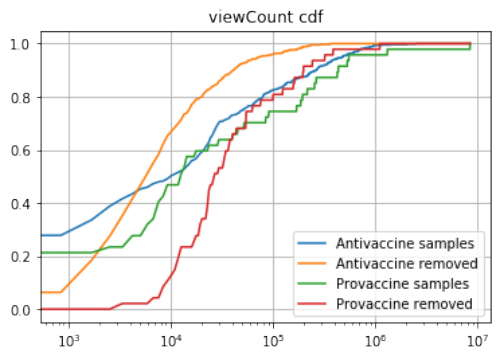
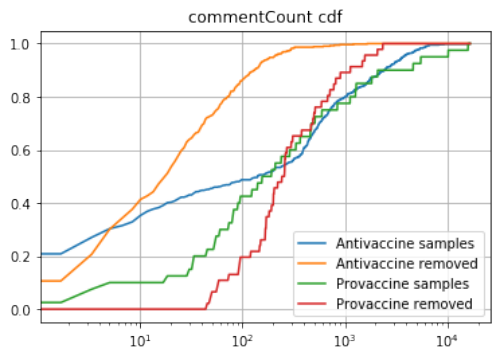
Given the considerable number of video removals, it became inter- esting to ascertain why the removal of these videos occurred and, thus, it was important to explore their statistics when compared to other videos of the same category that are still online. For this, a sample with the same number of videos was drawn from the dataset and their statistics were collected for comparison. The ECDF distri- butions in Figure 1 show the distribution of video statistics for the sample and removed videos. To further compare the removed videos and the sample, it was interesting to study the difference in emotions present in their transcripts and comment sections. For this,the Empath [6] tool was used, as it is useful for analyzing text across lexical categories and also generating new lexical categories to use for an analysis. For this analysis, the following categories were used among the available Empath categories: • positive: ’joy’, ’love’, ’politeness’. • negative: ’aggression’, ’anger’, ’disgust’, ’hate’, ’kill’, ’nervous- ness’, ’pain’, ’rage’, ’sadness’, ’suffering’, ’terrorism’, ’violence’. Ottoni et al. [21] proposed an analysis of right-wing YouTubers using Empath which could be used for our analysis, thus, following their proposed methodology, the following steps as well as the textual processing steps of lemmatization were performed. First, the Empath for transcripts and comments were obtained, then, the mean Empath for comments from each video was obtained. After that, the mean Empath for each channel was calculated, followed by the cosine similarity between comment and transcript Empath for each video.The similarity between a video’s comments and its transcript is defined as
Sv = cos(Ev,transcript, Ev,comments), (3)
where Sv denotes the similarity between the comments and tran- script of video v, Ev,transcript denotes the Empath metrics for the video transcript and Ev,comments denotes the mean Empath metrics for the video comments. By following the proposed steps using these relevant Empath categories, it is possible to obtain information on how much each comment and video is related to a given category. This information is useful to determine which categories prevail on a given kind of content and can be used to correlate video and comments content for each Empath category. As Empath currently does not natively support Portuguese, this analysis was only done for American videos. .
4.4 Counter misinformation operations
It is well-known that while YouTube is an important source of vaccine-related information to many people, it is also plagued by
Visual and table regions
Page 5
(a) Comment count ECDF (b) View count ECDF
(c) Like count ECDF (d) Dislike count ECDF
Figure 1: Video Statistics ECDFs
misinformation [5]. The platform is aware of this issue and fol- lows four principles in an attempt to mitigate the impact of fake news in its environment: (i) rewarding trusted content creators, (ii) removing content that violates YouTube policies, (iii) reducing recommendations of borderline content, and (iv) raising up author- itative sources for news and information sources6. However, the measures taken in accordance to the principles above have been shown to be insufficient [10]. In this study, we analyze the content removal in YouTube by the means of tracking the status of the videos on the database mentioned above. This was achieved using the YouTube Data API v3 on a daily basis to detect video take downs, be it by the user or by the platform. The period during which video removals were tracked ranges from May 30,2021 to October 3,2021.
6https://www.youtube.com/howyoutubeworks/our-commitments/fighting- misinformation/
5 RESULTS 5.1 Engagement
Tables 3 and 4 show the mean YouTube video views in the United States and in Brazil respectively. As mentioned, it is important to know the video popularity before looking at engagement metrics, since it is expected that lower popularity leads to higher engage- ment. The data from these tables will be discussed in the following sections.
5.1.1 United States. Table 5 shows the relative mean engagement with YouTube comments for each category and sentiment. The numbers were normalized by dividing all values by the mean en- gagement of all the comments in American videos. It is important to acknowledge that the comments from removed videos were obtained before the video was taken down. It can be seen that there is significantly higher engagement for removed videos irrespective of the sentiment of the comment.
Visual and table regions
Page 6
Absolute Relative
All videos 143139.5 1.0 Anti-vaccine 57576.5 0.40 Pro-vaccine 188843.2 1.31 All Removed videos 20095.2 0.14 Removed Anti-vaccine 16256.9 0.11 Removed Pro-vaccine 84449.3 0.58
Table 3: Mean YouTube views per category on American videos
Absolute Relative
All videos 71190.1 1.0 Anti-vaccine 82902.3 1.16 Pro-vaccine 60948.1 0.85 All Removed videos 41124.0 0.57 Removed Anti-vaccine 41124.0 0.57 Removed Pro-vaccine - -
There were no removed pro-vaccine videos in Brazil
Table 4: Mean YouTube video views per category on Brazil- ian videos
It is also interesting that while, in general, negative pro-vaccine comments show lower engagements, the opposite happens with positive sentiments, which may suggest that optimism is a more popular, or at least more discussed, view in this kind of content. In anti-vaccine content, however, negative sentiments are slightly more engaged with, which could suggest that pessimism causes more discussion in this category. Additionally, the fact that both positive and negative sentiments have greater mean engagement than the mean for all anti-vaccine comments is explained by neutral comments having lower mean engagement. Another interesting aspect to consider is the much higher user- user engagement in the removed videos, which could be an indica- tive that content deemed inappropriate by YouTube (or by the user who decided to remove their own video), sparks more discussion. Additionally, comments with links to other social network web- sites or other YouTube videos have shown, in most categories, comparable mean engagement to the mean for that category. But, when considering the whole database, they have shown consid- erably lower mean engagement. This could suggest that users in YouTube comment sections, in general, are less interested in links to other websites/videos than in purely conversational comments. When contrasting the relative popularity of content belonging to a given category and its user-user engagement, it can be seen that, while the expectation would be for less popular(on average) videos to have higher engagement, it can be seen that this does not always happen, for example, despite being more popular on average, comments in removed pro-vaccine videos have much lower mean engagement when compared to comments in anti-vaccine videos.
5.1.2 Brazil. Table 6 shows the relative mean engagement with YouTube comments for each category for Brazil. The numbers were
obtained by dividing all values by the mean engagement of all the comments in Brazilian videos. It can be seen that, for Brazil, anti-vaccine content had much lower mean user-user engagement when compared with pro-vaccine, which is the opposite of what happened in the case of the United States. However, similarly to the United States, comments with links and hashtags in general had relatively lower engagement, which could suggest that YouTube users are more interested in purely conversational comments. Unlike in the United States, removed Brazilian videos did not show extreme user-user engagement, however, they did show greater engagement than the videos of the same category that were not removed.
5.2 Tone of comments
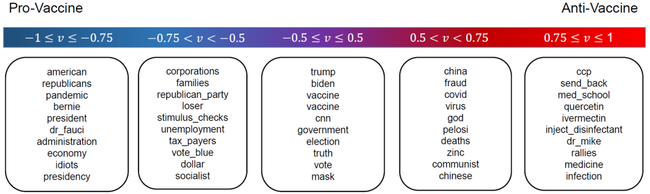
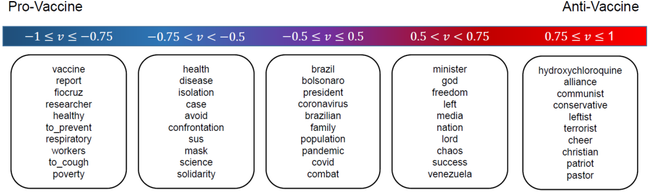
5.2.1 Valence. Figure 2 and Figure 3 shows valence score of words used, from April 2020 to June 2021, in US and Brazilian comments 7, respectively. We observe that, in both countries, anti-vaccine dis- course is more associated with conspiracy theories(e.g., commu- nist, ccp, chinese), misinformation and alternative medicine (e.g., injectdisinfectant, quercetin, ivermectin, hydroxychloroquine). Whereas pro-vaccine discourse is associated with election and pro- tective measures (e.g. president, administration, mask, healthy).
5.2.2 Toxicity. Figure 4a and Figure 4b show the toxicity proba- bility of US comments and Brazilian comments, respectively. We observe that, in both countries, comments on Anti-Vaccine channels have more toxicity probability than those on Pro-Vaccine channels. For instance, in the United States, 75% of comments on Anti-Vaccine channels have toxicity probability between 0.125 and 0.55, whereas on the Pro-Vaccine channels, 75% of comments have toxicity proba- bility between 0.09 and 0.27. In Brazil, we observe a similar char- acteristic. However, the majority of comments (75%) published in Pro-Vaccine are even less toxic than the comments published in Pro-Vaccine in the United States.
5.3 Lexical Categories Analysis
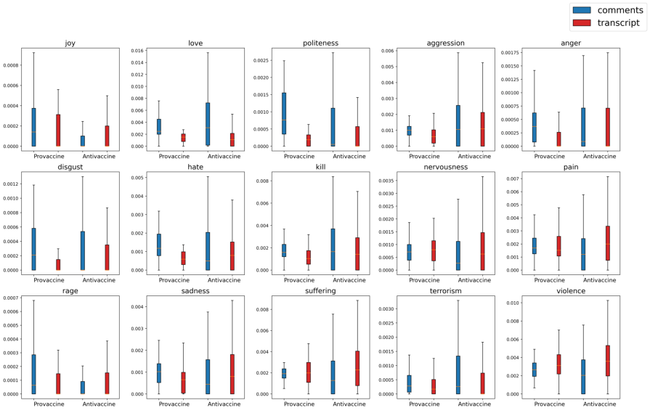
To compare the different video categories, for both removed as well as the samples, the previously mentioned mean Empath metric for each video was used to generate Figures 5 and 6. From them, it can be seen that in all categories, comments tend to have greater metrics in positive categories, while transcripts do not seem to show higher scores in negative categories in general. Additionally, transcripts from videos that are still online seem to have greater positive scores than their removed counterparts. Besides that, it can be observed that surprisingly, comments in the sampled non-removed pro-vaccine videos are more negative than those from removed videos, which could be a consequence of the low sample size. However, comments on anti-vaccine videos have shown greater negative scores in all categories when compared to the sample, with the exception of the “rage” category. Unsur- prisingly, in most categories, especially for the removed videos, anti-vaccine content has greater negative scores. Figure 7 presents a matrix in which each element is the correla- tion between average similarities and an Empath category. From it,
7The words in the figure are translated from Portuguese to English.
Visual and table regions
Page 7
General Anti-vaccine Pro-vaccine Removed anti-vaccine Removed pro-vaccine
All comments 1.0 1.13 0.95 8.11 3.82 Comments w/links 0.59 0.82 0.55 4.35 3.90 Comments w/hashtags 0.72 0.95 0.68 16.96 2.32
Negative sentiment
All comments 0.95 1.24 0.86 9.64 4.66 Comments w/links 0.92 1.38 0.84 3.44 3.37 Comments w/hashtags 1.08 1.24 1.04 11.79 2.79
Positive sentiment
All comments 1.15 1.14 1.16 7.51 3.77 Comments w/links 0.91 0.91 0.90 9.38 6.99 Comments w/hashtags 0.85 1.42 0.73 32.37 4.50
The mean engagement of all comments is 0.0006061521773068392
Table 5: Mean relative user-user engagement of comments per category of American YouTube videos
General Anti-vaccine Pro-vaccine Removed anti-vaccine Removed pro-vaccine
All comments 1.0 0.48 1.32 0.69 - Comments w/links 0.83 0.18 3.45 0.48 - Comments w/hashtags 0.25 0.14 1.11 0.27 -
The mean engagement of all comments is 0.0008826060131351426 There were no removed pro-vaccine videos in Brazil
Table 6: Mean relative user-user engagement of comments per category of Brazilian YouTube videos
Figure 2: Valence of words used in 2020 and 2021 in comments from US.
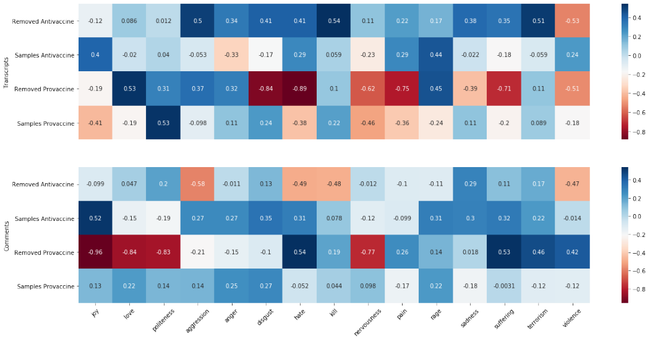
it can be seen that pro vaccine videos with less fraction of negative emotions on their transcripts have high similarity between caption and comments. Anti-vaccine transcripts, however, showed positive correlations with negative Empath categories, suggesting that a higher fraction of negative emotions correlates to a high similar- ity, in other words, whenever content creator and commenters’ views are aligned, anti-vaccine videos show more negative emo- tions, while pro-vaccine videos show less negative emotions. Both of these statements are especially true for removed content, as the correlations in absolute value, are higher for them.
Looking at the comments it can be seen that removed pro vac- cine comment sections have low correlation with positive emotions. Furthermore, removed anti-vaccine comments also show low cor- relations for some of the negative Empath categories.
5.4 Counter misinformation operations
During the data collection period, a total of 1141 videos were re- moved, of which 648 are from the United States, 306 are from Brazil, and 187 are from other countries. It is important to highlight that while most removed videos are anti-vaccine, 47 pro-vaccine videos
Visual and table regions
Page 8
Figure 3: Valence of words used in 2020 and 2021 in comments from Brazil.
1.00
0.90
Toxicity Probability
0.75
0.50
0.25
0.00
Anti−Vaccine Pro−Vaccine
Category
(a) Toxicity probability of YouTube comments from US.
Figure 4: Toxicity probability of YouTube comments.
were removed in the United States. Moreover, 5 anti-vaccine chan- nels from the United States and 2 from other countries were taken down. No channels from Brazil were removed during the the dis- cussed period. As it can be seen, while it is true that a large number (approx- imately 16%) of anti-vaccine videos were removed, most of the anti-vaccine videos were still available at the end of the tracking period, which illustrates why the measures taken by YouTube are said to be insufficient. It is important to note that most, if not all, pro-vaccine content removals happened due to the video creators themselves and not due to actions taken by YouTube. An even lower percentage of removals was found when looking at channels, where only 7% of anti-vaccine channels were removed. Another interesting aspect to consider is that the United States registered the largest absolute number and percentage of removed anti-vaccine videos, as 601 out of 1755 videos were removed(34%). Brazil registered the lowest ratio of removals, with only 306 out of 3121 videos being removed(9.8%). This could suggest that YouTube measures for filtering videos are more effective in some countries.
6 CONCLUSION
In the context of the COVID-19 pandemic, online social media platforms were important sources of information for many people. However, amidst the endless stream of content posted on those platforms, misinformation was widespread. As anti-vaccine content flooded the social networks, the efforts to prevent their spread grew,
1.00
0.90
Toxicity Probability
0.75
0.50
0.25
0.00
Anti−Vaccine Pro−Vaccine
Category
(b) Toxicity probability of YouTube comments from Brazil.
leading to different reactions from the various platforms. YouTube, the platform of interest for this study due to its large reach, dealt with this kind of content by the means of demonetizing [2], raising awareness via information panels 8, reducing recommendation for questionable videos, and content removal. Despite the aforementioned attempts to filter content and reduce disinformation, most comments and videos were still accessible at the end of the data collection period, with only about 16% of anti-vaccine videos being taken down. For this reason, it became clear that it is important to study the difference between anti and pro-vaccine content to ascertain what differentiates those two cat- egories and what are common characteristics among people who consume these kinds of videos, seeking to understand the dynamics of "comment sections". By analyzing comments in both anti and pro-vaccine videos, we found that, on average, English speaking users engage more with anti-vaccine content. This is specially noticeable when looking at the removed videos, which are supposedly more controversial, as the user-user engagement on those is significantly higher than the average of the database. Additionally, we note that positive senti- ments seem to be more popular in pro-vaccine "comment sections", while the same can be said for negative sentiments in anti-vaccine "comment sections". Moreover, during the study, it was possible to observe higher toxicity probability on anti-vaccine comments, corroborating to the observation that negative statements are more
8https://support.google.com/youtube/answer/9004474?hl=en
Visual and table regions
Page 9
Figure 5: Empath for removed videos comments and transcripts. The y axis represents the mean Empath metric.
Figure 6: Empath for sample videos comments and transcripts.The y axis represents the mean Empath metric.
Visual and table regions
Page 10
Figure 7: Correlation between similarities and Empath categories
popular in this environment. This is further explored when looking at the similarities between videos and their comments, as it is ob- served that anti-vaccine videos are more similar to their "comment section" when they show negative emotions, with the opposite being true for pro-vaccine content. In conclusion, in this study, the removal of videos by the YouTube platform was monitored and different methods were used to analyze anti and pro-vaccine "comment sections", finding key differences between them. Future work could explore similar concepts for different social network platforms such as Facebook, Instagram, and Twitter, seeking to ascertain whether the tendencies observed match those found on YouTube. Finally, the removal of content on YouTube could be explored over a larger time frame with a larger database, in an attempt to better understand the effectiveness of the actions taken by the platform.
ACKNOWLEDGMENTS
The authors would like to thank the participants of the project “Measuring The Impact Of Covid Misinformation Influence Opera- tions On Public Health Outcomes”, with support from the Carnegie Endowment for International Peace’s Partnership for Countering Influence Operations, for valuable discussions and feedbacks dur- ing the year of 2021. This work was funded in part by Brazilian agencies CNPq, CAPES and FAPEMIG, and by projects INCTCyber, MASWeb and CIIA-Saude.
REFERENCES
[1] David A Broniatowski, Amelia M Jamison, SiHua Qi, Lulwah AlKulaib, Tao Chen, Adrian Benton, Sandra C Quinn, and Mark Dredze. 2018. Weaponized
health communication: Twitter bots and Russian trolls amplify the vaccine debate. American journal of public health 108, 10 (2018), 1378–1384.
[2] Talha Burki. 2020. The online anti-vaccine movement in the age of COVID-19. The Lancet Digital Health 2, 10 (2020), e504–e505.
[3] Michael Conover, Jacob Ratkiewicz, Matthew Francisco, Bruno Gonçalves, Alessandro Flammini, and Filippo Menczer. 2011. Political Polarization on Twitter. In Proc. 5th International AAAI Conference on Weblogs and Social Media (ICWSM). http://www.aaai.org/ocs/index.php/ICWSM/ICWSM11/paper/view/2847
[4] Paul Davies, Simon Chapman, and Julie Leask. 2002. Antivaccination activists on the world wide web. Archives of disease in childhood 87, 1 (2002), 22–25.
[5] Gabriele Donzelli, Giacomo Palomba, Ileana Federigi, Francesco Aquino, Lorenzo Cioni, Marco Verani, Annalaura Carducci, and Pierluigi Lopalco. 2018. Misin- formation on vaccination: A quantitative analysis of YouTube videos. Human vaccines & immunotherapeutics 14, 7 (2018), 1654–1659.
[6] Ethan Fast, Binbin Chen, and Michael S Bernstein. 2016. Empath: Understanding topic signals in large-scale text. In Proceedings of the 2016 CHI conference on human factors in computing systems. 4647–4657.
[7] Jieyu D Featherstone, George A Barnett, Jeanette B Ruiz, Yurong Zhuang, and Benjamin J Millam. 2020. Exploring childhood anti-vaccine and pro-vaccine communities on twitter–a perspective from influential users. Online Social Networks and Media 20 (2020), 100105.
[8] Daniel W Franks, Jason Noble, Peter Kaufmann, and Sigrid Stagl. 2008. Extremism propagation in social networks with hubs. Adaptive Behavior 16, 4 (2008), 264– 274.
[9] Azhar Hussain, Syed Ali, Madiha Ahmed, and Sheharyar Hussain. 2018. The anti-vaccination movement: a regression in modern medicine. Cureus 10, 7 (2018).
[10] Eslam Hussein, Prerna Juneja, and Tanushree Mitra. 2020. Measuring misinfor- mation in video search platforms: An audit study on YouTube. Proceedings of the ACM on Human-Computer Interaction 4, CSCW1 (2020), 1–27.
[11] Clayton Hutto and Eric Gilbert. 2014. Vader: A parsimonious rule-based model for sentiment analysis of social media text. In Proceedings of the International AAAI Conference on Web and Social Media, Vol. 8.
[12] Neil F Johnson, Nicolas Velásquez, Nicholas Johnson Restrepo, Rhys Leahy, Nicholas Gabriel, Sara El Oud, Minzhang Zheng, Pedro Manrique, Stefan Wuchty, and Yonatan Lupu. 2020. The online competition between pro-and anti- vaccination views. Nature 582, 7811 (2020), 230–233.
[13] Jennifer Keelan, Vera Pavri-Garcia, George Tomlinson, and Kumanan Wilson.
YouTube as a source of information on immunization: a content analysis.
jama 298, 21 (2007), 2482–2484.
Visual and table regions
Page 11
[14] Jin Woo Kim, Andrew Guess, Brendan Nyhan, and Jason Reifler. 2021. The distorting prism of social media: How self-selection and exposure to incivility fuel online comment toxicity. Journal of Communication 71, 6 (2021), 922–946.
[15] Jin Woo Kim, Andrew Guess, Brendan Nyhan, and Jason Reifler. 2021. The Distorting Prism of Social Media: How Self-Selection and Exposure to Incivility Fuel Online Comment Toxicity. Journal of Communication (09 2021). https:// doi.org/10.1093/joc/jqab034 arXiv:https://academic.oup.com/joc/advance-article- pdf/doi/10.1093/joc/jqab034/40301657/jqab034.pdf jqab034.
[16] Thomas B Ksiazek, Limor Peer, and Kevin Lessard. 2016. User engagement with online news: Conceptualizing interactivity and exploring the relationship between online news videos and user comments. New media & society 18, 3 (2016), 502–520.
[17] Chaya Liebeskind, Shmuel Liebeskind, and Shoam Yechezkely. 2021. An Analysis of Interaction and Engagement in YouTube Live Streaming Chat. In 2021 IEEE SmartWorld, Ubiquitous Intelligence & Computing, Advanced & Trusted Comput- ing, Scalable Computing & Communications, Internet of People and Smart City Innovation (SmartWorld/SCALCOM/UIC/ATC/IOP/SCI). IEEE, 272–279.
[18] Tanushree Mitra, Scott Counts, and James W Pennebaker. 2016. Understanding anti-vaccination attitudes in social media. In Tenth International AAAI Conference on Web and Social Media.
[19] Rasmus Kleis Nielsen, Anne Schulz, and Richard Fletcher. 2021. An ongoing infodemic: how people in eight countries access news and information about
coronavirus a year into the pandemic. Reuters Institute for the Study of Journalism (2021).
[20] Adewale Obadimu, Esther Mead, Muhammad Nihal Hussain, and Nitin Agarwal. 2019. Identifying toxicity within YouTube video comment. In International conference on social computing, Behavioral-cultural modeling and prediction and behavior representation in modeling and simulation. Springer, 214–223.
[21] Raphael Ottoni, Evandro Cunha, Gabriel Magno, Pedro Bernardina, Wagner Meira Jr, and Virgílio Almeida. 2018. Analyzing right-wing youtube channels: Hate, violence and discrimination. In Proceedings of the 10th ACM conference on web science. 323–332.
[22] Kate Starbird, Ahmer Arif, and Tom Wilson. 2019. Disinformation as collaborative work: Surfacing the participatory nature of strategic information operations. Proceedings of the ACM on Human-Computer Interaction 3, CSCW (2019), 1–26.
[23] Yuxi Wang, Martin McKee, Aleksandra Torbica, and David Stuckler. 2019. Sys- tematic literature review on the spread of health-related misinformation on social media. Social science & medicine 240 (2019), 112552.
[24] Tom Wilson and Kate Starbird. 2020. Cross-platform disinformation campaigns: lessons learned and next steps. Harvard Kennedy School Misinformation Review 1, 1 (2020).
[25] John Zarocostas. 2020. How to fight an infodemic. The lancet 395, 10225 (2020), 676.
Do you like what you are reading? Subscribe to receive updates.
Unsubscribe anytime